 CareAide Prep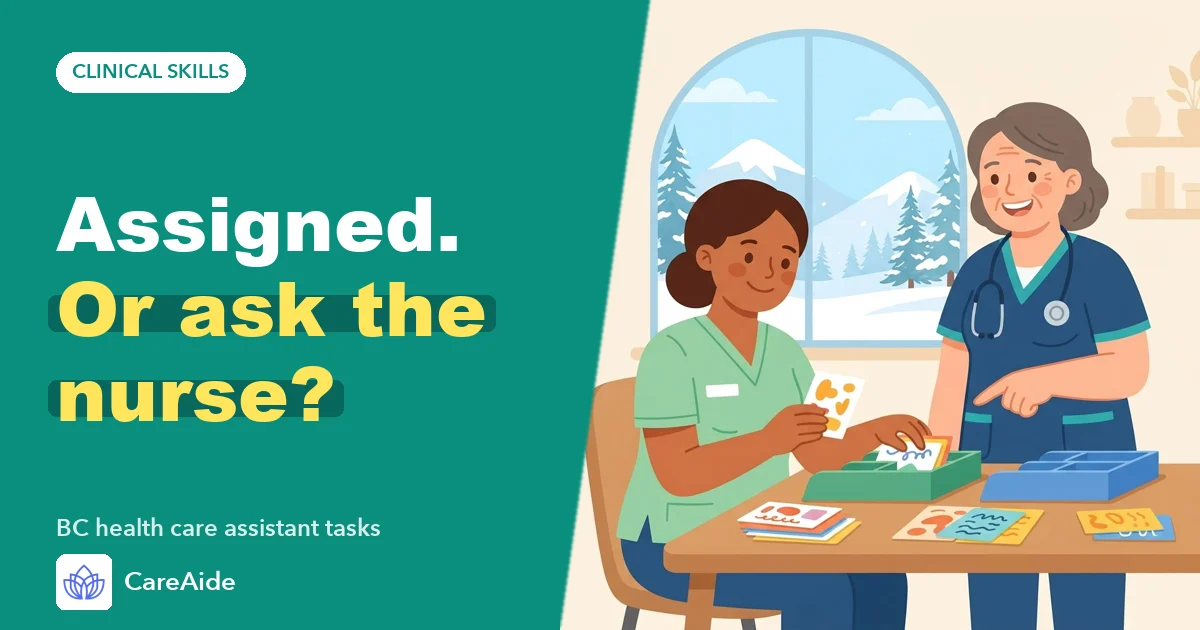
BC health care assistants: assigned tasks, restricted activities and delegation
A British Columbia health care assistant has no legally defined scope of practice, so the working question changes. Who assigned this task, to whom, and for which client? The answer separates assigned tasks from restricted activities.
- Legal scope
- BC health care assistants are unregulated and have no legally defined scope of practice
- The law
- The Health Professions and Occupations Act replaced the Health Professions Act on 1 April 2026, and no health occupation is designated under it yet
- Tasks
- Assigned by a regulated professional
- Restricted activities
- Not HCA tasks. They need a client-specific delegation from an LPN, RN, RPN or nurse practitioner
- Medication
- Assistance for a client who can direct their own care is an assigned task. Some forms need client-specific delegation
Why BC has no legal scope of practice for HCAs
A health care assistant in British Columbia is not licensed by a college, and no law sets out a list of what an HCA may do. The Health Professions and Occupations Act replaced the Health Professions Act on 1 April 2026, and no health occupation is designated under it yet. So BC health care assistants are unregulated and have no legally defined scope of practice.
That does not make the work a free-for-all. It moves the question. In British Columbia the useful question is not "what is an HCA allowed to do?" It is "who has assigned this task, to whom, for which client?"
Assigned tasks come from a regulated professional
An HCA's tasks are assigned by a regulated professional. An assignment is the ordinary way work reaches you: the nurse tells you what care this client needs and you provide it. Assignment covers the everyday work of personal care, mobility, meals and observation. Because it sits inside a care plan, you can see where it came from and who to ask.
A good habit is to treat every task as having a source. If you cannot say who assigned it, you have found a gap, and the response to a gap is to ask before you act.
Restricted activities are not HCA tasks
Some activities are not HCA tasks at all. These are restricted activities, and they are not part of the HCA's assigned work. They need a client-specific delegation from an LPN, RN, RPN or nurse practitioner. The delegation belongs to one client and one situation. It is not a permanent addition to what an HCA can do, and it does not carry over to the next client on the list.
The BC Care Aide and Community Health Worker Registry publishes a care activities chart that sets out how these tasks are classed. If your employer has a policy that differs, ask the nurse and follow the policy. Do not guess from what a colleague did last week.
Medication: the line runs through the middle of a task
Medication shows how fine the line can be. Medication assistance is an assigned task for a client who can direct their own care. It includes reminding, opening packaging, placing the medication in the client's hand and supervising self-administration.
The same medication can cross the line depending on the form. Administering prescription eye or ear drops, patches, prescription creams or suppositories needs client-specific delegation. So two tasks that feel similar, handing a client their tablet and putting prescription drops in their eye, fall on opposite sides. The first is assistance. The second is not an HCA task unless a nurse has delegated it for that client.
Oxygen follows the same pattern
HCAs are taught to apply and remove nasal prongs and to handle oxygen tubing safely. Administering oxygen is a restricted activity that needs a client-specific delegation. Adjusting oxygen concentration is not an HCA task. If a client tells you they feel short of breath and asks you to turn the oxygen up, you stay with them and call the nurse. The same logic from medication applies: you can do the part that is assigned, and you pass on the part that is not.
Two words for dementia, and why both appear
If you read BC's curriculum you will meet two terms for the behaviours that can accompany dementia. The curriculum uses both "responsive behaviours" and "behavioural and psychological symptoms of dementia", or BPSD. For an HCA the useful point is practical. Whatever the label, a person who is distressed, restless or resistant is usually communicating an unmet need, such as pain, hunger, fear or boredom, and your first task is to notice and report what you see, not to manage the person.
A worked example
Keiko is an HCA in an assisted living building. In one afternoon she gets three requests. A resident who manages her own medication asks Keiko to open the blister pack for her. Keiko opens it, puts the tablet in the resident's hand and watches while she takes it, because that is medication assistance for a client who can direct her own care. A second resident asks Keiko to put in the prescription eye drops his doctor ordered, since his hands shake. Keiko explains that she cannot do that unless the nurse has delegated it for him, and she asks the nurse to come. A third resident, on oxygen, says the flow feels low. Keiko checks that the prongs sit comfortably and the tubing is clear, does not touch the concentration, and tells the nurse.
Keiko made one decision three times. She asked whether the task was assigned or restricted. When it was assigned, she did it. When it was restricted, she handed it on, and she did so without making the resident feel like a problem.
Restraints and incidents in licensed residential care
The same sorting habit helps with two more situations. In licensed residential care a restraint may be used only to prevent imminent serious harm, or with written agreement from the person or their representative and a physician or nurse practitioner. It is never used as punishment or for staff convenience, and it is reassessed within 24 hours (Residential Care Regulation). An HCA does not decide to restrain anyone. If you are asked to apply something that looks like a restraint, you say so to the nurse.
Reportable incidents in licensed residential care are reported immediately, including to the person's family or representative and their physician or nurse practitioner (Residential Care Regulation, section 77). Your part is the factual account you give the nurse straight away.
What the registry does and does not do
To work as a health care assistant for a publicly funded employer in BC you must be on the BC Care Aide and Community Health Worker Registry. Registration is free and verified every year. BC program graduates register using proof of completion, and there is no provincial exam. Registry membership is how a public employer knows your training has been checked. It does not create a legal scope of practice, and it does not widen what a nurse has assigned to you.
Words that keep you inside the assignment
- To a resident who asks you to put in prescription drops: "I can't do that unless the nurse has delegated it for you, so I'll ask her to come now."
- To a resident who asks you to turn up the oxygen: "I'll stay with you and get the nurse straight away."
- To a nurse who asks you to do something you have not done before: "Is this assigned to me for this client? Can you show me what you want me to do?"
How this shows up in practice questions
BC has no entry exam, so CareAide uses a Readiness Check, a practice paper weighted to the curriculum and not a provincial test. Questions that turn on scope usually reward a calm sorting move. Which tasks have been assigned? Which are restricted? What does the HCA do for the part that is not theirs? You can practise this reasoning in the free BC Health Care Assistant practice test, and the registry route is explained in how to register with the BC Care Aide Registry.
Common questions
What is the scope of practice for a health care assistant in BC?
BC health care assistants are unregulated and have no legally defined scope of practice. Their tasks are assigned by a regulated professional, and restricted activities are not HCA tasks without a client-specific delegation.
Can a BC health care assistant give medication?
A BC health care assistant may provide medication assistance, such as reminding, opening packaging and supervising self-administration, for a client who can direct their own care. Prescription eye or ear drops, patches, creams and suppositories need client-specific delegation.
Can a BC health care assistant adjust oxygen?
No. BC health care assistants are taught to apply and remove nasal prongs and handle oxygen tubing safely, but administering oxygen is a restricted activity and adjusting oxygen concentration is not an HCA task.
Keep reading
-
 Reporting suspected abuse as a Saskatchewan CCA when there is no adult-protection act
Saskatchewan has no adult-protection act. Learn how a CCA reports suspected abuse in a special-care home, protects children and documents events.
Reporting suspected abuse as a Saskatchewan CCA when there is no adult-protection act
Saskatchewan has no adult-protection act. Learn how a CCA reports suspected abuse in a special-care home, protects children and documents events.
-
 Manitoba health care aides: medication and restraint rules in personal care homes
Who may give medication and apply restraints in a Manitoba personal care home, what reserved acts mean, and how a health care aide hands decisions on.
Manitoba health care aides: medication and restraint rules in personal care homes
Who may give medication and apply restraints in a Manitoba personal care home, what reserved acts mean, and how a health care aide hands decisions on.
-
 PSW medication in New Brunswick: why home support and nursing homes differ
What a New Brunswick PSW may do about medication in home support and in a nursing home, plus foot care, restraints and how reporting differs.
PSW medication in New Brunswick: why home support and nursing homes differ
What a New Brunswick PSW may do about medication in home support and in a nursing home, plus foot care, restraints and how reporting differs.