 CareAide Prep
Fire safety in long term care: RACE, PASS and the care aide's role
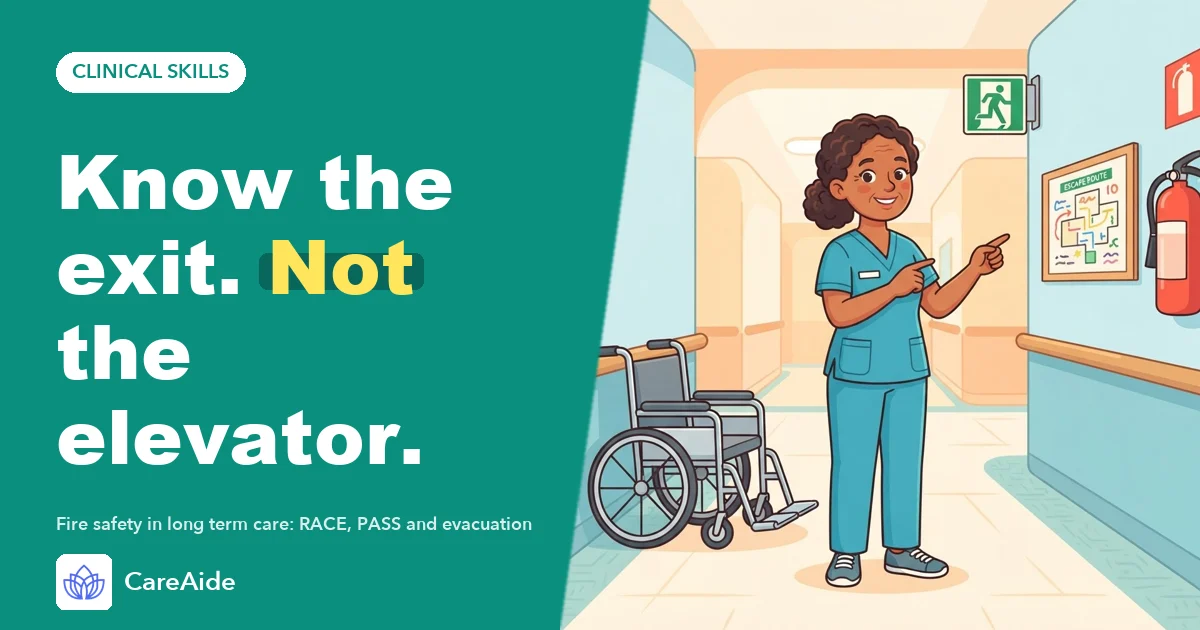
In long term care fire safety, a care aide follows the home's written fire plan: rescue residents from danger, sound the alarm, close doors to confine the fire, and use an extinguisher only if trained and it is safe. Never use an elevator to evacuate, and follow the person in charge.
- RACE
- Rescue, Alarm, Confine, Extinguish
- PASS
- Pull, Aim, Squeeze, Sweep, only if you are trained
- Elevators
- Avoid them when evacuating a burning building
- Your plan
- Follow your employer's written fire plan and the instructions of the person in charge
- Priority
- Move residents out of danger first and never put yourself at risk
What is the care aide's role in a long-term care fire?
Every long-term care home has a written fire plan, and your first duty is to know it and follow it. CCOHS says provincial, territorial or federal fire codes set fire protection requirements, which may include a fire safety plan. It also says staff should be given written instructions for their own emergency duties and should be trained to carry them out.
In a health authority orientation deck from Health PEI, a "Code Red" is called when the fire alarm is activated or when smoke or fire is seen in the facility. Its aims are to alert staff and first responders, remove residents and staff from danger, contain the fire or smoke, and put the fire out only if that is safe. Names for the call differ from one employer to another, so learn the one your site uses.
A care aide works as part of a team. The person in charge directs the response and makes the calls to emergency services. Your job is to do what your plan assigns you, and in most plans that starts with getting residents away from danger.
What does RACE stand for?
RACE is the memory aid most care homes use for the first minutes of a fire. The Health PEI deck sets out the four steps.
- Rescue. Move residents, visitors and staff away from immediate danger.
- Alarm. Sound the fire alarm, or ask a co-worker to do it while you move residents. Once it is safe, make sure the emergency number has been called.
- Confine. Close all doors to stop the spread of fire and smoke. If your home uses red door tags, use them as the plan directs. If it is safe, remove portable oxygen and other hazardous materials.
- Extinguish. Only properly trained staff may try to put the fire out with a portable extinguisher, using PASS.
The same deck notes that RACE and a second method called S.C.A.T.E.E. are essentially the same process, and that a site's Code Red plan decides which one staff use. A Minnesota Department of Health guide for long-term care adds that closing doors and windows next to the fire and turning off fans and air conditioners helps contain smoke, because fans and air conditioners can feed a fire and spread smoke. The order can feel different in a real emergency, and the person in charge may assign steps to different people. Follow the plan and the instructions you are given.
How do you use PASS, and when should you not?
PASS is the method for a portable fire extinguisher. CCOHS gives the steps in this order.
- Pull the pin on the extinguisher.
- Aim the extinguisher. Health PEI says to aim the nozzle, horn or hose at the base of the fire.
- Squeeze the trigger or top handle.
- Sweep the fire area with the spray until the fire is completely out. For a floor fire CCOHS says to sweep from the edges in.
The more important lesson is when not to use one. CCOHS says to be sure you are trained before you try to fight a fire. It also says not to fight a fire in any of these situations.
- You do not know what material is burning.
- You do not know which type of extinguisher to use.
- You do not know how to use the extinguisher.
- The fire is spreading beyond where it started.
- Your instincts tell you not to.
In those cases CCOHS says to pull the fire alarm, leave the area and call the fire department. If you do use an extinguisher, stand between the escape route and the fire so you can leave if it grows. The Health PEI deck says not to endanger yourself or others. A care aide who has not been trained on extinguishers does not use one. The exam and the job both reward the safe answer, which is to raise the alarm and move residents.
How are residents moved, and why never by elevator?
Residents may need help to leave the area. The Health PEI deck says to evacuate yourself and residents beyond the nearest fire door if the fire cannot be put out or safety is endangered. In the Minnesota guide, nursing, dietary and housekeeping staff all move residents out of danger, keep fire exits clear and stay with residents to reassure them. CCOHS says a plan should assign people to help anyone who needs help evacuating quickly, so find out whether your assignment includes particular residents.
OSHA's employee guidance says to avoid using elevators when evacuating a burning building. OSHA says to use the nearest stairwell that is free of fire and smoke and to follow instructions on the public address system. In a care home, how residents who cannot use stairs are moved is set by the home's plan, so staff follow the person in charge and do not decide it alone.
OSHA also lists these safety habits for anyone leaving a building.
- Stay low in smoke.
- Check a door for heat with the back of your hand before you open it. Do not open a hot door. Use another route.
- Keep fire doors closed to slow the spread of smoke and fire.
- Report to the designated meeting place.
- Do not go back in until the authorities say it is safe.
CCOHS says a plan should include safe gathering points where head counts confirm that everyone has left the danger zone. In a care home, the Minnesota guide says the person in charge keeps a resident roster, so tell the person in charge where the residents you moved are.
What should you know before a fire happens?
Most of the work happens before an emergency. CCOHS says evacuation routes and alternate exits should be known to all staff and kept unobstructed. In practice that means keeping hallways, fire exits and doorways clear.
- Learn your home's fire plan and the name it uses for a fire call.
- Find the nearest alarm pull station, fire exits and fire doors on every unit where you work.
- Learn where the designated meeting place is.
- Take part in fire drills. CCOHS says drills should be held and that performance should be reviewed right after each drill or actual emergency.
- Ask your employer for training before you ever touch an extinguisher.
CCOHS also says to use only one signal type for the evacuation order, to avoid confusion. That is one reason to learn what your own home's alarm sounds like and what it means.
What if the fire is in a resident's room or involves oxygen?
The Health PEI deck says that, if it is safe to do so, portable oxygen and other hazardous materials should be removed as part of confining the fire. Treat that as a task only when it is safe and when your plan says so. If it is not safe, leave it and close the door. A care aide who is unsure asks the person in charge before the emergency, not during it.
After a fire, CCOHS says to never walk away from a fire you think is out, because residue may reignite. Leave that decision to the fire department.
How does fire safety show up on a care aide exam?
Fire questions test whether you put people first, raise the alarm, confine the fire and follow the plan. Wrong options tend to have the aide using an elevator, fighting a large fire alone, searching for belongings, or ignoring the alarm because a drill is expected. The guides to preventing falls and safe patient handling cover related safety topics.
CareAide offers free exam practice on safety scenarios for care aides across Canada. It is practice for your exam, and it does not replace the fire training your employer must give you.
Common questions
What does RACE stand for in long-term care?
For a health care aide or PSW, RACE stands for Rescue, Alarm, Confine and Extinguish. Move residents from danger, sound the alarm, close doors to stop smoke and fire spreading, and extinguish only if trained and it is safe.
What does PASS mean for a fire extinguisher?
A health care aide or PSW who is trained uses PASS: Pull the pin, Aim at the base of the fire, Squeeze the handle, and Sweep from side to side. CCOHS says not to fight a fire if you are untrained.
Can a care aide use the elevator in a fire?
No. A health care aide or PSW should avoid elevators when evacuating a burning building, as OSHA guidance says. Use the stairwell that is free of fire and smoke, and follow your home's plan and the person in charge.
When should a care aide not try to put out a fire?
A health care aide or PSW should not fight a fire if the burning material or extinguisher type is unknown, the fire is spreading, or they are untrained. Pull the alarm, leave the area and call the fire department.
Why are doors closed during a fire in a care home?
A health care aide or PSW closes doors and fire doors to confine the fire. OSHA guidance says keeping fire doors closed slows the spread of smoke and fire while residents are moved.
Keep reading
-
 How AI is changing healthcare tutoring
What AI actually changes in health care aide education: unlimited applied practice, spoken rehearsal, and feedback on reasoning rather than recall.
-
 Health care aide interview questions
The questions Alberta health care aide interviews actually ask, how to structure an answer, and how to rehearse aloud before the interview, not during it.
-
 Where health care aides work in Alberta
The settings Alberta health care aides work in, what the work involves in each, and how registration with the CLHA changed the role in 2026.