 CareAide Prep
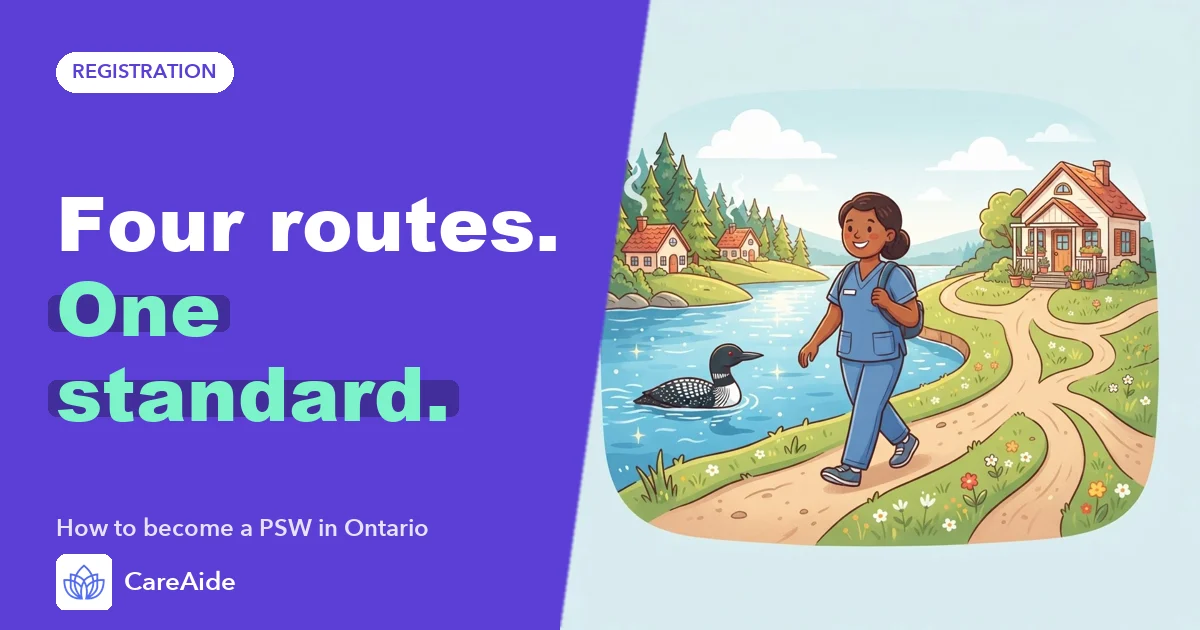
How to become a PSW in Ontario, including the NACC PSW exam
To become a PSW in Ontario you finish a personal support worker certificate program, clear your placement checks, and then choose whether to register with the HSCPOA. Only one route has an exam: students of NACC's program at career colleges write the NACC PSW Final Exam, and no law requires a PSW to pass an exam to work in Ontario.
- Training
- A PSW certificate from a public college, career college, district school board or Indigenous Institute
- Length
- As little as five months, up to about eight
- Admission
- An Ontario high school diploma or equivalent credits
- Exam
- Only for students of the NACC program at career colleges: 200 questions in 2.5 hours, up to three attempts, 65% pass mark published by member colleges
- Legal requirement
- No law requires a PSW to pass an exam to work in Ontario
- Registration
- HSCPOA, voluntary since 1 December 2024, no fee at present
- Before placement
- A vulnerable sector screening
Step 1: choose a program that meets the Ontario standard
Ontario lets four kinds of school teach personal support workers: publicly assisted colleges, private career colleges, district school boards and Indigenous Institutes. Each program follows the same provincial Personal Support Worker Standard, published in January 2022. Only the name of the certificate changes. A college awards an Ontario College Certificate, a career college an Ontario Training Certificate, and a school board an Ontario Program Training Certificate.
Ontario's own guide says a program can take as little as five months, and some take up to eight, with classroom learning and a clinical placement. The province also points to lower-cost routes. District school board students have their fees covered, select Indigenous Institutes offer tuition-free training, and people already working in long-term care can join the Learn & Earn Accelerated Program.
One thing to check before you enrol: a program with a similar name, such as "personal attendant", does not lead to a PSW credential. Ontario's policy directive for career colleges says so plainly. Ask the school whether its program delivers the provincial PSW Standard.
Step 2: clear the placement checks
Every PSW student needs a vulnerable sector screening before placement, and career colleges must tell you this before you start. Most schools ask for more, usually CPR and first aid, a set of immunizations and a mask fit test. Each school sets its own list, so read your program's placement page early. Some checks take weeks to come back, so start yours early.
Step 3: the NACC exam, only if your program is NACC's
Most Ontario PSWs never write a provincial exam. No law requires a PSW to pass an exam to work in Ontario, which surprises many students. The exception is the NACC PSW Final Exam, which belongs to the National Association of Career Colleges' own PSW program. NACC's 700-hour program is taught only at its member career colleges, and its students must pass the exam to graduate. As NACC puts it, you cannot just take the final exam.
The exam is part of one program's graduation. It is not an entrance test, and it is not a licence. It is a final check, set by NACC, that you have learned what the program teaches. If you study at a public college, a school board or an Indigenous Institute, there is no final provincial exam for you to write, and you have not missed a step. Employers set their own hiring rules, so if you are unsure what applies to you, ask your college and the employer you hope to work for.
How the NACC PSW Final Exam works
NACC's student guide from January 2025 describes the exam this way:
- On a computer, at your college. You write it at the college, not at home, with a college proctor and photo ID.
- After the program. You write it once the program and both placements are finished. Your college tells you when and how to book it.
- 200 questions in 2.5 hours. Every question needs an answer within that time.
- Up to three attempts. A third failure means repeating the program.
The pass mark published by NACC member colleges is 65%. Because that is the figure colleges publish, confirm it with your own college. If you do not pass, use the time before your next attempt well: ask your college what support it offers and look closely at the topics that were hard for you. Read the NACC student guide for the current format, since details can change.
How to manage your time on 200 questions
Two and a half hours for 200 questions means you cannot spend long on any one question. A calm routine helps.
- Read the whole question before you look at the answers.
- Look for the client's plan of care in the question. It often points to the right answer.
- Choose the answer that keeps the client safe and reports to the supervisor or registered staff.
- If you are stuck, make your best choice and move on. Do not let one question use the time of several.
- Keep a few minutes at the end to check that you answered every question.
Practise with a timer before exam day. Speed is a skill, and it grows with practice.
How to prepare for the NACC exam
Good preparation is steady and simple. These habits work for most students, including students who study in English as a second language.
- Start early. Short study sessions on most days beat one long night before the exam.
- Use your program notes. The exam follows what your program taught, so your class notes and placement experience matter most.
- Learn the key words. Ontario uses the term plan of care, and long-term care law uses the term responsive behaviours. Make a list of terms you do not know well, such as these and reporting, and say them out loud. If you are unsure what a term means in an Ontario setting, ask your instructor.
- Think like a PSW. You provide personal care, observe, report and record. You follow the plan of care and the instructions of your supervisor or registered staff. You do not diagnose, and you do not decide anything about medication.
- Review your mistakes. When you get a practice question wrong, read the explanation and write one line about why.
- Look after yourself. Sleep well, eat before you write and arrive at the college early.
A word on "real" exam questions
Many students search for NACC PSW exam questions. Be careful with what you find. A list that claims to be the real exam may be wrong or out of date, and you cannot check it. A better plan is to practise the skill the exam tests: reading a situation, thinking about safety and scope, and choosing the best action. A question you understand, with an explanation of why each option is right or wrong, teaches you more than an answer you memorised from a list you cannot trust.
On the day of the exam
Plan the practical things first. Know the time and the room at your college. Bring your photo ID and anything else your college asks you to bring, and arrive early so you are calm when the proctor starts.
During the exam, breathe and read slowly at the start. Many students lose marks by rushing the first questions and then panic. Keep your pace steady. If a question mentions a client, picture the person, the plan of care and who you would tell. That habit turns a hard question into a simple one. Afterwards, do not replay every answer in your head. Rest, and wait for your college to tell you the result.
Step 4: register with the HSCPOA, if you choose to
The Health and Supportive Care Providers Oversight Authority (HSCPOA) opened PSW registration on 1 December 2024. Registration is voluntary and separate from any exam: you do not need to register to work as a PSW, and passing the NACC exam does not register you. Registration adds you to a public register and commits you to a code of ethics. The HSCPOA application guide (February 2026) says there is currently no fee, because the Government of Ontario funds the authority.
The guide sets out four pathways:
- an Ontario PSW program completed on or after 1 July 2014;
- at least 600 hours employed as a PSW;
- labour mobility from another province;
- a competency assessment.
None of the pathways has an exam. For the education pathway you will need your certificate and transcript, government photo ID, a headshot, and a criminal record check from the past 12 months. If you want to know whether registration is worth it for you, read what the Authority publishes and ask your employer.
Where the jobs are, and what Ontario offers
PSWs work in long-term care homes, retirement homes, hospitals and clients' own homes. Ontario's become-a-PSW page lists incentives for PSWs who commit to long-term care or home care, or who work in a rural, remote or northern community. It also lists a program that helps PSWs go on to practical or registered nursing. Terms change, so check the current page before you rely on one.
Your next step, by route
Which step comes next depends on where you are.
- Still choosing a school. Compare programs from the four kinds of school, confirm each one delivers the provincial PSW Standard, and read its placement page so you know which checks to start early.
- A student in NACC's program. Ask your college for the exam booking steps and the NACC student guide, then add regular timed practice to your week well before you finish your second placement.
- A student at a public college, school board or Indigenous Institute. You have no provincial exam to book. Put your effort into your placements, and keep your certificate and transcript safe for the HSCPOA education pathway if you decide to register.
- Already working as a PSW. If you have at least 600 hours employed as a PSW, the HSCPOA lists a pathway for you, and you can decide whether registration is worth it.
How practice fits in
A PSW program teaches the job, and a placement proves you can do it. Practice questions help with something different: choosing the safe, in-scope answer when the options look alike. Our Ontario PSW exam practice is written to Ontario law and the PSW Standard, and explains every answer. It does not copy the real exam, and our mock exams are shorter than the NACC paper: they build skill rather than copy its length. If you trained under another province's title, read health care aide vs personal support worker. CareAide is practice only. It is not a program, a registry or a regulator.
Common questions
How long does it take to become a PSW in Ontario?
Ontario's guide says a PSW certificate program can take as little as five months, and some take up to eight. Each includes classroom learning and a clinical placement.
Do I have to write an exam to become a PSW in Ontario?
Only if you study in NACC's PSW program at a member career college. Its students must pass the NACC PSW Final Exam to graduate. Graduates of public colleges, school boards and Indigenous Institutes write no provincial exam.
How many questions are on the NACC PSW exam?
The NACC PSW Final Exam has 200 questions and lasts 2.5 hours, according to NACC's guide. It is written on a computer at the college with a college proctor, after the program and both placements.
What is the pass mark for the NACC PSW exam?
The pass mark that NACC member colleges publish is 65%. Students may write the exam up to three times, and a third failure means repeating the program.
Is a PSW exam required by law in Ontario?
No. No law requires a PSW to pass an exam to work in Ontario. The NACC exam belongs to one program's graduation, and employers set their own hiring rules.
Is HSCPOA registration mandatory for Ontario PSWs?
No. Registration of Ontario personal support workers with the Health and Supportive Care Providers Oversight Authority opened on 1 December 2024 and is voluntary. There is currently no fee.
Can I register with the HSCPOA without a PSW certificate?
The HSCPOA lists pathways for people with at least 600 hours employed as a PSW and for those who pass a competency assessment. Registration is not a training credential, though, and each employer decides whom it hires.
Keep reading
-
 The Residents' Bill of Rights for Ontario PSWs, and the duty to report
What the Residents' Bill of Rights in Ontario's Fixing Long-Term Care Act means for a PSW's daily work, and the duty to report abuse or neglect.
-
 PSW scope of practice in Ontario: daily duties by setting, and where the line sits
PSW scope of practice in Ontario: daily duties by setting, the plan of care, controlled acts, medication rules, reporting duties and a resume checklist.
-
 Fire safety in long term care: RACE, PASS and the care aide's role
Fire safety in long term care for care aides: what RACE and PASS mean, when not to fight a fire, why elevators are avoided, and following your home's plan.