 CareAide Prep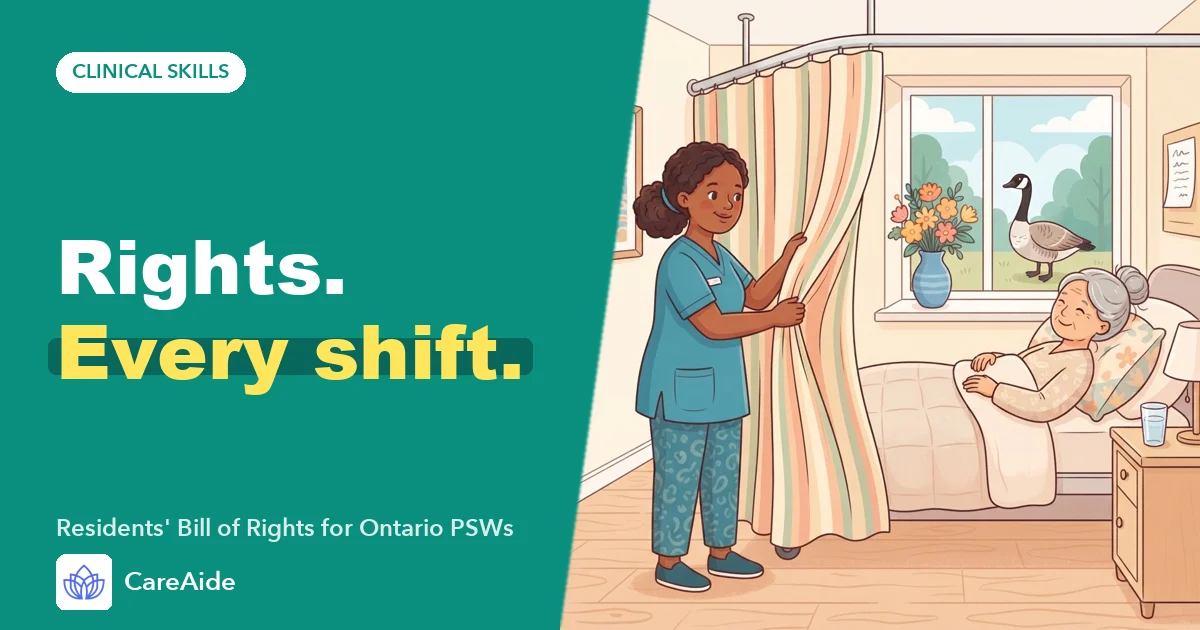
The Residents' Bill of Rights for Ontario PSWs, and the duty to report
The Residents' Bill of Rights is part of the Fixing Long-Term Care Act, 2021, and a PSW meets it on almost every shift. It sits beside a legal duty to report suspected abuse immediately, which reaches anyone with reasonable grounds to suspect it.
- The law
- The Residents' Bill of Rights, section 3 of the Fixing Long-Term Care Act, 2021
- Who it protects
- Residents of Ontario long-term care homes
- Duty to report
- Anyone with reasonable grounds to suspect abuse, neglect, improper or incompetent care, unlawful conduct or misuse of a resident's money must report it immediately to the Director
- Retirement homes
- The same kinds of suspected harm go immediately to the Registrar under the Retirement Homes Act, 2010
- If a staff member does not report
- Failing to report is an offence
What the Residents' Bill of Rights is
The Residents' Bill of Rights is section 3 of Ontario's Fixing Long-Term Care Act, 2021. It lists the rights that every resident of a long-term care home holds, and it expects the people who work in the home to honour them in ordinary care, not only in emergencies. The list is long. It includes freedom from abuse, privacy in treatment and personal care, freedom from restraint except as the Act allows, and the right to have family present around the clock when a resident is dying or very ill.
A personal support worker does not interpret the law or enforce it. A PSW delivers personal care, many times a day, in rooms where these rights either hold or quietly fail. That is why the Bill of Rights is working knowledge for a PSW, and why it keeps appearing in practice scenarios: the right answer is usually the one that protects a right the resident cannot easily protect for themselves.
Four rights you meet on almost every shift
Freedom from abuse
Freedom from abuse is the right the rest of this article returns to. Abuse is not only the dramatic case. A rough transfer, a resident ignored when they ask for help, or money going missing from a room are all things a PSW may see first, because a PSW is in the room more than anyone else.
Privacy in treatment and personal care
Privacy in personal care is practical. You close the door and draw the curtain before you begin, you uncover only the part of the body you are washing, and you do not talk about a resident's care in a hallway where visitors can hear. A resident who is embarrassed by help with toileting still has the right to have that help given privately.
Not being restrained except as the Act allows
Restraint is a decision the Act controls. A PSW does not add a restraint on their own initiative, and does not improvise one because a resident keeps getting up. If you see something being used that worries you, tell the nurse in charge. Raising it is part of protecting the right, not a criticism of a colleague.
Family present around the clock when a resident is dying or very ill
This right changes how care is done at the end of life. A daughter who wants to stay through the night is exercising a right in the Act. Your part is to make her welcome, to keep the room calm, and to tell the nurse if she needs anything that is outside what you provide.
The duty to report: who, what and how fast
Section 28 of the Fixing Long-Term Care Act is the part of the law with the sharpest edge. Anyone who has reasonable grounds to suspect any of the following must report it immediately to the Director:
- abuse of a resident
- neglect of a resident
- improper or incompetent treatment or care
- unlawful conduct
- misuse or misappropriation of a resident's money
Three words in that duty carry the weight. "Anyone" means the duty is not limited to nurses or managers, and it reaches a PSW. "Suspect" means you do not need proof. "Immediately" means the report is not held until the end of a shift, or until you have asked three colleagues whether they noticed too. A staff member who fails to report commits an offence, so this is a legal duty and not only good practice.
Your home will also have its own process for telling the nurse in charge, and you follow it. The legal duty is separate. Telling a supervisor is not a substitute for making the report the Act requires.
Retirement homes have their own version
Not every older adult in Ontario lives in long-term care. In a retirement home, the same kinds of suspected harm must be reported immediately to the Registrar under section 75 of the Retirement Homes Act, 2010. The reader's takeaway is simple: the setting changes who receives the report, and the speed and the low threshold stay the same. If you work across both kinds of building, learn the two names, the Director and the Registrar, and which law belongs to which.
What "reasonable grounds to suspect" looks like in practice
Reasonable grounds do not mean certainty. They mean that a thoughtful person, looking at what you saw or heard, would suspect something is wrong. A PSW's job is to notice and to report, not to investigate.
- You do not question the resident until they give you a full account.
- You do not confront the person you are worried about.
- You do not wait for the problem to happen a second time.
- You write down what you saw and heard in plain, factual words, with the time.
A worked example
Amara is a PSW on an evening shift. While helping Mr. Dubois change for bed she notices a bruise on his forearm in the shape of fingers. He says quietly that he does not want a particular night staff member to help him, and then asks her to forget he said it.
Amara does not promise to forget it. She tells Mr. Dubois she is glad he told her and that she will make sure the right people know. She stays with him until he is settled, then tells the nurse in charge and writes down exactly what she saw and exactly what he said, with the time. Because she has reasonable grounds to suspect abuse, the duty to report immediately is hers too, and she follows the home's process so that the Director is told. She does not question the staff member, and she does not decide for herself what happened.
Notice what Amara did not do. She did not wait a night to see whether it happened again, she did not ask a colleague to confirm her suspicion first, and she did not leave the decision to whoever had more seniority. Each of those choices feels reasonable in the moment, and each is the wrong answer in a practice question.
Responsive behaviours do not suspend anyone's rights
Ontario long-term care law uses the term "responsive behaviours", and Behavioural Supports Ontario also speaks of "personal expressions" of unmet needs. The idea is the same in both: a resident who shouts or pushes away help is usually communicating something, such as pain, fear or a need that nobody has met. A responsive behaviour is a reason to look for the unmet need. It is never a reason to restrain, to ignore or to rough-handle a resident, and the Bill of Rights applies to a resident in distress exactly as it does to a calm one.
How this shows up in practice questions
Scenario questions on rights and reporting tend to share a shape. One option waits and watches. One option asks the family to keep it quiet. One option confronts the person involved. The strongest option protects the resident, makes the report immediately and records what was observed. If you can recognise that shape, these questions become some of the most reliable marks in your practice. You can work through the pattern with the free Ontario PSW practice questions, and the step-by-step route into the work is in how to become a PSW in Ontario.
Common questions
What is the Residents' Bill of Rights in Ontario?
The Residents' Bill of Rights is section 3 of Ontario's Fixing Long-Term Care Act, 2021. It lists the rights of every long-term care resident, including freedom from abuse, privacy in personal care and freedom from restraint except as the Act allows.
Does an Ontario PSW have to report suspected abuse?
Yes. Under the Fixing Long-Term Care Act, 2021, anyone, including an Ontario PSW, with reasonable grounds to suspect abuse or neglect of a resident must report it immediately to the Director. A staff member who fails to report commits an offence.
Who do you report to in an Ontario retirement home?
In an Ontario retirement home, suspected abuse, neglect or misuse of a resident's money must be reported immediately to the Registrar under section 75 of the Retirement Homes Act, 2010.
Keep reading
-
 Manitoba health care aides: medication and restraint rules in personal care homes
Who may give medication and apply restraints in a Manitoba personal care home, what reserved acts mean, and how a health care aide hands decisions on.
Manitoba health care aides: medication and restraint rules in personal care homes
Who may give medication and apply restraints in a Manitoba personal care home, what reserved acts mean, and how a health care aide hands decisions on.
-
 BC health care assistants: assigned tasks, restricted activities and delegation
BC health care assistants have no legal scope of practice. Learn how assigned tasks, restricted activities and client-specific delegation sort the work.
BC health care assistants: assigned tasks, restricted activities and delegation
BC health care assistants have no legal scope of practice. Learn how assigned tasks, restricted activities and client-specific delegation sort the work.
-
 PSW medication in New Brunswick: why home support and nursing homes differ
What a New Brunswick PSW may do about medication in home support and in a nursing home, plus foot care, restraints and how reporting differs.
PSW medication in New Brunswick: why home support and nursing homes differ
What a New Brunswick PSW may do about medication in home support and in a nursing home, plus foot care, restraints and how reporting differs.