 CareAide Prep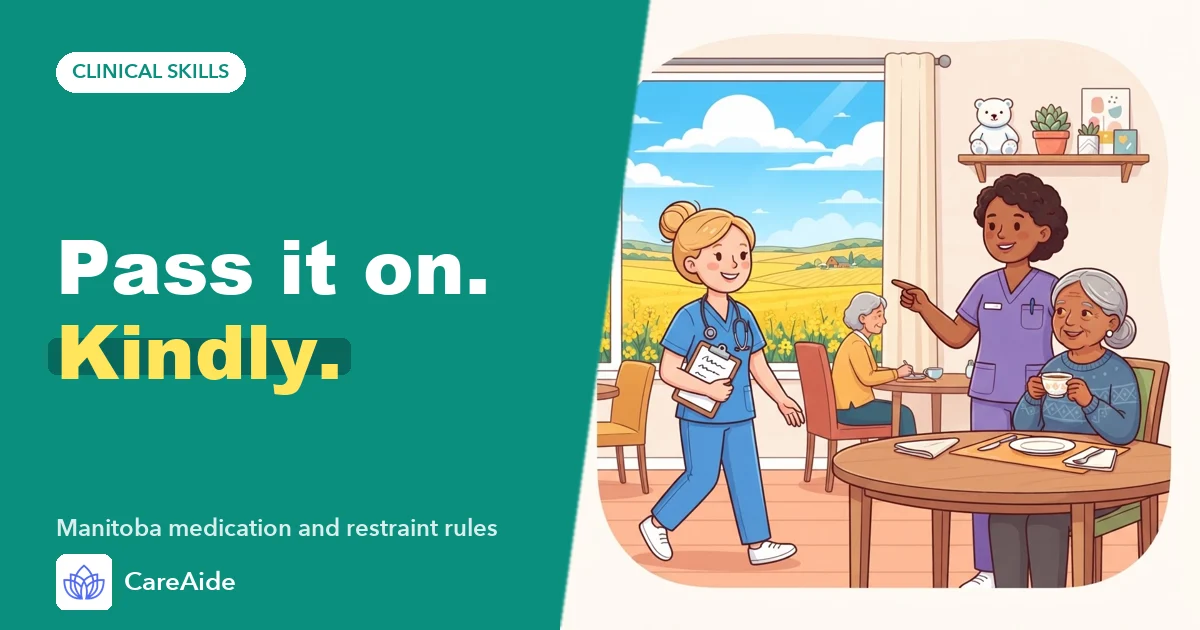
Manitoba health care aides: medication and restraint rules in personal care homes
Manitoba health care aides are unregulated, so the boundaries come from the laws and rules around them. In a personal care home two of those rules decide who gives medication and when a restraint is allowed.
- Status
- Health care aides in Manitoba are unregulated care providers. No legislation formally defines their role
- Who sets scope
- The employer, based on the aide's education
- Reserved acts
- Under The Regulated Health Professions Act, administering a drug by any method and administering a substance by inhalation are reserved acts
- Medication in a personal care home
- Administered only by a physician, registered nurse, registered psychiatric nurse or licensed practical nurse
- Restraints in a personal care home
- Need the consent of the resident or their legal representative, or an order from a physician, RN, LPN or RPN, after positive methods have failed
Where a Manitoba aide's scope comes from
A health care aide in Manitoba is an unregulated care provider. No legislation formally defines the aide's role, and the scope of employment is set by the employer based on the aide's education. There is no registry and no college. Because the role has no legal definition, the boundaries are set elsewhere: in the laws that regulate other people's work, in the rules for the building you work in, and in what a nurse assigns you.
That makes two Manitoba documents unusually practical for an aide. One is The Regulated Health Professions Act, which tells you which acts belong to regulated professionals. The other is the Personal Care Homes Standards Regulation, which tells you who may give medication and apply restraints where many aides work.
Reserved acts: what an aide never does alone
Under The Regulated Health Professions Act, certain acts are reserved for regulated professionals. Two matter most to an aide. Administering a drug by any method is a reserved act, and so is administering a substance by inhalation. Assisting a person with routine activities of living is exempt for some of them.
Read that exemption narrowly. It is about routine activities of living, and it is not a general permission to give drugs. When the act is giving a drug, the fact that it is common in a facility makes no difference.
Medication in a personal care home
The Personal Care Homes Standards Regulation is specific. In a Manitoba personal care home, medications are administered only by a physician, registered nurse, registered psychiatric nurse or licensed practical nurse. Health care aides are not on that list.
The practical rule follows from it. An aide does not give a resident a pill, even when the resident asks, even when the nurse is occupied and even when the aide has seen it done many times. What an aide can do is notice and report. A resident who says the pain pill has not come, a tablet found on the floor, and a resident who refuses medication are all things the aide tells the nurse.
Restraints in a personal care home
Restraint is the second area where the regulation steps in. In a personal care home a physical restraint needs the consent of the resident or their legal representative, or an order from a physician, RN, LPN or RPN after positive methods have failed. It must be the minimum needed, and it must be discontinued as soon as the reason for it ends.
Look at how many conditions that sentence holds. There must be consent or an order. Positive methods must have been tried first. The restraint must be the least needed. It must stop when the reason stops. An aide who sees a restraint in use, or who is asked to apply one without those conditions, has seen a problem and reports it. The aide is not the person who decides.
Assignment and delegation
Nurses assign work to aides, and the vocabulary is worth learning because it is used precisely. A nurse may assign an unregulated care provider tasks within their scope of employment. Delegation is different. Delegation of a task outside the scope of employment is always client-specific, and only for a task that would normally be part of the client's own self-care.
Two points follow. First, a delegation never turns an aide into someone who can do the task for everyone, because it belongs to one client. Second, the test that the task would normally be part of the client's own self-care is a real limit, not a formality.
A worked example
Priya is a health care aide in a personal care home. During the lunch hour a resident, Mr. Okafor, tells her that his heart tablet is late and asks if she could "just pop one out of the pack". Priya says kindly that she cannot give it, that she will tell the nurse now, and she goes to find her. She stays in the dining room until the nurse has come, and she mentions the time Mr. Okafor first asked.
Later in the afternoon, a colleague suggests tying a belt around the chair of a resident who keeps standing up, because the resident has fallen once this week. Priya recognises a restraint. She does not do it and does not argue with her colleague. She explains that a restraint needs consent or an order and says she will ask the nurse what is allowed. Then she does. The nurse can talk to the resident and family about the options that come before a restraint.
In each moment Priya was friendly, quick and clear, and in each she passed the decision to the person who holds it. That is what Manitoba's rules ask of an aide, and it is a standard you can meet every shift.
Responsive behaviours as unmet needs
Shared Health describes responsive behaviours as communication of unmet needs rather than problems to manage. That framing matters most when a resident is distressed and a restraint seems like the fast answer. If a resident keeps trying to stand, the question is what the standing is saying. Perhaps they are looking for the toilet, are in pain or are bored. Reporting what you observe gives the nurse the chance to address the need before restraint ever comes up.
Three more duties that travel with the job
Medication and restraint are the headline rules, but three reporting duties belong in the same mental folder. Under the Protection for Persons in Care Act, anyone with a reasonable basis to believe that a patient or resident of a hospital or personal care home is being abused or neglected must promptly report it to the Protection for Persons in Care Office, and a reporter acting in good faith is protected. Under The Child and Family Services Act, a person who reasonably believes a child is or might be in need of protection must report it forthwith to a child and family services agency.
The third is disclosure. A critical incident in health care must be disclosed to the person as soon as possible and recorded promptly. An aide is not the person who decides how a critical incident is disclosed, but an aide who sees one writes down what was observed and tells the nurse straight away, because everything after that depends on a prompt, accurate record.
Questions worth asking in your first week
- Which tasks has the nurse assigned to me for each resident I care for?
- Where is the home's policy on restraints, and who do I tell if I see one in use?
- Who is the nurse I go to first when a medication question comes up on this shift?
- How does this home record and report a critical incident?
Asking these in the first week is not a sign that you are unsure. It is how an aide in an unregulated role builds the working boundary that no statute provides.
How this shows up in practice questions
Manitoba has no provincial entry exam, so CareAide uses a Readiness Check. Questions about medication and restraints are consistent. The wrong answers have the aide giving, applying or deciding. The right answer provides comfort and safety, stays with the resident and reports to the nurse. You can practise this pattern in the free Manitoba Health Care Aide practice test, and the route into the work is in how to become a health care aide in Manitoba.
Common questions
Can a health care aide give medication in a Manitoba personal care home?
No. In a Manitoba personal care home, medications are administered only by a physician, registered nurse, registered psychiatric nurse or licensed practical nurse, so a health care aide tells the nurse instead.
Is a Manitoba health care aide regulated?
No. Health care aides in Manitoba are unregulated care providers, and no legislation formally defines their role. The scope of employment is set by the employer based on the aide's education.
When can a Manitoba personal care home use a restraint?
A physical restraint in a Manitoba personal care home needs the consent of the resident or their legal representative, or an order from a physician, RN, LPN or RPN after positive methods have failed, and it must be the minimum needed.
Keep reading
-
 BC health care assistants: assigned tasks, restricted activities and delegation
BC health care assistants have no legal scope of practice. Learn how assigned tasks, restricted activities and client-specific delegation sort the work.
BC health care assistants: assigned tasks, restricted activities and delegation
BC health care assistants have no legal scope of practice. Learn how assigned tasks, restricted activities and client-specific delegation sort the work.
-
 PSW medication in New Brunswick: why home support and nursing homes differ
What a New Brunswick PSW may do about medication in home support and in a nursing home, plus foot care, restraints and how reporting differs.
PSW medication in New Brunswick: why home support and nursing homes differ
What a New Brunswick PSW may do about medication in home support and in a nursing home, plus foot care, restraints and how reporting differs.
-
 CCA scope of practice in Nova Scotia: what a CCA may and may not do
What a Nova Scotia CCA may do under the Occupational Standards of Practice: checks, medication help, oxygen, nail care and how delegation works.
CCA scope of practice in Nova Scotia: what a CCA may and may not do
What a Nova Scotia CCA may do under the Occupational Standards of Practice: checks, medication help, oxygen, nail care and how delegation works.