 CareAide Prep
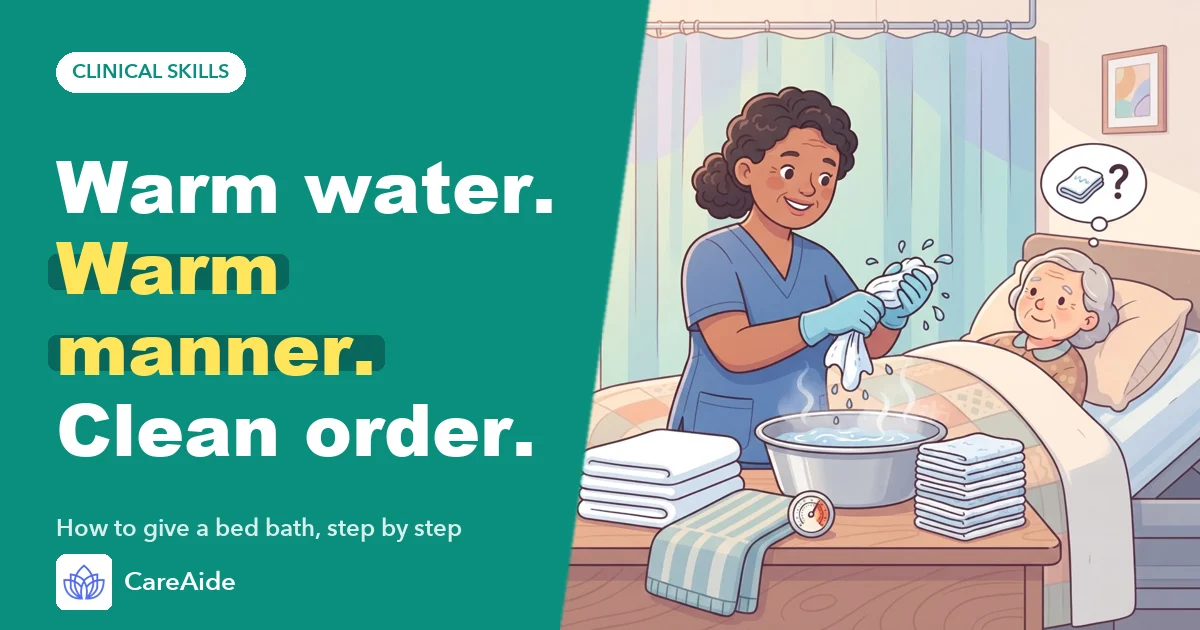
How to give a bed bath: privacy, water temperature, order of washing and what to report
To give a bed bath, a care aide provides privacy, has the client test water no hotter than 105 degrees Fahrenheit (about 40.5 degrees Celsius), and washes one covered body part at a time from head to toe and from the cleanest area to the least clean, finishing with the perineal area and buttocks. The aide dries well, makes the client comfortable and reports any skin issue to the nurse or supervisor.
- Who it is for
- Clients who are immobile, weak or frail, as set out in the care plan
- Water
- No hotter than 105 degrees Fahrenheit (about 40.5 degrees Celsius), and the client tests it too
- Order
- Head to toe, cleanest area to least clean, front first and then the back
- Last
- Perineal area and buttocks, with clean cloths and fresh water
- Afterwards
- Check comfort, lower and lock the bed, call light in reach, report skin changes
How do you give a bed bath?
A bed bath is a full wash given to a client who stays in bed. The steps below follow the full bed bath checklist in the open textbook Nursing Assistant and the bed bath procedure in Foundations for Assisting in Home Care. Both are CC BY books. Your program, your employer's policy and the client's care plan decide the exact method you use.
The core idea is simple. You wash one part at a time, expose only that part, work from the cleanest area to the least clean, and keep the client covered, warm and in charge of what is happening.
Who gets a bed bath?
The home care textbook says a bed bath suits patients who are immobile, weak or frail, because a tub bath could cause a fall. It also says to encourage the patient to do as much as they can and to help only as needed. A client who can wash their own face and hands should be handed the cloth.
How do you prepare for a bed bath?
- Knock, perform hand hygiene, introduce yourself and identify the client. Speak respectfully and explain what you are about to do.
- Provide privacy. The home care text says to close doors, draw curtains and limit others' access to the area.
- Gather your supplies. The checklist lists a basin, warm water, soap, lotion, six washcloths, two towels, a barrier, gloves, clean clothes or a gown, and a linen bag.
- Raise the bed to a safe working height and lock the brakes. Lower the side rail only on the side you are working, and raise it again before you move to the other side.
- Offer the bedpan or urinal before you start, and remove glasses and jewellery.
- Cover the client with a bath blanket or sheet. Remove clothing only from the area you are washing.
Take a moment to speak plainly and warmly. Many clients feel exposed during a bed bath, and covering them and explaining each step helps them keep their dignity.
What temperature should the water be?
The home care textbook says the water should be no greater than 105 degrees Fahrenheit (about 40.5 degrees Celsius), and that the client should test it too. The nursing assistant checklist says the same thing in a different way: the client puts a hand in the water or a wet cloth on the back of their hand. Recheck the temperature every time you change or add water.
Your employer may use a different measure or a bath thermometer. Follow the facility policy, and always let the client say whether the water feels comfortable.
In what order do you wash the body?
The home care textbook says to wash and dry one body part at a time from head to toe, moving from the cleanest area to the least clean. It says to finish the front before you roll the client to wash the back. The steps below follow that order.
- Eyes, face, ears and neck. Use plain water on the face unless the client asks for soap. Clean each eye with a separate corner of the cloth, from the inner corner outward. Wash behind the ears and the neck, rinse and pat dry.
- Arms and hands. Start with the arm farthest from you. Wash from the wrist up to the elbow and then from the elbow to the shoulder. The textbook notes that this direction helps blood return to the heart. Soak and clean one hand at a time and dry between the fingers.
- Chest and abdomen. Fold the cover down only as far as needed. Dry under skin folds well. Change the water.
- Legs and feet. Expose one leg at a time with a towel beneath it. Wash, rinse and pat dry the leg and then the foot, and dry between the toes. Change the water after the feet.
- Perineal area. Offer the client the chance to wash this area themselves. If they need help, use a clean cloth and follow the steps in the guide to perineal care steps.
- Back and buttocks. With the side rail up, help the client roll onto their side, using a lift sheet or other supportive device. Wash, rinse and pat dry the back, and wash the buttocks last. Change the water afterwards.
Cleanest to dirtiest has one firm rule attached: never move from the buttocks back to the back, and never from the anal area to the vaginal area. If a cloth has touched the area near the rectum, it does not touch another body part.
When do you change the water?
The textbook says to change the water after the chest and abdomen, after the feet, after the buttocks, and whenever it is cool or dirty. It also says not to reuse water from genital or anal cleaning on other parts of the body. Each time you add or change water, test the temperature again.
How do you finish the bed bath?
- Make sure every part of the body is completely dry. Moisture in skin folds and between the toes promotes bacterial and fungal growth.
- Apply lotion if the client wants it and the care plan allows. Wear gloves.
- Help the client dress in a clean gown or clothes, and apply an incontinence product if one is used.
- Empty, rinse and dry the basin, return equipment, and put soiled linen in the hamper. Remove gloves inside out and wash your hands.
- Ask whether the client is comfortable. Lower the bed to its lowest position and lock it, and place the call light within reach.
- Open the privacy curtain and the door.
- Document and report any skin issues or changes.
What should you look for and report?
You are not assessing the skin. You are noticing and telling the right person. The textbooks list the things to report:
- Red or white areas, skin breakdown or open areas.
- Rashes.
- New bruises.
- Changes in skin colour, temperature or swelling.
- Any change in the client's condition or behaviour.
Pay attention to skin folds and the area between the toes, because those places stay moist. Report in plain words: where it is, what it looks like, when you saw it and what the client said. Do not name a cause, a stage or a condition. The guides to SBAR and to DARP documentation show how to structure a report and a chart entry.
What if the client refuses a bath?
The home care textbook says that when a patient refuses a bath you document the reason and the refusal and inform your supervisor. It says to explain why bathing matters and to find out what is behind the refusal, because the client may agree later. You do not force the care.
How does this appear on a care aide exam?
Questions on personal care are short scenarios. They test whether you protect privacy, check the water temperature with the client, wash from clean to dirty, dry thoroughly and report skin changes. Wrong options often have the aide using very hot water, washing the perineal area first, or naming a rash. See also the guide to the Provision of Care domain.
CareAide offers exam practice on personal care and safety scenarios for care aides across Canada, and it is free to start. It is practice for your exam, not a substitute for the skills training your program gives you.
Common questions
What temperature should bed bath water be?
A health care aide or PSW keeps bed bath water no greater than 105 degrees Fahrenheit (about 40.5 degrees Celsius), as the home care textbook says, and has the client test it too. Recheck the temperature whenever water is changed or added.
In what order does a care aide wash a client in a bed bath?
A health care aide or PSW washes one part at a time from head to toe and from the cleanest area to the least clean, finishing the front before the back, with the perineal area and buttocks last.
How do you wash the eyes during a bed bath?
A health care aide or PSW uses plain water on the face unless the client asks for soap, and cleans each eye with a separate corner of the washcloth, moving from the inner corner outward.
What skin changes should a care aide report after a bed bath?
A health care aide or PSW reports red or white areas, skin breakdown, open areas, rashes, new bruises and changes in colour, temperature or swelling, using plain words, to the nurse or supervisor.
What should a care aide do if a client refuses a bed bath?
A health care aide or PSW does not force the bath. The aide explains why it matters, tries to learn the reason for the refusal, documents it, and informs the supervisor. The client may agree later.
Keep reading
-
 Fire safety in long term care: RACE, PASS and the care aide's role
Fire safety in long term care for care aides: what RACE and PASS mean, when not to fight a fire, why elevators are avoided, and following your home's plan.
-
 How AI is changing healthcare tutoring
What AI actually changes in health care aide education: unlimited applied practice, spoken rehearsal, and feedback on reasoning rather than recall.
-
 Health care aide interview questions
The questions Alberta health care aide interviews actually ask, how to structure an answer, and how to rehearse aloud before the interview, not during it.