 CareAide Prep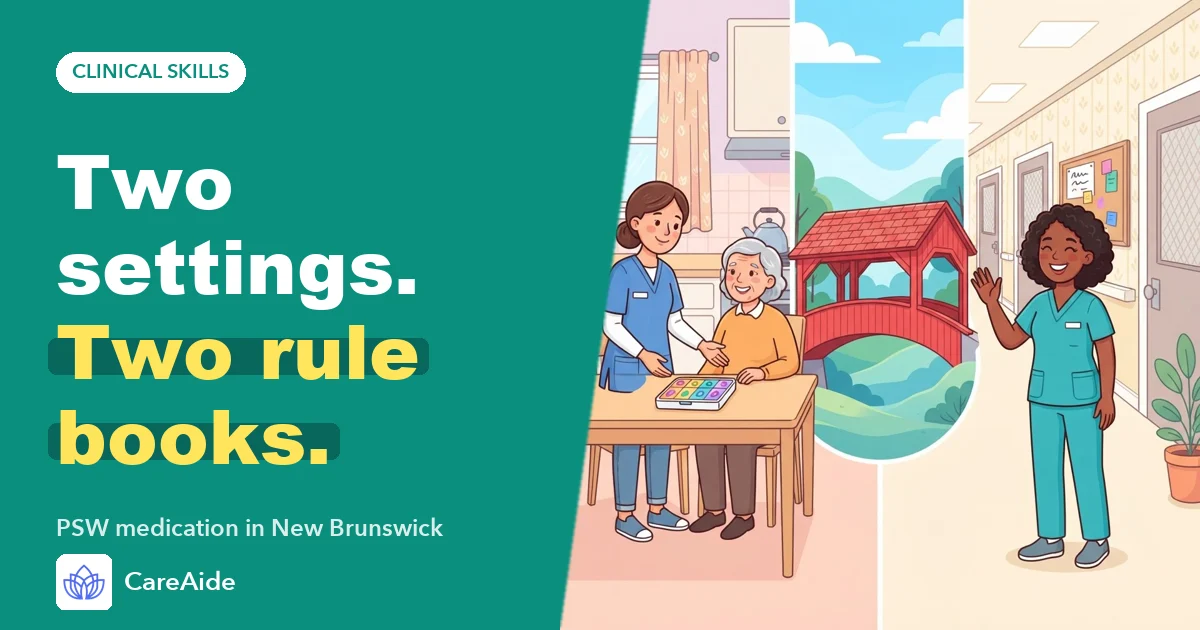
PSW medication in New Brunswick: why home support and nursing homes differ
In New Brunswick the medication rule depends on where a personal support worker is standing. Home support and nursing homes are governed by different documents, and each sets a different way to report when something goes wrong.
- Home support
- Home support workers do not administer medication. They monitor, supervise or assist the client with it
- Nursing home
- Medication is given only on the order of a physician, pharmacist, nurse practitioner or dentist (Nursing Homes Act General Regulation 85-187, section 21)
- Foot care in home support
- Limited to washing, drying, a soft brush and non-prescription lotion
- Reporting
- Home support: verbally to the case manager immediately, in writing within 2 working days. Nursing home: a written incident report to the administrator
- Scope document
- Board Order V188.1 for Personal Support Workers
One occupation, two rule books
A New Brunswick personal support worker may work in a client's home through a home support agency, or on the floor of a nursing home. The occupation has a published scope. Board Order V188.1 covers personal care and a safe environment, the needs of clients with health conditions or disabilities, individualized service plans, and administrative duties such as care plan and incident reports. Medication is different. It is governed by the rules of the setting, and the two settings do not say the same thing.
That is the first thing to hold on to. When a practice question asks what a PSW may do with medication in New Brunswick, the first thing to ask is where the PSW is standing.
In home support: monitor, supervise, assist
The Home Support Services Standards are direct. Home support workers do not administer medication. The verbs the standards allow are monitoring, supervising and assisting the client with their medication. In practice, the client takes their own medication and the worker helps the client do it safely.
That might mean noticing that the pill organizer has not been emptied for two days and saying so to the case manager. It might mean reminding a client it is time for a dose, or standing by while the client takes it. It does not mean choosing a dose, deciding that a medication can be skipped, or putting a pill in a client's mouth.
In a nursing home: only on the right order
In a nursing home, the rule is stated from the other direction. Under section 21 of the Nursing Homes Act General Regulation 85-187, medication is given only on the order of a physician, pharmacist, nurse practitioner or dentist. The sentence describes who must order the medication. It says nothing that makes medication a routine PSW task, and it is the regulation a PSW should keep in mind when a colleague or a family member asks for a shortcut.
The practical lesson is that, in either setting, a PSW's part in medication is narrow. The PSW does not decide what, when or whether. If a resident says they have not had their morning tablet, the PSW does not go looking for it. The PSW tells the nurse.
Foot care in home support is deliberately limited
The Home Support Services Standards also limit foot care. Foot care is washing, drying, a soft brush and non-prescription lotion. Scissors, picks and clippers are not used. Shaving is done with an electric razor only.
The list is the whole job. A client with a thick toenail that has started to hurt is not a reason to reach for the clippers. The PSW does what the standard allows, notes what was seen and tells the case manager so that someone with the right training can deal with it.
Restraints in a nursing home
Restraint belongs in a conversation about medication because both are decided by someone other than the PSW. In a nursing home a restraint may be used only to prevent injury, on the written order of a physician, registered nurse or nurse practitioner. It must be quick-release, and it must be checked at least every 2 hours (Regulation 85-187, section 20). A PSW who is asked to apply a device that is not on an order, or who sees one that has not been checked, reports it.
Reporting is where the settings differ most
When something goes wrong, the setting decides how you tell people. In home support, suspected abuse or neglect, falls and similar events are reported verbally to the case manager immediately, and in writing within 2 working days. In a nursing home, staff promptly complete a written incident report to the administrator.
The two procedures look alike and they are not interchangeable. A home support worker who files a nursing home form, or who waits a week to tell the case manager, has not met the standard. Learn the pair together.
A worked example
Marc is a PSW with a home support agency. He visits Mrs. Leblanc, who manages her own tablets from a labelled organizer. On Tuesday he notices that Monday's compartment is still full. He does not tell her which pills to take, and he does not open the compartment himself. He asks how her morning went, reminds her that the organizer is hers to use, stays while she takes her dose, and then tells the case manager by phone that afternoon what he saw. He writes it up within two working days.
On Thursday, Mrs. Leblanc slips getting out of her chair. She is not hurt, but Marc reports the fall to the case manager verbally straight away, because falls are reported immediately, and puts it in writing within two working days. He does not wait to see whether the soreness develops.
Now imagine Marc's colleague Josée, who works in a nursing home. A resident tells her that his tablet was left on the bedside table. Josée does not give it to him and does not leave it where it is. She tells the nurse, and the nurse deals with the medication. She then completes the written incident report promptly. Same concern, different building, different paperwork.
What certification changes, and what it does not
Personal Support Worker is a designated occupation in New Brunswick, and the Certificate of Qualification is voluntary. Since 1 July 2025 the only way to be certified is to pass the exam. Certification does not widen the medication rules above. A certified PSW and an uncertified one are bound by the same Home Support Services Standards and the same nursing home regulation. It is a credential that shows you have met the standard, not a licence to do more.
Words that keep you inside the standard
Clear, kind phrases make it easier to hold the line without sounding unhelpful:
- To a home support client who asks you to cut a thick toenail: "I'm only allowed to wash, dry, use the soft brush and apply plain lotion, so I'll tell your case manager it needs attention."
- To a client who asks you to hand over "whichever pills look right": "Your pills are yours to choose from your organizer, and I'm glad to stay with you while you take them."
- To a nursing home family member who asks you to give a tablet that was left behind: "I can't give medication, but I'll get the nurse right now."
Questions worth asking in a new placement
- Is this a home support placement or a nursing home placement, and which standards apply?
- Who is the case manager, or who is the nurse I go to first?
- Where do I find the incident report form, and how quickly is it due?
- How does this agency or home want the verbal report made, and to whom?
The answers turn the two rule books above into a few lines you can follow on any shift.
How this shows up in practice questions
New Brunswick scenarios on medication usually hinge on setting. The wrong options have a PSW giving, choosing or adjusting. The right option monitors, supervises or assists in home support, or tells the nurse in a nursing home. You can test the pattern with the free New Brunswick PSW practice questions, and the route into the work is in how to become a PSW in New Brunswick.
Common questions
Can a PSW give medication in New Brunswick?
In New Brunswick home support, a PSW does not administer medication and instead monitors, supervises or assists the client. In a nursing home, medication is given only on the order of a physician, pharmacist, nurse practitioner or dentist.
What foot care can a New Brunswick PSW do in home support?
Under the Home Support Services Standards, a New Brunswick PSW's foot care is limited to washing, drying, a soft brush and non-prescription lotion. Scissors, picks and clippers are not used.
How does a New Brunswick PSW report a fall in home support?
In New Brunswick home support, a PSW reports a fall verbally to the case manager immediately and in writing within 2 working days. In a nursing home, staff complete a written incident report to the administrator.
Keep reading
-
 Reporting suspected abuse as a Saskatchewan CCA when there is no adult-protection act
Saskatchewan has no adult-protection act. Learn how a CCA reports suspected abuse in a special-care home, protects children and documents events.
Reporting suspected abuse as a Saskatchewan CCA when there is no adult-protection act
Saskatchewan has no adult-protection act. Learn how a CCA reports suspected abuse in a special-care home, protects children and documents events.
-
 Manitoba health care aides: medication and restraint rules in personal care homes
Who may give medication and apply restraints in a Manitoba personal care home, what reserved acts mean, and how a health care aide hands decisions on.
Manitoba health care aides: medication and restraint rules in personal care homes
Who may give medication and apply restraints in a Manitoba personal care home, what reserved acts mean, and how a health care aide hands decisions on.
-
 BC health care assistants: assigned tasks, restricted activities and delegation
BC health care assistants have no legal scope of practice. Learn how assigned tasks, restricted activities and client-specific delegation sort the work.
BC health care assistants: assigned tasks, restricted activities and delegation
BC health care assistants have no legal scope of practice. Learn how assigned tasks, restricted activities and client-specific delegation sort the work.