 CareAide Prep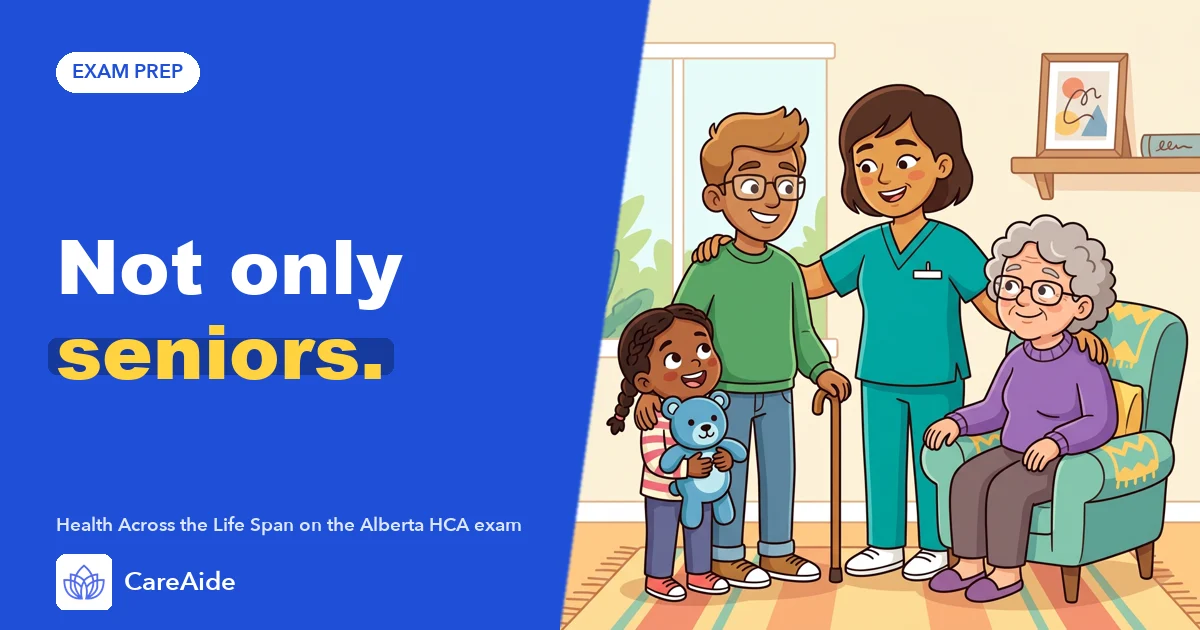
Health Across the Life Span on the Alberta HCA exam: why younger clients catch candidates out
Many health care aide candidates spend their clinical placements working almost exclusively in long-term care settings with older adults. The Alberta HCA Registration Examination, however, reflects a broader range of care environments. Understanding how principles of growth and development change the correct response for younger clients is essential for earning marks in this domain.
Why younger clients appear on the examination
Many candidates complete the majority of their clinical hours in supportive living or long-term care environments. Because these placements feature primarily older adults, candidates often enter the Alberta HCA Registration Examination expecting every scenario to center on geriatric care. However, the examination specification outlines a client-age target of about 5 per cent aged 0 to 18, about 30 per cent aged 19 to 60, and about 65 per cent aged 61 and over.
This distribution means that more than a third of the scenarios on the test involve pediatric or working-age adult clients. Candidates who assume every question takes place in a nursing home risk selecting interventions that are developmentally inappropriate for younger individuals.
What changes with age and what remains constant
Core principles of health care aide practice apply equally across every age group. Respecting client dignity, obtaining informed consent prior to care, following the care plan, and maintaining scope boundaries do not change when a client is seven years old rather than eighty-seven. A health care aide always works under the supervision of a regulated health care professional and observes, reports, and documents changes in client condition. An aide never diagnoses, assesses, or makes clinical judgements regardless of client age.
What changes across the life span is how an aide applies growth and development knowledge to daily interactions. Competency 5.1 requires candidates to "Demonstrate knowledge of the basic principles of growth and development, the aging process, and psychosocial dimensions of health across the life span." Similarly, Competency 2.2 expects aides to "Utilize knowledge of growth and development, the aging process, and related health conditions when implementing the care plan." A task like encouraging intake or explaining a routine must match the client's developmental stage.
Common effects of ageing and condition management
The examination tests a candidate's ability to distinguish normal age-related changes from acute or chronic illness. Competency 5.6 requires candidates to "Demonstrate knowledge of common effects of aging, as well as the effects of acute and chronic health conditions of the client." Normal physiological ageing includes gradual changes such as reduced skin elasticity, altered sensory perception, and decreased muscle mass. Sudden confusion or rapid functional decline, by contrast, indicates an acute change such as delirium or infection, which requires prompt reporting.
For cognitive and behavioural changes, Competency 5.6.1 mandates candidates to "Demonstrate appropriate interaction with clients who experience cognitive, behavioural, and psychological impairment (e.g., dementia and/or delirium)." In Alberta, the standard terminology for behavioural expressions linked to cognitive decline is "responsive behaviours". Recognizing how these expressions differ between acute conditions and chronic progressive disorders is crucial when answering scenario-based questions. For more detailed analysis on cognitive care, candidates can review our guide on Dementia care on the Alberta HCA exam.
Growth and development in practical scenarios
Developmental stage directly influences how a health care aide approaches care tasks. Consider a practical scenario occurring at 10:00 a.m. in Room 204. Health care aide Maya is assigned to assist eight-year-old Liam, who is recovering from appendectomy surgery, with morning mobility exercises outlined in his care plan. Liam expresses fear about moving because he worries it will hurt.
If Maya were working with an adult, she might explain the physiological benefits of early ambulation and offer choices regarding timing. For an eight-year-old child, growth and development principles dictate a different communication approach. Maya might break the activity into a structured game, offer limited concrete choices such as picking which footwear to put on first, and involve his parent or guardian if approved in the care plan. In both cases, Maya follows the care plan and provides care within scope, but her interaction style adapts to Liam's cognitive and emotional stage.
Scope boundaries remain strict across all age groups. Competency 2.7 outlines that an aide may "Provide medication assistance as assigned by a regulated health care professional". An aide assists with medication according to the established plan but never administers medication or adjusts dosages, whether assisting a child or a senior.
Domain weight and examination structure
The Health Across the Life Span domain accounts for 11 to 15 per cent of the marks on the Alberta HCA Registration Examination. The exam consists of 100 independent multiple choice questions administered over two hours by Meazure Learning for the College of Licensed Practical Nurses and Health Care Aides of Alberta (CLHA). This timing allows an average of 72 seconds per question.
Because the test evaluates real-world decision-making, candidates who understand growth principles across all age brackets can quickly identify the correct intervention without losing time. To review how this content fits into the broader examination layout, consult The Alberta HCA exam blueprint, or test your readiness using Free Alberta HCA practice questions.
Common questions
How much of the Alberta HCA exam focuses on Health Across the Life Span?
The Health Across the Life Span domain represents 11 to 15 per cent of the total marks on the Alberta HCA Registration Examination. Questions in this section test a health care aide's understanding of growth, development, and age-related health changes from infancy through older adulthood. Preparing across all client age groups ensures candidates are ready for pediatric and adult scenarios.
Do health care aides in Alberta care for pediatric clients?
Yes, health care aides in Alberta provide care to clients of all ages, including children and youth. The examination client-age target includes approximately 5 per cent pediatric clients aged 0 to 18, reflecting community and specialized care settings across the province. Every health care aide must follow the care plan and adapt communication to match the child's developmental level.
What is the difference between normal ageing and disease on the examination?
The Alberta HCA Registration Examination expects candidates to distinguish normal physiological effects of ageing from acute or chronic health conditions. A health care aide recognizes that gradual changes like decreased skin elasticity are standard with age, whereas sudden onset confusion or rapid changes in function require immediate reporting to a regulated health care professional.
Keep reading
-
 The hardest part of the Alberta HCA exam, in 13,200 practice answers
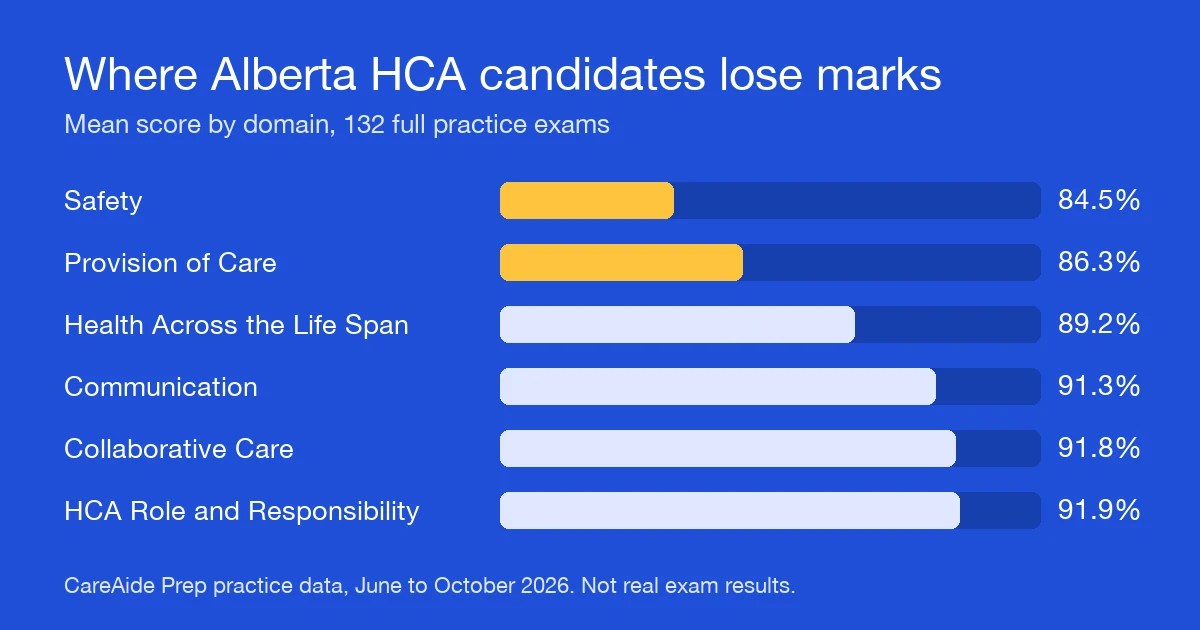
Across 132 full practice exams, Alberta HCA candidates scored lowest in Safety and Provision of Care, the two domains worth the most marks on the exam.
The hardest part of the Alberta HCA exam, in 13,200 practice answers
Across 132 full practice exams, Alberta HCA candidates scored lowest in Safety and Provision of Care, the two domains worth the most marks on the exam.
-
 Am I ready for the Alberta HCA exam? Four signals that matter more than a practice score
Discover how to gauge your readiness for the Alberta HCA Registration Examination. Learn four reliable indicators of success before booking your test.
Am I ready for the Alberta HCA exam? Four signals that matter more than a practice score
Discover how to gauge your readiness for the Alberta HCA Registration Examination. Learn four reliable indicators of success before booking your test.
-
 The Provision of Care domain on the Alberta HCA exam: how to win the largest block of marks
Learn how to apply person-centred principles on the Alberta HCA exam. Master the Provision of Care domain with competency breakdowns and scenario strategy.
The Provision of Care domain on the Alberta HCA exam: how to win the largest block of marks
Learn how to apply person-centred principles on the Alberta HCA exam. Master the Provision of Care domain with competency breakdowns and scenario strategy.