 CareAide Prep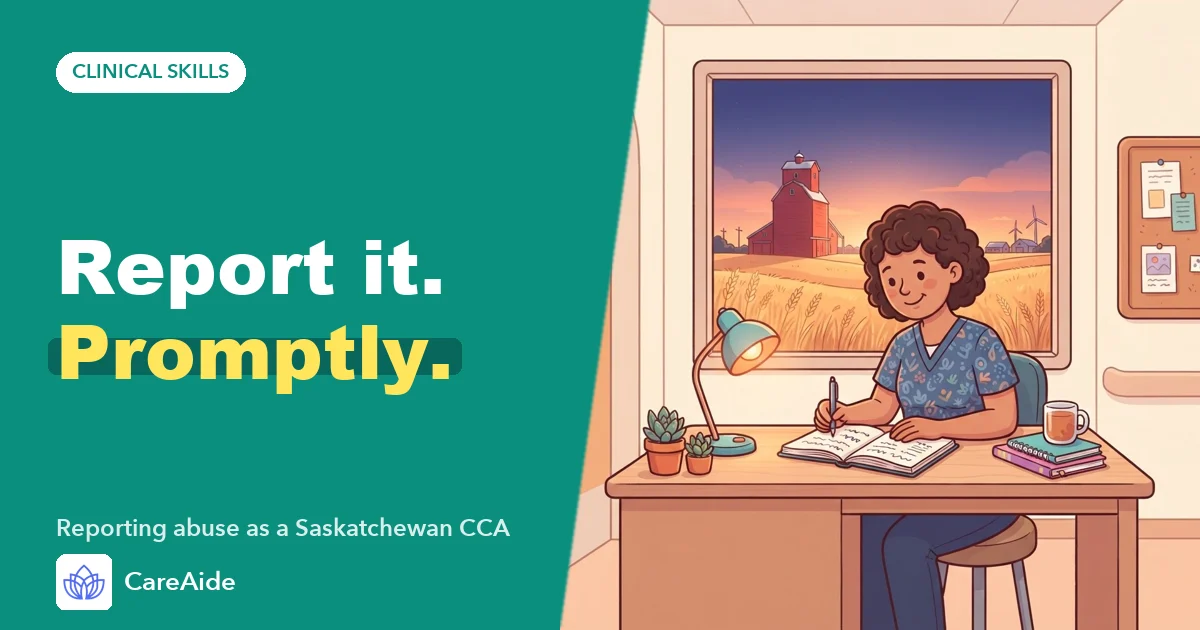
Reporting suspected abuse as a Saskatchewan CCA when there is no adult-protection act
Saskatchewan has no adult-protection act, so a continuing care assistant's duty to report comes from the home's policy, the criminal law and, for children, a statute. Knowing which source applies is the skill.
- Adult abuse law
- Saskatchewan has no adult-protection act
- Special-care homes
- Employees must promptly report any evidence or suspicion of abuse under the home's policy. Criminal abuse is reported to police
- Children
- Under The Child and Family Services Act, section 12, every person with reasonable grounds to believe a child is in need of protection must report it to an officer or a peace officer
- Documenting
- Unusual events are documented immediately by the care provider who observed them
- Privacy
- Under The Health Information Protection Act, employees may use only the personal health information their work requires
Saskatchewan reports abuse without an adult-protection act
In many provinces a statute spells out a duty to report abuse of an adult. Saskatchewan does not have an adult-protection act. A continuing care assistant there is also an unregulated care provider, so no college sets a duty that follows the CCA from job to job. That can leave a new CCA unsure where the duty to report comes from.
The answer is that the duty comes from the setting and the policy of the home, plus the criminal law and, for children, a statute. Knowing which source applies to which situation is the skill.
In a special-care home: report promptly, under the home's policy
In special-care homes, employees must promptly report any evidence or suspicion of abuse under the home's policy. Two words in that sentence matter. "Suspicion" means you do not need proof, and "promptly" means you do not wait for a better moment. The home's policy tells you the route, usually to the nurse in charge or a named manager, and you follow it.
The policy does not stand in for the law when the abuse is a crime. Criminal abuse is reported to police. That is a separate step from the home's internal report. If you believe a crime may have happened, ask the nurse in charge how the home reports to police and make sure that it happens.
When the person is a child
Children are covered by a different law. Under The Child and Family Services Act, section 12, every person with reasonable grounds to believe a child is in need of protection must report it to an officer or a peace officer. The word "every" is broad on purpose. A CCA who sees a visiting grandchild with injuries that do not fit the explanation, or hears something troubling in a family conversation, is a person with a duty.
Write it down straight away, and only your own observations
Documentation closes the loop. Unusual events are documented immediately after they occur by the care provider who observed them. Two rules sit inside that sentence. "Immediately" means before the end of the shift and not from memory the next morning. "The care provider who observed them" means you write what you saw and heard, and you do not write up what someone told you as though you had witnessed it.
Good notes are specific and neutral. Compare "Mrs. Bell was upset and I think her son shouted at her" with "At 14:20 Mrs. Bell was crying and said, 'He shouted at me and took my purse.' Her son was in the hallway. I told Nurse Grant at 14:25." The second tells the next reader exactly what was seen and said, and it contains no conclusion.
Privacy does not take a holiday
Under The Health Information Protection Act, employees may use only the personal health information their work requires, and wilfully accessing any other is an offence. The link to reporting is direct. A CCA who suspects abuse reports through the proper route and does not discuss it with other staff, other residents or visitors. Curiosity about a resident's chart is not part of the job.
A worked example
Dana is a CCA in a special-care home. During a bath she sees fresh bruising on Mr. Whitford's upper arms. He tells her quietly that a night worker grips him hard when he will not settle. Dana does not question him further, and she does not confront the night worker. She makes sure Mr. Whitford is comfortable, tells the nurse in charge promptly, as the home's policy asks, and records what she saw and what he said before her shift ends.
The nurse mentions that if there is evidence of a crime, police are involved. Dana does not need to decide whether the grip was criminal. She needs to ensure the right people know, quickly and accurately. She also does not mention it in the staff room or look through other residents' charts to see whether the night worker's name appears.
Responsive behaviours are not the same as abuse, and not an excuse for it
Saskatchewan's special-care home guidelines call them responsive behaviours: a person with dementia responding to an unmet need. This idea cuts two ways. A resident who strikes out is not being "difficult", and a worker who loses patience is not excused by calling the resident difficult. If you see a worker handle a resident roughly in response to a responsive behaviour, that is something to report, because the resident's behaviour never makes rough handling acceptable.
When a resident says "please keep this secret"
Residents sometimes tell a CCA something and then ask for silence. You cannot promise it. What you can say, honestly and kindly, is: "Thank you for telling me. I can't keep this to myself, because it's important, but I will make sure the right people help and I'll stay with you." That sentence keeps the trust, tells the truth, and still allows you to report promptly. A promise of secrecy that you then break does more harm than a gentle explanation at the start.
A second worked example, with a child
Luc is a CCA in a special-care home. A resident's young granddaughter visits every Sunday. This week Luc notices that she flinches when an adult raises a voice, and he sees a bruise on her arm that does not match what she says about how she got it. Luc does not question the child and does not confront the family. He recognises that The Child and Family Services Act, section 12, applies to every person with reasonable grounds to believe a child is in need of protection, and he asks the nurse in charge who in the home handles that kind of report so that it is made to an officer or a peace officer. Then he writes down exactly what he saw and heard, with the time, and keeps it to himself.
Questions worth asking in your first week
- What does this home's policy say about reporting abuse, and who receives the report?
- How does the home report possible criminal abuse to police?
- Where do I document an unusual event, and by when?
- Who is the nurse who decides what is assigned to me today?
Saskatchewan places the weight of these decisions on the home's policy, so the policy is the document to learn first.
How this shows up in practice questions
Saskatchewan has no entry exam, so CareAide uses a Readiness Check. Reporting scenarios reward a recognisable sequence. Protect the resident, report promptly under the home's policy, document immediately what you observed, and keep the information private. Options that wait, investigate or confront are the distractors. You can practise this sequence in the free Saskatchewan Continuing Care Assistant practice test, and the route into the work is in how to become a CCA in Saskatchewan.
Common questions
Does Saskatchewan have an adult abuse reporting law for CCAs?
Saskatchewan has no adult-protection act. In special-care homes, a CCA must promptly report any evidence or suspicion of abuse under the home's policy, and criminal abuse is reported to police.
Who does a Saskatchewan CCA report suspected child abuse to?
Under The Child and Family Services Act, section 12, every person, including a CCA, with reasonable grounds to believe a child is in need of protection must report it to an officer or a peace officer.
When should a Saskatchewan CCA document an unusual event?
A Saskatchewan CCA documents an unusual event immediately after it occurs. The care provider who observed the event writes what they saw and heard in factual words.
Keep reading
-
 Manitoba health care aides: medication and restraint rules in personal care homes
Who may give medication and apply restraints in a Manitoba personal care home, what reserved acts mean, and how a health care aide hands decisions on.
Manitoba health care aides: medication and restraint rules in personal care homes
Who may give medication and apply restraints in a Manitoba personal care home, what reserved acts mean, and how a health care aide hands decisions on.
-
 BC health care assistants: assigned tasks, restricted activities and delegation
BC health care assistants have no legal scope of practice. Learn how assigned tasks, restricted activities and client-specific delegation sort the work.
BC health care assistants: assigned tasks, restricted activities and delegation
BC health care assistants have no legal scope of practice. Learn how assigned tasks, restricted activities and client-specific delegation sort the work.
-
 PSW medication in New Brunswick: why home support and nursing homes differ
What a New Brunswick PSW may do about medication in home support and in a nursing home, plus foot care, restraints and how reporting differs.
PSW medication in New Brunswick: why home support and nursing homes differ
What a New Brunswick PSW may do about medication in home support and in a nursing home, plus foot care, restraints and how reporting differs.