 CareAide Prep
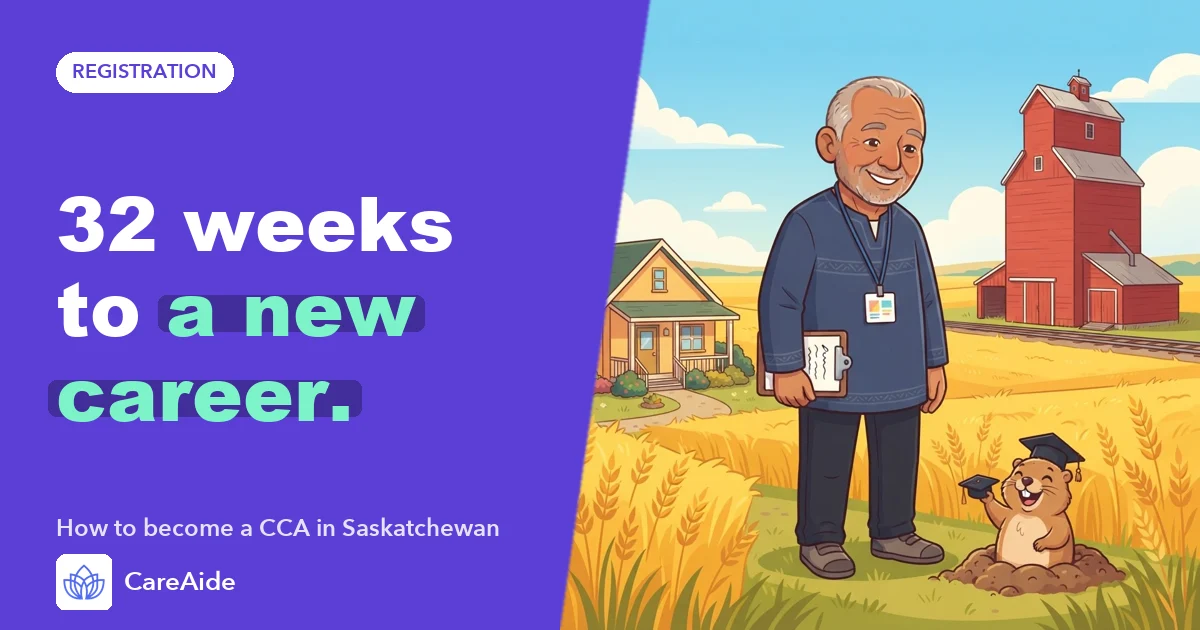
How to become a CCA in Saskatchewan
To become a CCA in Saskatchewan you complete a continuing care assistant certificate, most often Saskatchewan Polytechnic's 32-week program or one of its regional college versions. CCAs are unregulated and we found no provincial exam or registry. On the job, the employer sets your role and a regulated nurse assigns any nursing activity.
- Regulation
- Unregulated care provider with no legally defined scope of practice; the employer sets the job
- Provincial exam or registry
- None found in any Saskatchewan source
- Main credential
- Saskatchewan Polytechnic CCA certificate, 32 weeks full-time
- Where
- Saskatoon, Regina and Prince Albert campuses, regional colleges, and part-time distance
- Indigenous route
- SIIT Indigenous Continuing Care Assistant certificate, 34 weeks
- Admission
- Grade 12 or 15 post-secondary credits, age 18 by 31 December from 2026-27, English proficiency
- On the job
- A regulated nurse assigns any nursing activity and sets the level of supervision. A CCA does not manage medication independently
What a continuing care assistant does
A continuing care assistant gives hands-on care to people who need support with daily living, and works under the direction of regulated nurses. You observe, report and record changes, and you ask when you are unsure. In plain terms, a CCA is a trained care worker who helps people with daily living and reports changes to the nurse. In Saskatchewan the title is continuing care assistant, so use it on your résumé and in interviews.
Saskatchewan has no single legal job description for a CCA. Your employer decides your role and your training, and a regulated nurse assigns any nursing activity you do. That gives you a simple working rule: you do the tasks you were hired and trained to do, and the tasks a nurse has assigned to you.
What "unregulated" means for a CCA
Saskatchewan has three nursing regulators. They list continuing care assistants as unregulated care providers. Their joint guidance says the employer sets the job: its policies, duties, skills and training. "Unregulated" means there is no regulatory body that licenses CCAs and no legally defined scope of practice. It does not mean your work is unimportant or unsupervised. It means the limits come from your employer, from the nurse who works with you and from the laws that apply to everyone in care settings.
We checked the province's and the colleges' own pages. None of them mentions a CCA exam or a CCA registry. The certificate is what employers ask for, but it is not a licence. It shows you completed training. Employers decide what you do on the job, and nurses decide what they assign to you.
Route 1: Saskatchewan Polytechnic's CCA certificate
Saskatchewan Polytechnic's program runs 32 weeks full-time. You can take it on campus in Saskatoon, Regina or Prince Albert. Regional colleges run it too, and there is a part-time distance option. It has 37 theory credits and 15 clinical credits in long-term care. The clinical part is two placements, at two different sites, over six weeks.
To be admitted you need:
- Grade 12, or 15 post-secondary credits;
- to be at least 18 by 31 December of your admission year (new for 2026-27);
- English language proficiency;
- a criminal record check and vulnerable sector search before you start;
- current immunization records.
The program page also lists Standard First Aid with CPR Level C, WHMIS, Transferring, Lifting and Repositioning (TLR), PART Intermediate and N95 fit testing. Ask your campus which of these you complete during the program. Remember that the program prepares you for the work, while your employer still decides your exact role and training once you are hired.
Route 2: a regional college near home
Several regional colleges teach the CCA program for Saskatchewan Polytechnic, so you can train closer to home. Great Plains College is one. It runs the program full-time and part-time at Biggar, Kindersley, Maple Creek, Swift Current and Warman. It asks for Canadian citizenship or permanent residence. Start dates change each year, so check the college's own page.
Route 3: SIIT's Indigenous CCA certificate
The Saskatchewan Indian Institute of Technologies (SIIT) grants its own certificate, the Indigenous Continuing Care Assistant. It runs 34 weeks full-time. First Nations applicants get preference, and anyone can apply. It asks for a criminal record check, a vulnerable sector check and immunizations.
Where CCAs work, and what the province offers
CCAs work in continuing care, acute care and home care. The setting changes who is on site, what people are called and who handles medication, so learn the differences:
- Special-care homes. A registered nurse or registered psychiatric nurse provides nursing care on a 24-hour basis. The people you care for are called residents. Medications are given only on a written order.
- Private, licensed personal care homes. The people you care for are also residents. A nurse is not on site, so you follow the home's policies closely and report concerns to the person your employer names.
- Home care. You work in the client's own home, and a nurse is not on site. You rely on your training, your employer's policies and the instructions you were given.
- Hospitals (acute care). The people you care for are called patients. Medication in this setting is for nurses.
At the start of every shift, ask yourself: Who is the nurse for my assignment today? What exactly has been assigned to me? Who do I call if something changes?
The province's Rural and Remote Recruitment Incentive lists $30,000 over three years for CCAs. It is for new permanent full-time staff of the Saskatchewan Health Authority, its affiliates or the Cancer Agency, in eligible towns. You commit to three years of service. The page was updated on 13 April 2026 and says applications are open. The 2026-27 budget also funds more CCA training seats in La Ronge.
We found no dedicated provincial route for internationally educated CCAs. If you trained outside Canada, the English proficiency requirement above is the first thing to check.
How a nurse assigns work to a CCA
A regulated nurse assigns nursing activities to a CCA. This is the centre of the role, and two rules follow from it.
- You cannot pass an assigned task on. If a nurse assigns an activity to you, you do not reassign it to another aide, a student or a family member. If you cannot do it, you tell the nurse.
- The nurse sets the supervision. The nurse, not the employer, decides how closely you are supervised for the task. A new or unfamiliar task usually means you ask more questions, and that is the right instinct.
If a task is not assigned to you, you do not do it because it looks simple or because someone is in a hurry. You tell the nurse what you noticed and let the nurse decide.
Medication: assisting, not managing
Medication is the area where CCAs most often step over the line, usually while trying to be helpful. In Saskatchewan, CCAs may assist regulated nurses with some aspects of medication management. Their training does not prepare them to manage medication independently.
So you never decide on a medication, change how it is given or act on your own opinion about it. If a client refuses a medication, seems unwell after one or asks you a question about it, you report to the nurse and you record what you saw.
Private, licensed personal care homes have their own rule: the home designates who may give medication. If your home designates you for that role, you follow the home's policy and the nurse's assignment, and you do not go beyond them. If you are not sure whether you have been designated, ask before you act.
Restraints, responsive behaviours and dementia care
In special-care homes, a restraint is a last resort. It is used only when there is a risk of injury and alternatives have failed. It needs a written order and written consent, an assessment within 24 hours and a review at least quarterly. A CCA does not decide to restrain a resident. If a resident is at risk of injury, you stay calm, keep the person safe in the ways your care plan allows, and get the nurse. Then tell the nurse what you tried and what happened.
Saskatchewan's special-care home guidelines use the term responsive behaviours: a person with dementia responding to an unmet need. That small change in wording changes your response. Instead of asking "How do I stop this behaviour?", you ask "What is this person trying to tell me?" Look for causes you can address and report, such as pain, hunger, thirst, noise, a need for the toilet, fear or loneliness. Do not argue with the person, correct them at length, or block or hold them. Report what you observe to the nurse, and write it down.
Reporting abuse and documenting unusual events
Saskatchewan has no adult-protection act. In special-care homes, employees must promptly report any evidence or suspicion of abuse under the home's policy. Criminal abuse is reported to police. Know your employer's policy before you need it.
A different rule applies to children. Under The Child and Family Services Act, section 12, every person with reasonable grounds to believe a child is in need of protection must report it to an officer or a peace officer. That includes you.
Unusual events are documented immediately after they occur, by the care provider who observed them. Write what you saw and heard in plain facts, with the time. Do not add opinions or guesses.
Privacy and who decides for a client
Under The Health Information Protection Act, employees may use only the personal health information their work requires. Wilfully accessing any other is an offence.
Consent is also part of daily care. When there is no directive, proxy or guardian, the nearest relative makes health care decisions. The order is spouse or partner, adult child, parent, adult sibling, grandparent, adult grandchild, adult uncle or aunt, then adult nephew or niece. You do not choose which relative decides. If a family member asks you to do something outside your assignment, you tell the nurse.
How practice fits in
Use this guide as a checklist. With no provincial exam, what counts is sound judgment in your placements and first shifts: know your setting, know who assigned your tasks, and report anything outside them. Our Saskatchewan continuing care assistant practice is a Readiness Check written to Saskatchewan law, and it explains every answer. If you trained under another title, see health care aide vs personal support worker. CareAide is practice only. It is not a program, a registry or a regulator.
Common questions
How long does it take to become a CCA in Saskatchewan?
Saskatchewan Polytechnic's CCA certificate is 32 weeks full-time, with a part-time distance option, and includes 37 theory credits and 15 clinical credits in long-term care. SIIT's Indigenous Continuing Care Assistant certificate is 34 weeks.
Is there an exam to become a CCA in Saskatchewan?
None of the Saskatchewan government or college sources we checked mentions a provincial CCA exam or registry. You are assessed within your certificate program.
What do I need to get into a CCA program in Saskatchewan?
Saskatchewan Polytechnic asks for Grade 12 or 15 post-secondary credits, English proficiency, a criminal record check and vulnerable sector search, and immunization records. From 2026-27 you must also be 18 by 31 December of your admission year.
Are continuing care assistants regulated in Saskatchewan?
No. Saskatchewan's nursing regulators list CCAs among unregulated care providers with no legally defined scope of practice, and the employer sets the job description, skills and training.
What does a continuing care assistant do in Saskatchewan?
A continuing care assistant in Saskatchewan gives hands-on care, observes and reports changes, and records unusual events. The employer sets the role, and a regulated nurse assigns any nursing activity.
Can a CCA give medication in Saskatchewan?
A Saskatchewan CCA may assist regulated nurses with some aspects of medication management but does not manage medication independently. In a personal care home, the home designates who may give medication, and the CCA follows the home's policy and the nurse's assignment.
Who supervises a continuing care assistant in Saskatchewan?
A regulated nurse sets the level of supervision for the nursing activities a Saskatchewan CCA is assigned. The CCA cannot reassign an assigned activity.
Keep reading
-
 CCA reporting abuse in Saskatchewan, and the medication rules setting by setting
Saskatchewan has no adult-protection act. How a CCA reports suspected abuse, documents events, and what a CCA may do with medication in each setting.
-
 Fire safety in long term care: RACE, PASS and the care aide's role
Fire safety in long term care for care aides: what RACE and PASS mean, when not to fight a fire, why elevators are avoided, and following your home's plan.
-
 How to give a bed bath: privacy, water temperature, order of washing and what to report
How to give a bed bath step by step: privacy, water no hotter than 105 F (40.5 C), cleanest to dirtiest order, drying, and skin changes to report.