 CareAide Prep
AI tutoring in healthcare education: a study buddy that never tires of why
The useful change is not that a model can answer a question. It is that a learner can now practise the applied reasoning an examination measures, as often as they need to, and receive an explanation for every option rather than a mark.
The constraint AI removes
Health care aide education has always been limited by the supply of practice. An instructor can write a certain number of scenario questions, supervise a certain number of role plays, and read a certain number of charting attempts. Beyond that point the learner practises alone, usually by re-reading notes, which is the least effective form of study available to them.
Artificial intelligence changes the economics of that supply. Generating an applied scenario, marking a written handover against a rubric, and holding a spoken conversation in the role of a resident are all tasks a language model performs at a cost close to zero per repetition. The pedagogy is not new. What is new is that the ceiling on repetition has moved.
Why this matters for the Alberta examination specifically
The Alberta HCA Registration Examination allocates between 53 and 73 per cent of its marks to Applying, and only 18 to 38 per cent to Remembering and Understanding. A candidate who prepares by memorising definitions is preparing for the smaller half of the paper. Applied practice is not a study preference in this context; it is what the blueprint measures.
The examination also withholds the one thing a learner most needs. Results are reported as pass or fail, with a strengths and weaknesses graph but no access to the questions themselves. A candidate who fails learns which domain was weak without learning why any particular decision was wrong. Practice material that explains all four options addresses exactly the gap the examination leaves open.
Three capabilities that were not previously practical
Spoken rehearsal with a simulated client
Communication carries 12 to 16 per cent of the examination, and responsive behaviours appear throughout the Provision of Care and Safety domains. Both are difficult to rehearse from a textbook. A learner can now speak aloud to a simulated resident who refuses care, repeats a question, or becomes distressed, and can do so at eleven at night without booking a partner. The value is not realism for its own sake. It is that the learner hears their own first sentence, which is the sentence that matters.
Documentation marked on reasoning
DARP and SBAR are structures, and a structure can be marked. A model can identify that an entry recorded an interpretation where it should have recorded an observation, or that a handover omitted the recommendation entirely. That feedback used to require an instructor's time and therefore arrived days later, if at all.
Practice that adapts to the individual
A fixed question bank asks every learner the same questions in the same order. A generated one can weight towards the domains a particular learner answers poorly, while still respecting the blueprint proportions so that practice does not drift away from the shape of the real paper.
What artificial intelligence does not change
Three limits are worth stating plainly, because a tool that oversells itself teaches learners to distrust it.
A model does not know Alberta scope of practice unless it is constrained to it. Left unconstrained, a general purpose assistant will cheerfully describe a health care aide administering medication, which is wrong. An Alberta HCA provides medication assistance as assigned by a regulated health care professional. Every question, explanation and simulated conversation has to be written to that wording, and checked.
A model does not replace clinical placement. Practising a conversation is preparation for a real one, not a substitute for it. Judgement under genuine time pressure, with a real person whose dignity is at stake, is learned in practicum.
A model does not replace an instructor. What it can do is return the instructor's time to the work only a person can do: observing a student in practice, and knowing which of them is quietly struggling.
How to evaluate a tool honestly
Three questions separate preparation material from content that merely looks like it.
- Does it follow the published blueprint proportions, or does it distribute questions evenly across domains that are not evenly weighted?
- Does it explain the wrong options as well as the right one? Knowing why a plausible answer fails is what changes a score.
- Does it respect scope of practice in its wording? A single question implying that a health care aide adjusts a dose reveals that the material was not written for Alberta.
Common questions
Can AI replace an instructor in health care aide training?
No. Artificial intelligence increases the supply of practice and feedback available to health care aide students, which is what most programs are short of, but clinical placement and an instructor observing a student in practice remain irreplaceable. The realistic effect is that instructor time moves towards the work only a person can do.
Is AI-generated practice reliable for the Alberta HCA exam?
It is reliable when it is constrained to the published blueprint and to Alberta scope of practice, and when every option carries an explanation. An unconstrained general-purpose assistant will describe a health care aide administering medication, which is outside scope and would teach a candidate the wrong answer.
Why does applied practice matter more than memorisation?
The Alberta HCA Registration Examination allocates 53 to 73 per cent of its marks to applying knowledge to a situation, and only 18 to 38 per cent to recall and understanding. Preparation built on definitions addresses the smaller half of the paper.
Keep reading
-
 The hardest part of the Alberta HCA exam, in 13,200 practice answers
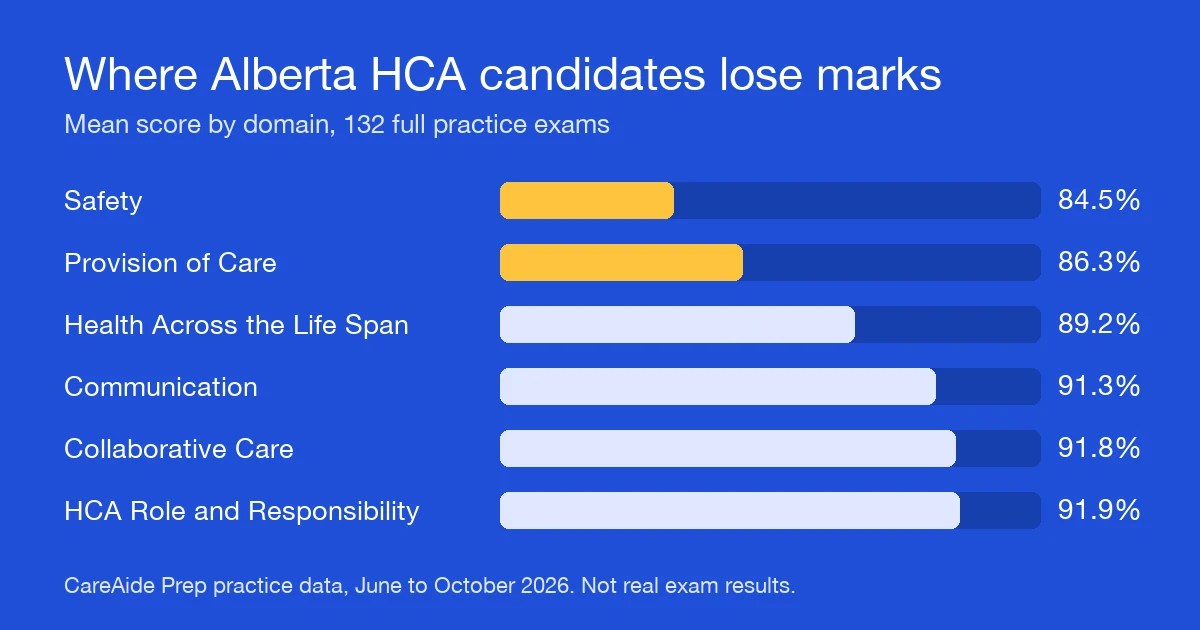
Across 132 full practice exams, Alberta HCA candidates scored lowest in Safety and Provision of Care, the two domains worth the most marks on the exam.
The hardest part of the Alberta HCA exam, in 13,200 practice answers
Across 132 full practice exams, Alberta HCA candidates scored lowest in Safety and Provision of Care, the two domains worth the most marks on the exam.
-
 Health Across the Life Span on the Alberta HCA exam: why younger clients catch candidates out
Prepare for the Health Across the Life Span domain on the Alberta HCA Registration Examination: age-specific growth, development and care principles.
Health Across the Life Span on the Alberta HCA exam: why younger clients catch candidates out
Prepare for the Health Across the Life Span domain on the Alberta HCA Registration Examination: age-specific growth, development and care principles.
-
 Am I ready for the Alberta HCA exam? Four signals that matter more than a practice score
Discover how to gauge your readiness for the Alberta HCA Registration Examination. Learn four reliable indicators of success before booking your test.
Am I ready for the Alberta HCA exam? Four signals that matter more than a practice score
Discover how to gauge your readiness for the Alberta HCA Registration Examination. Learn four reliable indicators of success before booking your test.