 CareAide Prep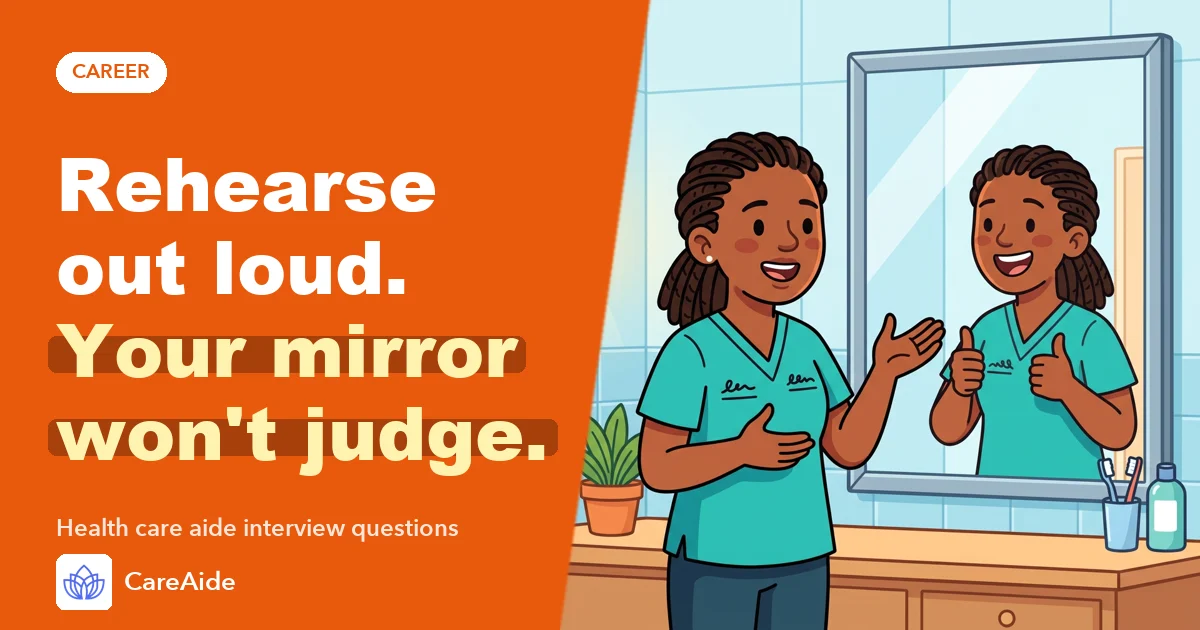
Health care aide interview questions: how to answer them, and rehearse out loud
Health care aide interviews are predictable in structure and unforgiving in one specific way: an answer that strays outside scope of practice ends the conversation regardless of how well it is delivered.
What interviewers are testing
An interview for a health care aide position is rarely an examination of knowledge. The employer already has your registration status. What they are establishing is whether you will be safe on shift without supervision, whether you will report rather than improvise, and whether a resident's family would be reassured by meeting you.
Questions therefore tend to be situational. They describe something that went wrong and ask what you would do. The structure of your answer matters more than its cleverness.
The six areas questions come from
Interview questions map closely onto the same competency areas the examination tests, which is convenient: preparation for one supports the other.
- Provision of care. Personal care, mobility, mealtime assistance, and how you adapt when a client's needs change.
- Safety. Falls, infection prevention, safe transfers, and recognising and reporting abuse or neglect.
- Role and responsibility. What you do when asked to perform a task outside your scope. This question is asked more often than candidates expect.
- Communication. A distressed family member, a colleague who is short with you, a client who refuses care.
- Health across the life span. Adapting your approach for a client with cognitive changes, or at end of life.
- Collaborative care. Handover, working with nursing staff, and raising a concern you are not certain about.
How to structure an answer
Situational answers are best given in four parts, commonly taught as STAR. Describe the situation briefly, state the task or the problem, then spend most of your answer on the action you took, and close with the result. Candidates most often fail by spending too long on the situation and running out of time before the action, which is the only part the interviewer is assessing.
Two additions are specific to this role. Say what you reported and to whom, because reporting is a competency rather than an afterthought. And where a task fell outside scope, say so explicitly. An interviewer hearing a candidate identify the boundary correctly learns more than any confident answer could tell them.
The question that fails candidates
Some version of the following is nearly always asked: a resident asks you for their pain medication, or a family member asks you to give it. The answer is that a health care aide provides medication assistance as assigned by a regulated health care professional. You do not administer, you do not adjust, and you do not decide. You report the request to the nurse.
Candidates who answer this by describing what they would give reveal that they have not internalised the boundary, and no amount of warmth in the delivery recovers it.
Rehearsing aloud
Reading interview questions is not rehearsal. The gap between knowing an answer and delivering it under mild pressure is where most interviews are lost, and it closes only by speaking.
The Interview Room runs a spoken mock interview with an AI interviewer, or with a panel that hands off between interviewers as a real panel does. Questions are drawn from the six competency areas above so that a full interview covers the ground an employer will. Afterwards you receive a scorecard against a five-dimension hiring rubric, with a specific constraint: any answer that breaches scope of practice caps the hiring signal regardless of how well it was delivered. That mirrors how a real panel would treat it.
You can also type answers rather than speak them if you are somewhere you cannot talk, though speaking is the point of the exercise.
Questions worth asking them
Interviews end with an invitation to ask questions, and declining it is a missed opportunity. Useful questions include the staffing ratio on a typical shift, how handover is conducted, what orientation looks like for a new aide, and how the team escalates a concern outside of hours. Each signals that you are thinking about the work rather than the offer.
Common questions
What questions are asked in a health care aide interview?
Most Alberta health care aide interview questions are situational and map onto the six competency areas: provision of care, safety, role and responsibility, communication, health across the life span, and collaborative care. Employers are establishing whether you will be safe unsupervised and whether you report rather than improvise.
How should I answer a health care aide interview question?
Use a four-part structure: situation, task, action, result, spending most of the answer on the action. Two additions matter for a health care aide interview. Say what you reported and to whom, and where a task fell outside scope, name the boundary explicitly.
What is the most common mistake in a health care aide interview?
Answering a medication question by describing what you would give. An Alberta health care aide provides medication assistance as assigned by a regulated health care professional and reports the request to the nurse. An answer that crosses that boundary is not recoverable by good delivery.
Keep reading
-
 Is health care aide a good career in Alberta? An honest look at the work and where it leads
An honest evaluation of working as a health care aide in Alberta, covering professional regulation, daily duties, career pathways, and real job trade-offs.
Is health care aide a good career in Alberta? An honest look at the work and where it leads
An honest evaluation of working as a health care aide in Alberta, covering professional regulation, daily duties, career pathways, and real job trade-offs.
-
 Your first shift as a health care aide: what to expect, what to ask, what to report
What actually happens on a first shift as a health care aide, what to ask before it starts, and the reporting habit that matters most in week one.
Your first shift as a health care aide: what to expect, what to ask, what to report
What actually happens on a first shift as a health care aide, what to ask before it starts, and the reporting habit that matters most in week one.
-
 How Job Hunter finds Alberta HCA postings: real jobs, real dates, a draft cover letter
What Job Hunter does: live Alberta health care aide postings from Job Bank Canada, full text for thin listings, and a cover letter drafted from your own resume.
How Job Hunter finds Alberta HCA postings: real jobs, real dates, a draft cover letter
What Job Hunter does: live Alberta health care aide postings from Job Bank Canada, full text for thin listings, and a cover letter drafted from your own resume.