 CareAide Prep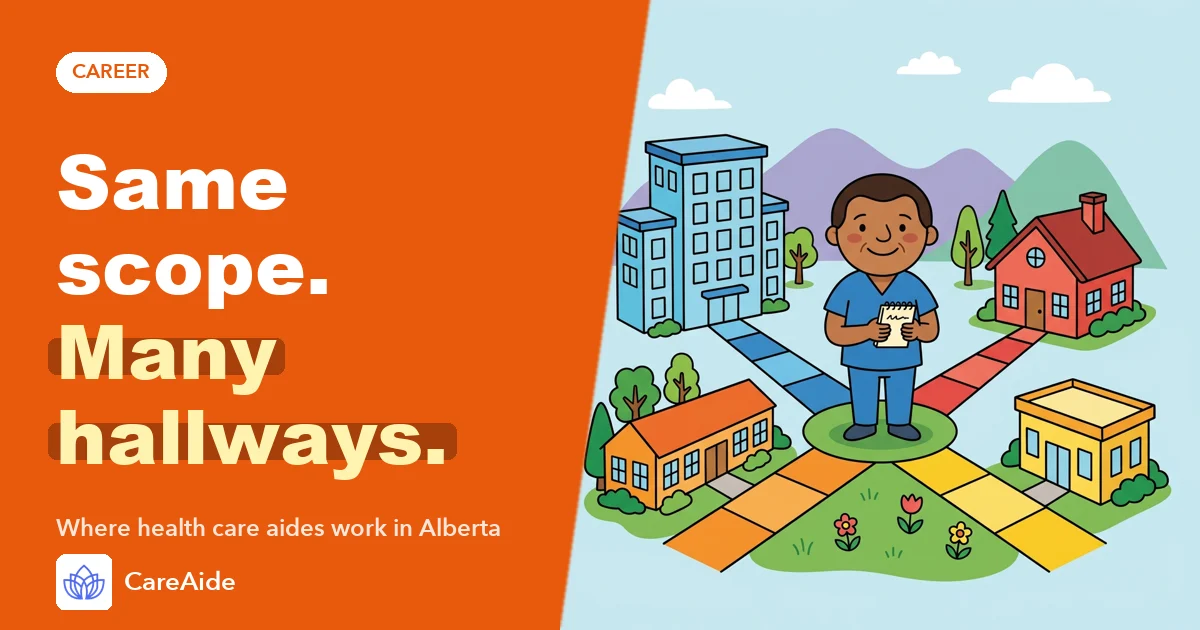
Where health care aides work in Alberta: same scope, many hallways
Health care aides deliver the majority of hands-on personal care in Alberta, across settings that differ more than the shared job title suggests. The registration requirement introduced on 2 February 2026 applies to all of them.
How many there are
The College of Licensed Practical Nurses and Health Care Aides of Alberta reported 37,630 active health care aides in the province as of July 2026, of whom 1,026 also held an active licensed practical nurse registration. It is one of the largest regulated groups in Alberta's health workforce, and the great majority of hands-on personal care in the province is delivered by them.
What changed in 2026
Since 2 February 2026, health care aides in Alberta must register with the College of Licensed Practical Nurses and Health Care Aides of Alberta and hold a practice permit. The examination candidates sit was renamed the Alberta HCA Registration Examination at the same time. Provisional registrants have one year and three attempts.
Registration formalises something the role already carried in practice: accountability. A registered profession has a public register, a scope defined in writing, and a complaints process. For candidates entering the field this is worth understanding before the examination rather than after it, because several examination domains test precisely the boundaries that registration makes enforceable.
The settings
Continuing care and long-term care
The largest employer of health care aides in the province. Work centres on personal care, mobility and transfers, mealtime assistance, and supporting residents living with dementia. Relationships are long term, which changes the nature of the work: an aide often knows a resident's baseline better than anyone else on shift, and noticing a change from that baseline is a substantial part of the contribution.
Supportive living and assisted living
Residents retain more independence, and the aide's role shifts towards enabling rather than performing. Judgement about how much assistance to offer is a daily question, and offering too much is as much an error as offering too little.
Home care
An aide works alone in a client's home, which removes the immediate availability of a colleague to consult. Documentation and reporting carry more weight when nobody else witnessed the visit, and the ability to recognise when a situation exceeds scope and requires escalation becomes the central safety skill.
Acute care
Hospital settings involve shorter relationships, higher turnover of patients, and closer proximity to regulated staff. The pace differs and the reporting lines are more immediate.
What the role does not include
The Competency Profile is specific, and candidates lose marks on this more than on any other single point. A health care aide provides medication assistance as assigned by a regulated health care professional. The aide does not administer medication, does not adjust a dose, and does not decide whether a medication should be given. Care is provided under supervision and follows the client's care plan.
Similarly, an aide reports and documents according to employer standards but does not assess, diagnose, or form clinical judgements. The distinction between observing and reporting a change, which is in scope, and interpreting what that change means, which is not, runs through the whole examination.
Terminology that matters
Alberta uses the term responsive behaviours, or changing behaviours, rather than terms that locate the difficulty in the person. The wording is not cosmetic. It reflects a position that behaviour is a response to something in the environment, the care, or an unmet need, and that the aide's task is to find the cause rather than to manage the person. Examination questions use this language, and candidates who learned other terminology elsewhere should expect it.
Abuse and neglect recognition
The Safety domain, which carries 16 to 20 per cent of the examination, explicitly includes recognising and reporting abuse and neglect. This is a legal obligation rather than a matter of judgement, and it applies regardless of who the suspected source is. Candidates should know their employer's reporting pathway before they need it.
Common questions
Do health care aides need to register in Alberta?
Yes. Since 2 February 2026, health care aides in Alberta must register with the College of Licensed Practical Nurses and Health Care Aides of Alberta and hold a practice permit. Provisional registrants have one year and three attempts to pass the Alberta HCA Registration Examination.
How many health care aides are there in Alberta?
The College of Licensed Practical Nurses and Health Care Aides of Alberta reported 37,630 active health care aides in the province as of July 2026, of whom 1,026 also held an active licensed practical nurse registration.
Where do most health care aides work in Alberta?
Continuing care and long-term care employ the largest share of Alberta health care aides, followed by supportive living, home care and acute care. The settings differ substantially in pace, independence and the length of the relationship with each client.
Can a health care aide give medication in Alberta?
A health care aide provides medication assistance as assigned by a regulated health care professional. The aide does not administer medication, adjust a dose, or decide whether a medication should be given. This wording is the single point candidates most often answer incorrectly.
Keep reading
-
 Is health care aide a good career in Alberta? An honest look at the work and where it leads
An honest evaluation of working as a health care aide in Alberta, covering professional regulation, daily duties, career pathways, and real job trade-offs.
Is health care aide a good career in Alberta? An honest look at the work and where it leads
An honest evaluation of working as a health care aide in Alberta, covering professional regulation, daily duties, career pathways, and real job trade-offs.
-
 Your first shift as a health care aide: what to expect, what to ask, what to report
What actually happens on a first shift as a health care aide, what to ask before it starts, and the reporting habit that matters most in week one.
Your first shift as a health care aide: what to expect, what to ask, what to report
What actually happens on a first shift as a health care aide, what to ask before it starts, and the reporting habit that matters most in week one.
-
 Health care aide interview questions: how to answer them, and rehearse out loud
The questions Alberta health care aide interviews actually ask, how to structure an answer, and how to rehearse aloud before the interview, not during it.
Health care aide interview questions: how to answer them, and rehearse out loud
The questions Alberta health care aide interviews actually ask, how to structure an answer, and how to rehearse aloud before the interview, not during it.