 CareAide Prep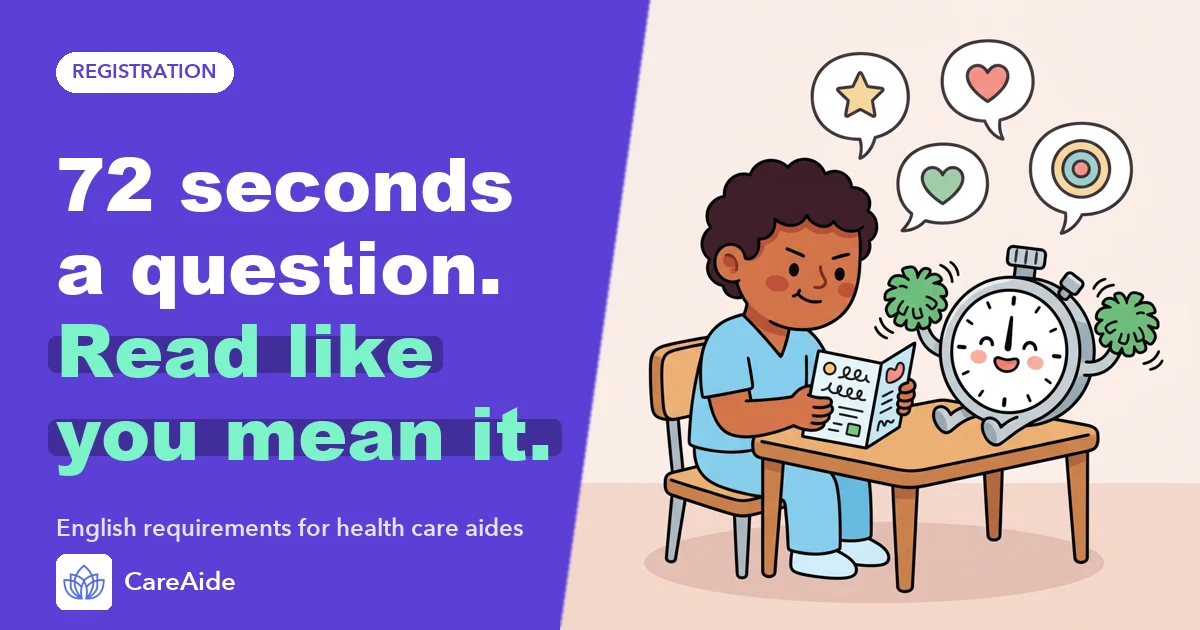
English language requirements for health care aides in Alberta: the exam is a reading test too
Two different questions get confused here. One is what the College requires of you to register. The other is what the examination itself demands of your reading, which is a separate problem and the one most candidates underestimate.
The requirement, and where to confirm it
English language proficiency is part of registration, and the authority on it is the College of Licensed Practical Nurses and Health Care Aides of Alberta. Accepted tests and minimum scores are set by the College and can change, so the only responsible advice is to read the current requirement on the College's own site before you pay for a test. An article that quotes a score is out of date the moment the College revises it, and a candidate who books the wrong test loses months.
What does not change is the shape of the obligation. You will be asked to demonstrate proficiency either through an accepted test result or through education completed in English. If your health care aide program was delivered in English in Canada, that route usually applies to you.
The examination is a reading test as well as a knowledge test
This is the part nobody warns candidates about. The Alberta HCA Registration Examination is one hundred multiple choice questions in two hours, which is seventy two seconds a question. Between 53 and 73 per cent of the marks are allocated to Applying, meaning most questions describe a situation and ask what you would do. A situation has to be read, held in mind, and compared against four options that are deliberately close together.
A candidate whose clinical knowledge is sound can still run out of time because reading each scenario twice costs them thirty seconds a question. That is not a language deficiency in any meaningful sense. It is a familiarity problem, and familiarity is trainable.
What actually helps, in order
Read the question stem first, then the scenario
Most scenario questions can be answered after one pass if you know what you are looking for before you start reading. Reading the final sentence first tells you whether the question is about safety, communication or scope, and you then read the scenario for that.
Learn the vocabulary that carries the answer
A small number of words decide a large number of questions. Words like assist, report, observe, document and supervise are not decoration; they are the difference between an option that is in scope and one that is not. A question that offers you the chance to administer a medication is offering you a wrong answer, because an Alberta health care aide provides medication assistance as assigned by a regulated health care professional. Recognising that wording instantly is worth more than any amount of general vocabulary work.
Practise under the clock, not just for accuracy
Answering fifty questions correctly with unlimited time proves less than answering thirty under seventy two seconds each. If your practice has no clock on it, it is not rehearsing the thing that will actually go wrong.
Where an ESL mode helps and where it does not
Reading support belongs in practice, not in the examination hall. There will be no glossary and no simplified phrasing on the day, so any tool that softens the language permanently is training you for a test that does not exist. Used properly, plain-language explanations and phonetic guides are scaffolding: they let you understand why an answer was wrong, in your own time, so that the next scenario is read faster.
The measure of whether it is working is simple. Your median time per question should fall while your accuracy holds. If accuracy is climbing but time is not falling, you are learning the content and not yet the reading.
A note on confidence
Candidates who trained outside Canada frequently know more clinical content than they give themselves credit for, and lose marks to phrasing rather than to care. Alberta uses particular terms for particular things. Responsive behaviours is the term you will see, rather than any of the alternatives used elsewhere. Learning the province's vocabulary is a short, finite task, and it is usually the highest-value week of study available to an internationally educated candidate.
If you trained under a different provincial title, the substantial equivalence route is the process that concerns you, and the scope of practice page is where the vocabulary above is set out in full.
Common questions
Do I need an English test to work as a health care aide in Alberta?
English language proficiency forms part of registration with the College of Licensed Practical Nurses and Health Care Aides of Alberta. Accepted tests and minimum scores are set by the College and are revised from time to time, so confirm the current requirement on the College’s own site before booking a test. Education completed in English is often an alternative route.
Is the Alberta HCA exam available in any language other than English?
The Alberta HCA Registration Examination is written in English. There is no glossary or simplified wording available on the day, which is why reading speed under time pressure is worth practising rather than only content.
How do I prepare for the exam if English is my second language?
Practise against the clock rather than only for accuracy, learn the specific Alberta vocabulary that decides questions such as assist, report and supervise, and read the question stem before the scenario so you know what you are reading for. Watch median time per question, not only your score.
Keep reading
-
 How to become a CCA in Saskatchewan
: the Saskatchewan Polytechnic certificate, regional colleges, the SIIT program, admission checks and rural incentives.
How to become a CCA in Saskatchewan
How to become a CCA in Saskatchewan: the Saskatchewan Polytechnic certificate, regional colleges, the SIIT program, admission checks and rural incentives.
-
 How to become a health care aide in Manitoba
: certificate programs, the paid uncertified route and bridging, abuse registry checks, and what unregulated means.
How to become a health care aide in Manitoba
How to become a health care aide in Manitoba: certificate programs, the paid uncertified route and bridging, abuse registry checks, and what unregulated means.
-
 How to register with the BC Care Aide Registry
How to register with the BC Care Aide and Community Health Worker Registry: who is eligible, the five application routes, review times, and yearly verification.
How to register with the BC Care Aide Registry
How to register with the BC Care Aide and Community Health Worker Registry: who is eligible, the five application routes, review times, and yearly verification.