 CareAide Prep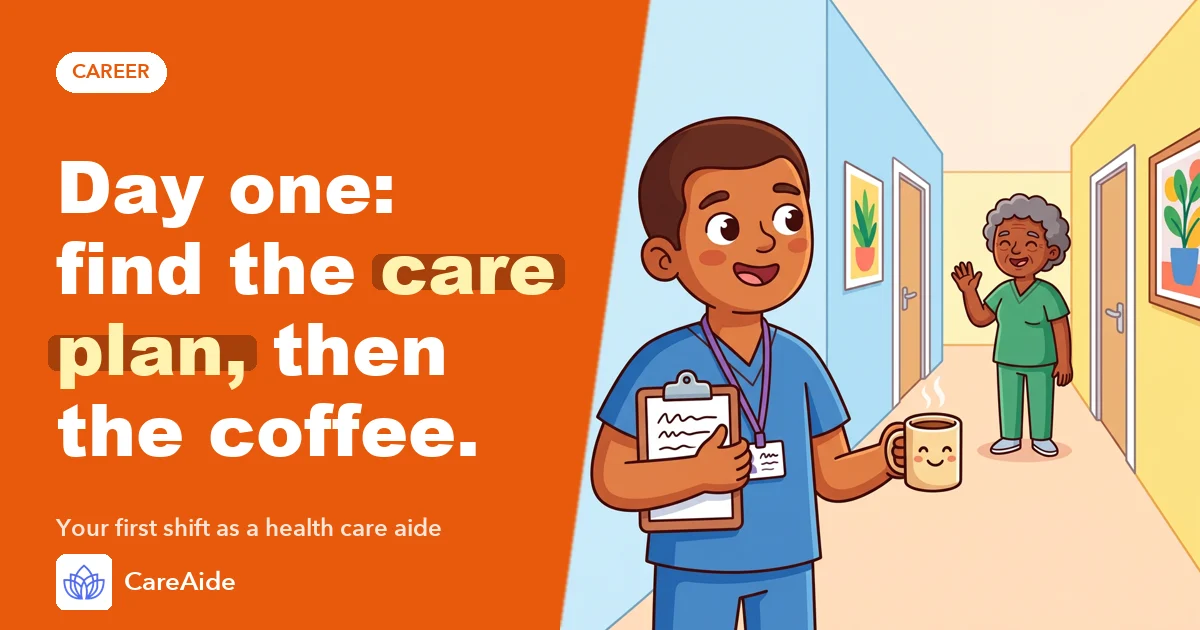
Your first shift as a health care aide: what to expect, what to ask, what to report
Nobody expects you to be fast in week one. What they expect is that you ask, and that you report what you see. Both are learnable in an afternoon, and both are what separates a calm first shift from a hard one.
Before the shift starts
Three questions asked at the beginning will save you the whole day. Who is the regulated professional I report to today. Where is the care plan for each of my clients. What am I expected to document, and where. None of these makes you look inexperienced. Asking none of them and guessing does.
Care plans are not paperwork. Alberta health care aides work to the client's care plan, and the plan is the answer to most of the questions you will have about a person you have never met: how they transfer, what they can do themselves, what they find distressing, how they take their meals.
The habit that matters most
Observe, report, document. It sounds like an exam phrase because it is one, but it is also the whole job in three words. You are the person in the building who sees the client most often, which makes you the early warning system for everything from a pressure area to a change in behaviour.
New aides consistently under-report, for a reason that is entirely understandable: they are not sure whether something counts. The rule that resolves it is that a change counts. You do not need to know what a change means, and you are not expected to. Interpreting it belongs to a regulated professional. Noticing it and saying so belongs to you.
What is not yours to decide
This is the boundary that most often surprises people, especially those who have cared for family members. A health care aide provides medication assistance as assigned by a regulated health care professional. You do not administer, adjust, withhold or decide. If a client refuses something, that is a report, not a negotiation you have to win.
Equally, you do not assess or diagnose. If a client seems confused today and was not yesterday, you report confusion. You do not decide it is a urinary tract infection, even if you have seen it a hundred times and you are probably right.
Pace, and the thing nobody tells you
You will be slower than the people around you for several weeks. That is not a problem unless you hide it. The dangerous version of a first shift is the one where somebody rushes a transfer to keep up. Safe body mechanics and safe patient handling are in the competency profile because injuries end careers, and the injuries happen when people hurry.
Ask for a second person. Every time you are unsure, ask for a second person. Nobody remembers the aide who asked for help with a transfer. Everyone remembers the one who did not.
Ending the shift properly
Handover is where your observations become useful to somebody else. A structured handover, whether or not your workplace calls it SBAR, moves faster and is trusted more. Say the situation, the relevant background, what you observed, and what you think should happen next. If you have practised writing handovers, this is the moment it pays.
If you are still preparing to register, the scope of practice page sets out the boundaries above in full, and health care aide jobs in Alberta covers finding the shift in the first place.
Common questions
What should I ask on my first shift as a health care aide?
A new health care aide should ask who the regulated professional they report to is, where the care plan for each client is kept, and what they are expected to document and where. Asking these is normal; guessing at them is what causes problems.
What should I report as a new health care aide?
Any change. A health care aide does not need to know what a change means, because interpreting it belongs to a regulated professional; noticing it and reporting it is the aide’s part. New aides under-report because they are unsure whether something counts, and a change always counts.
Can a health care aide give medication?
A health care aide provides medication assistance as assigned by a regulated health care professional. Administering, adjusting, withholding or deciding on medication is outside the role. A refusal is something to report rather than something to resolve yourself.
Keep reading
-
 Is health care aide a good career in Alberta? An honest look at the work and where it leads
An honest evaluation of working as a health care aide in Alberta, covering professional regulation, daily duties, career pathways, and real job trade-offs.
Is health care aide a good career in Alberta? An honest look at the work and where it leads
An honest evaluation of working as a health care aide in Alberta, covering professional regulation, daily duties, career pathways, and real job trade-offs.
-
 Health care aide interview questions: how to answer them, and rehearse out loud
The questions Alberta health care aide interviews actually ask, how to structure an answer, and how to rehearse aloud before the interview, not during it.
Health care aide interview questions: how to answer them, and rehearse out loud
The questions Alberta health care aide interviews actually ask, how to structure an answer, and how to rehearse aloud before the interview, not during it.
-
 How Job Hunter finds Alberta HCA postings: real jobs, real dates, a draft cover letter
What Job Hunter does: live Alberta health care aide postings from Job Bank Canada, full text for thin listings, and a cover letter drafted from your own resume.
How Job Hunter finds Alberta HCA postings: real jobs, real dates, a draft cover letter
What Job Hunter does: live Alberta health care aide postings from Job Bank Canada, full text for thin listings, and a cover letter drafted from your own resume.