 CareAide Prep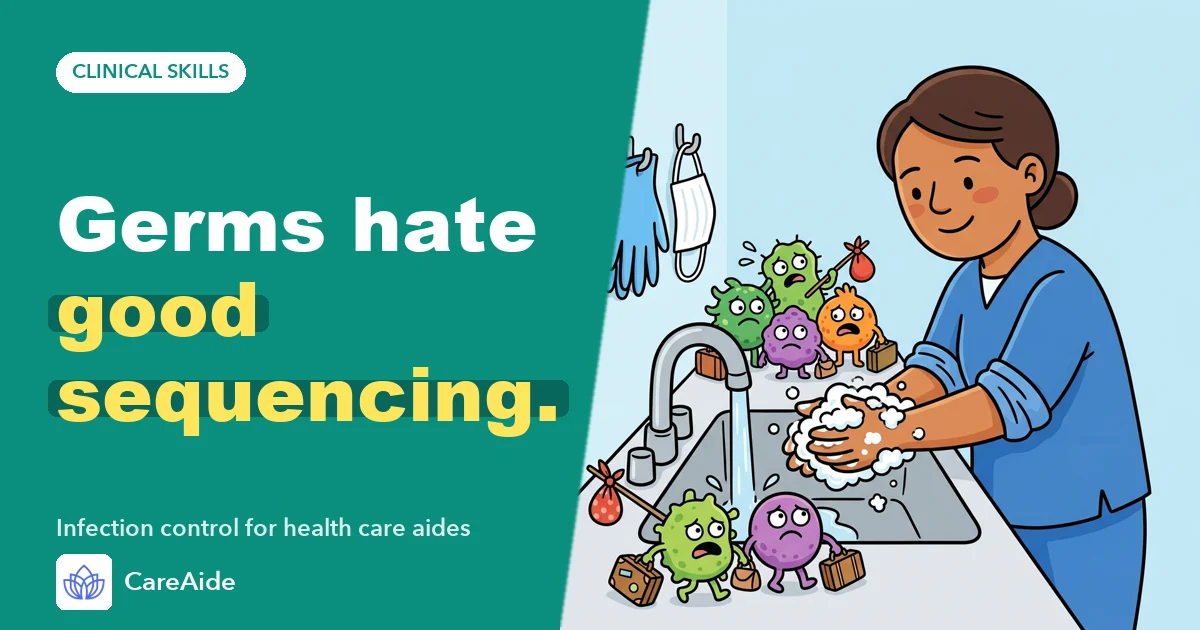
Infection control for health care aides: why the order of steps decides the mark
Most infection control questions are not asking whether you know what personal protective equipment is. They are asking whether you know what order to do things in, and who you tell.
Where this sits on the paper
Infection prevention and control belongs to the Safety domain, which carries 16 to 20 per cent of the marks on the Alberta HCA Registration Examination. That makes it the second largest domain after Provision of Care. It is also the domain where candidates most often lose marks to sequence rather than to knowledge.
Sequence is the thing being tested
A question that describes a task and offers four plausible actions is usually asking what comes first. Hand hygiene before and after contact is the answer more often than any other single action, and it is the one candidates skip past because it feels too obvious to be the point. It is the point.
Putting on and removing protective equipment is the same kind of question. Removal order matters more than application order, because removal is where contamination transfers. If a scenario has you leaving a room, the marks are in the order you take things off and when you clean your hands.
Standard precautions apply to everyone
The principle behind standard precautions is that you cannot tell by looking. They are applied to every client, not to the ones with a known diagnosis, and an option that applies extra caution only after a diagnosis is usually wrong for that reason.
Additional precautions layer on top when a specific transmission route is involved. The examination expects you to recognise that they are added rather than substituted.
The part that is genuinely about scope
A health care aide observes and reports. If a client has new diarrhoea, a new rash, or a wound that looks different today, that is a report to a regulated health care professional, and it is urgent in a way that new aides often underestimate because they are waiting to be sure. You are not required to be sure. Deciding what an observation means is not your role.
Nor is deciding on treatment. Any option that has the aide starting, stopping or adjusting anything therapeutic is outside scope. The aide's contribution is early notice, correct technique and accurate documentation.
Environment, laundry and food
Safe food handling and mealtime assistance sit in the same domain, and they are tested more often than candidates expect. The reasoning is the same throughout: contain at the source, clean hands at every transition, and never move from a dirty task to a clean one without stopping in between.
If you can articulate that single principle, most environmental questions answer themselves, including the ones about linen, spills and shared equipment.
How to practise it
Reading a list of precautions produces recognition, not recall under pressure. Working through scenarios where four reasonable actions compete produces the ordering instinct the paper is actually measuring. The domain weightings are on the exam blueprint page; what an aide may and may not do is on the scope of practice page.
Common questions
How much of the Alberta HCA exam covers infection control?
On the Alberta HCA Registration Examination, infection prevention and control sits within the Safety domain, which carries 16 to 20 per cent of the marks, making it the second largest domain after Provision of Care.
What is the most common infection control answer?
On the Alberta HCA exam, hand hygiene before and after contact is the correct first action more often than any other single option, and it is the one candidates skip because it seems too obvious. Questions in this area usually test the order of actions rather than knowledge of the actions themselves.
Do standard precautions only apply to clients with a known infection?
No. A health care aide applies standard precautions to every client, because you cannot tell by looking. Additional precautions are layered on top when a specific transmission route is involved; they are added rather than substituted.
Keep reading
-
 Reporting suspected abuse as a Saskatchewan CCA when there is no adult-protection act
Saskatchewan has no adult-protection act. Learn how a CCA reports suspected abuse in a special-care home, protects children and documents events.
Reporting suspected abuse as a Saskatchewan CCA when there is no adult-protection act
Saskatchewan has no adult-protection act. Learn how a CCA reports suspected abuse in a special-care home, protects children and documents events.
-
 Manitoba health care aides: medication and restraint rules in personal care homes
Who may give medication and apply restraints in a Manitoba personal care home, what reserved acts mean, and how a health care aide hands decisions on.
Manitoba health care aides: medication and restraint rules in personal care homes
Who may give medication and apply restraints in a Manitoba personal care home, what reserved acts mean, and how a health care aide hands decisions on.
-
 BC health care assistants: assigned tasks, restricted activities and delegation
BC health care assistants have no legal scope of practice. Learn how assigned tasks, restricted activities and client-specific delegation sort the work.
BC health care assistants: assigned tasks, restricted activities and delegation
BC health care assistants have no legal scope of practice. Learn how assigned tasks, restricted activities and client-specific delegation sort the work.