 CareAide Prep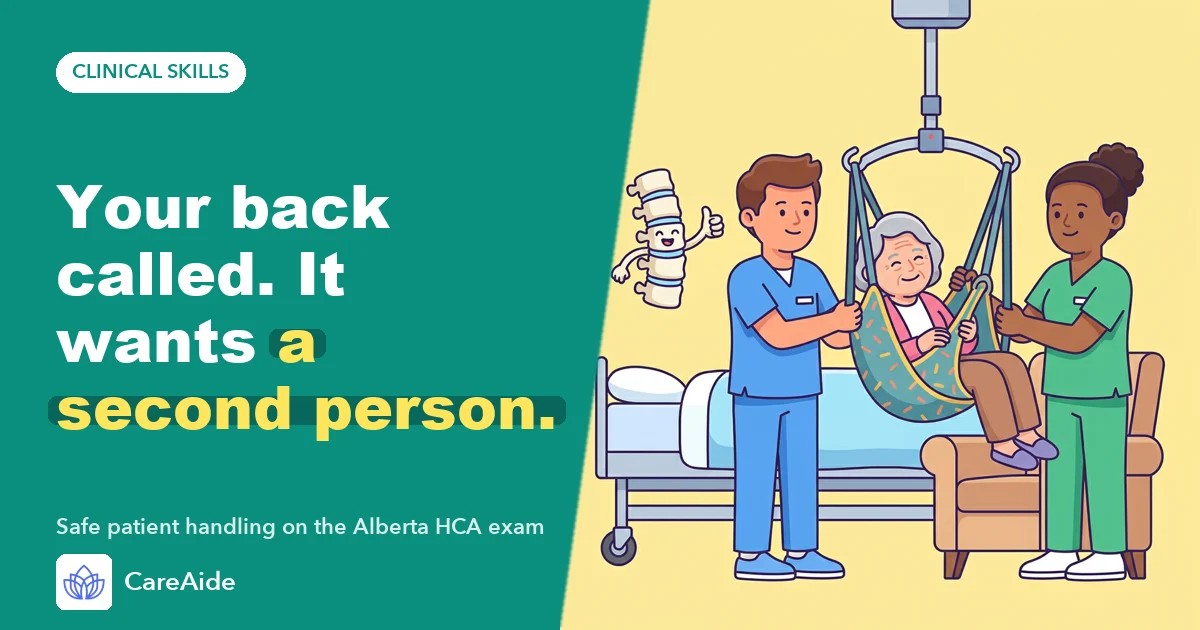
Safe patient handling for health care aides in Alberta: why stopping for a second person is so often right
Transfer questions look like technique questions. They are usually decision questions, and the decision being tested is whether you know when not to proceed alone.
Why this carries weight
Safe body mechanics and safe patient handling sit in the Safety domain, which carries 16 to 20 per cent of the marks. The reason the competency profile treats it seriously is not academic. Musculoskeletal injury is one of the main reasons people leave this work, and it usually happens during a transfer that somebody decided to do alone.
The care plan decides, not the day
An Alberta health care aide works to the client's care plan. If the plan specifies a mechanical lift and two staff, that is the transfer, on a quiet Tuesday and on a short-staffed Saturday equally. A scenario that describes a busy unit and offers you a faster method is offering you the wrong answer, and it is offering it deliberately, because that is exactly the pressure the examination wants to see you resist.
If the client's condition has changed so that the plan no longer fits, that is a report to a regulated health care professional. It is not an invitation to improvise a new method.
What good technique actually is
Most of it reduces to a few principles that generate correct answers across many questions. Get close to the load rather than reaching. Use your legs and keep your back in a neutral position. Avoid twisting; move your feet instead. Raise the bed to your working height rather than bending to it. Tell the client what is about to happen, and use their remaining ability rather than lifting a person who could take some of their own weight.
That last point is easy to miss and appears frequently. Doing too much for a client is not kindness in this context. It removes ability, and it makes the transfer heavier than it needed to be.
Equipment, and the honest answer about time
Mechanical lifts are slower to set up than a manual transfer. That is the entire reason they get skipped, and it is the reason questions about them exist. Check the sling, check the weight limit, check the brakes, and use the number of people the equipment requires. An option that describes a competent shortcut is still a wrong option.
The answer that is right more often than any other
Stop and get a second person. When a scenario contains any uncertainty about whether a transfer is safe, that is generally the response the profile supports. It is also true on a real unit, which is worth saying, because candidates sometimes suspect the examination of describing a world that does not exist. In this case it does not: nobody remembers the aide who asked for help, and everybody remembers the injury.
The domain weightings behind this are on the exam blueprint page, and your first shift covers the same instinct in the setting where it matters most.
Common questions
How is safe patient handling tested on the Alberta HCA exam?
Within the Safety domain of the Alberta HCA Registration Examination, which carries 16 to 20 per cent of the marks. Questions usually present a decision rather than a technique: whether to proceed, whether the care plan still fits, and whether to get a second person.
What if the unit is short staffed and a transfer needs two people?
An Alberta health care aide works to the client’s care plan, so the plan decides the transfer rather than how busy the shift is. An exam scenario describing a busy unit and offering a faster method is offering the wrong answer deliberately, because resisting that pressure is what is being measured.
Should a health care aide do as much as possible for a client?
No. A health care aide using a client’s remaining ability is practising both better care and safer handling. Doing too much removes ability and makes the transfer heavier than it needed to be.
Keep reading
-
 Manitoba health care aides: medication and restraint rules in personal care homes
Who may give medication and apply restraints in a Manitoba personal care home, what reserved acts mean, and how a health care aide hands decisions on.
Manitoba health care aides: medication and restraint rules in personal care homes
Who may give medication and apply restraints in a Manitoba personal care home, what reserved acts mean, and how a health care aide hands decisions on.
-
 BC health care assistants: assigned tasks, restricted activities and delegation
BC health care assistants have no legal scope of practice. Learn how assigned tasks, restricted activities and client-specific delegation sort the work.
BC health care assistants: assigned tasks, restricted activities and delegation
BC health care assistants have no legal scope of practice. Learn how assigned tasks, restricted activities and client-specific delegation sort the work.
-
 PSW medication in New Brunswick: why home support and nursing homes differ
What a New Brunswick PSW may do about medication in home support and in a nursing home, plus foot care, restraints and how reporting differs.
PSW medication in New Brunswick: why home support and nursing homes differ
What a New Brunswick PSW may do about medication in home support and in a nursing home, plus foot care, restraints and how reporting differs.