 CareAide Prep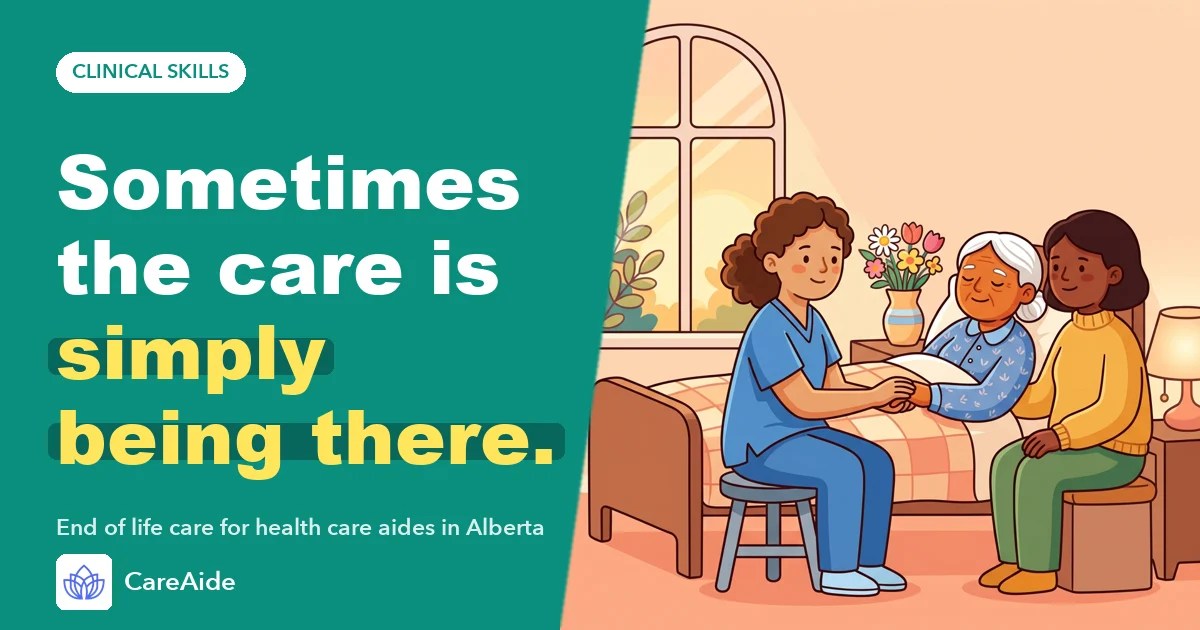
End of life care for health care aides in Alberta: comfort, dignity and knowing your role
These questions are among the few where doing less is usually the right answer. Comfort, presence and dignity are the competencies being measured, and none of them requires you to fix anything.
What is being tested
End of life care appears across Provision of Care, which is the largest domain at 25 to 35 per cent of the marks, and Communication, at 12 to 16 per cent. The questions tend to describe a situation with a family member or a client and offer four responses, of which one protects dignity, one avoids the subject, one over-promises, and one steps outside the aide's role.
Comfort is the intervention
Positioning, mouth care, warmth, quiet, clean linen, a hand held. These are not what you do while waiting for real care to arrive. At end of life they are the care, and the competency profile treats them that way.
Candidates sometimes read comfort measures as the passive option and choose something more active. Repositioning a person who cannot move themselves, and keeping their mouth from drying, are among the most valuable things anyone will do for them that day.
What to say, and what not to promise
Families ask questions that have no comfortable answer. How long. Is he in pain. Did she know I was here. The tested response is almost never a reassurance you cannot support, and almost never a deflection either.
Acknowledging the question, staying present, and passing it to a regulated health care professional is the pattern the profile supports. "I do not know, but I will ask the nurse to come and speak with you" is a complete and correct answer. Saying "he is not in any pain" when you cannot know that is not kindness; it is a clinical claim outside your scope.
The boundaries, stated plainly
You observe, report and document. You do not assess, diagnose, or prognosticate. Medication remains assistance as assigned by a regulated health care professional, which means options involving comfort medication decisions are not yours regardless of how obviously indicated they might seem.
Cultural and spiritual practices are followed as the client and family wish, and asked about rather than assumed. An option that applies a default practice without asking is generally wrong for that reason.
After a death, and afterwards for you
Care after death is still care, and dignity does not end. Follow the employer's procedure, treat the body with the same respect as the person, and give the family the time they need where that is possible.
The part that is rarely written down is that this work accumulates. Aides who do end of life care well are often the ones who carry it home. Knowing that in advance, and knowing that your workplace has people whose job includes supporting you, is worth as much as any competency on the paper.
Domain weightings are on the exam blueprint page, and the role boundaries above on the scope of practice page.
Common questions
What is a health care aide’s role at end of life?
A health care aide provides comfort, presence and dignity: positioning, mouth care, warmth, quiet and clean linen. At end of life these are the care rather than something done while waiting for care, and the Alberta competency profile treats them that way.
What should I say when a family asks if their relative is in pain?
Acknowledge the question, stay present, and pass it to a regulated health care professional. Saying someone is not in pain when you cannot know that is a clinical claim outside a health care aide’s scope; "I do not know, but I will ask the nurse to speak with you" is a complete answer.
Are cultural practices assumed or asked about?
Asked about. A health care aide follows practices as the client and family wish, and an Alberta HCA exam option that applies a default practice without asking is generally wrong for that reason.
Keep reading
-
 Manitoba health care aides: medication and restraint rules in personal care homes
Who may give medication and apply restraints in a Manitoba personal care home, what reserved acts mean, and how a health care aide hands decisions on.
Manitoba health care aides: medication and restraint rules in personal care homes
Who may give medication and apply restraints in a Manitoba personal care home, what reserved acts mean, and how a health care aide hands decisions on.
-
 BC health care assistants: assigned tasks, restricted activities and delegation
BC health care assistants have no legal scope of practice. Learn how assigned tasks, restricted activities and client-specific delegation sort the work.
BC health care assistants: assigned tasks, restricted activities and delegation
BC health care assistants have no legal scope of practice. Learn how assigned tasks, restricted activities and client-specific delegation sort the work.
-
 PSW medication in New Brunswick: why home support and nursing homes differ
What a New Brunswick PSW may do about medication in home support and in a nursing home, plus foot care, restraints and how reporting differs.
PSW medication in New Brunswick: why home support and nursing homes differ
What a New Brunswick PSW may do about medication in home support and in a nursing home, plus foot care, restraints and how reporting differs.