 CareAide Prep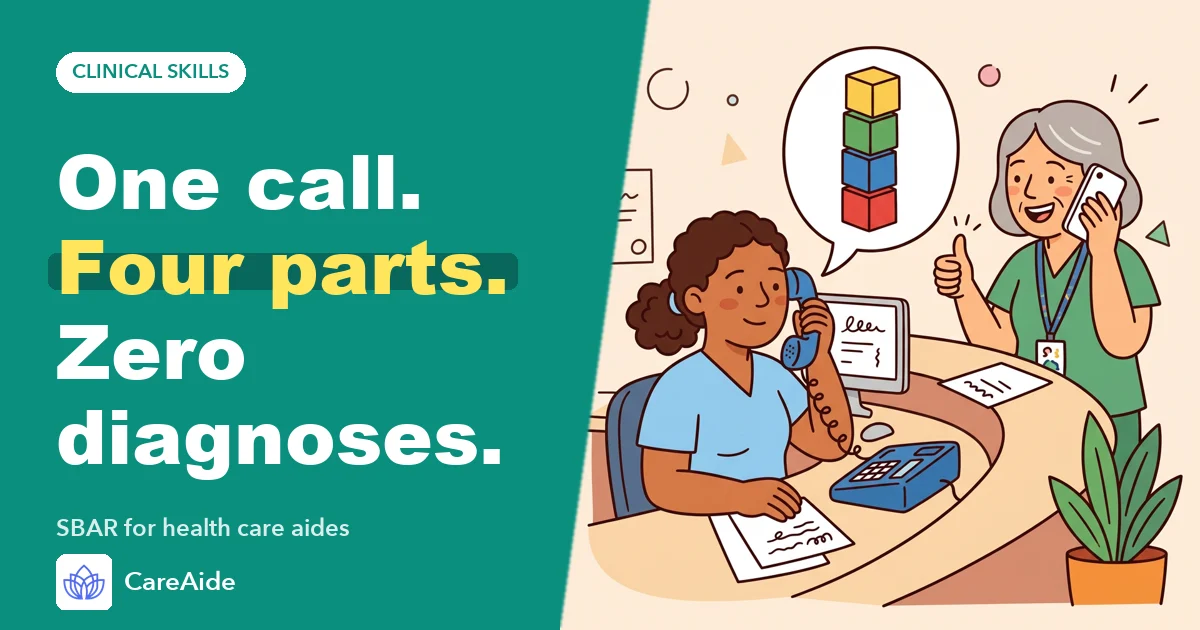
SBAR for health care aides: reporting factual observations without crossing into clinical diagnosis
When a client's condition changes, a regulated health care professional needs a clear, structured report to decide what to do. The SBAR framework gives health care aides a reliable structure for spoken handovers, but using it correctly requires staying strictly within the HCA scope of practice. Knowing how to translate observations into an SBAR report without diagnosing is essential both on the job and on the Alberta HCA exam.
What SBAR means for a health care aide
SBAR stands for Situation, Background, Assessment, and Recommendation. Originally developed for clinical communication, it translates directly into Alberta health care aide practice under competency 4.2.1: "Communicate through a variety of methods: written (electronic/paper, client chart and emails), verbal (telephone and in person)."
Because an aide observes, reports, and documents rather than assessing or diagnosing, the last two letters of SBAR adapt to fit the HCA role. An Alberta health care aide does not make clinical judgements or prescribe interventions. In an aide's report, the Assessment phase presents factual observations and why those observations cause concern, while the Recommendation phase is a request for the nurse to evaluate the client, never a treatment decision.
Adapting Assessment and Recommendation to the HCA scope
Competency 3.4 requires aides to "Report changes in the client to the appropriate regulated health care team member in a timely manner." Under the HCA scope of practice in Alberta, an aide must never diagnose a condition or suggest clinical treatments like medication administration.
When presenting the Assessment line, state plain physical facts: what you saw, heard, or measured, and how it differs from the client's normal baseline. Instead of saying a client has a chest infection or delirium, describe the rapid breathing or new confusion. In the Recommendation line, your request is for action within your role, such as asking the licensed practical nurse to come to the room to examine the client.
A worked example: bad handover vs good handover
Consider a scenario at 14:00 involving an aide named Priya and an older resident named Mr. Chen in room 12. Priya notices that Mr. Chen, who is usually alert and converses easily, is struggling to catch his breath and managing only a few words at a time.
The poor handover (rambling and diagnosing)
Priya calls the nurse: "Hi, I think Mr. Chen in room 12 is having a stroke or maybe getting pneumonia. He seems really off and his chest sounds bad. I think we should give him some oxygen or his PRN inhaler right away because he is deteriorating."
This report fails on multiple levels. Priya offers clinical diagnoses, suggests medication interventions, and fails to give objective baseline comparisons or structured details.
The effective SBAR handover
Priya uses the SBAR model instead:
- Situation: "This is Priya, the health care aide on the east wing, calling about Mr. Chen in room 12. At 14:00, I noticed he has new shortness of breath and difficulty speaking."
- Background: "Mr. Chen is normally alert, speaks clearly, and breathes comfortably on room air."
- Assessment: "He is taking rapid, shallow breaths and could only speak two words at a time before stopping. He appears unsteady while sitting upright. This is a noticeable change from his baseline this morning."
- Recommendation: "Could you please come to room 12 to assess Mr. Chen now?"
This report gives the nurse precise factual observations immediately without crossing any scope boundaries.
How SBAR relates to DARP charting
Spoken communication and written records work together under competency 2.10: "Report and/or record client information in accordance with employer documentation standards and guidelines." SBAR is the spoken handover used for immediate communication with the nurse, while DARP is the written record placed in the client's chart.
The factual details gathered for SBAR become the Data section of your DARP entry. After reporting to the nurse, you record what you observed, the action you took (such as reporting to the LPN), the client's immediate response, and the plan for continued observation. You can read more about written charting in our guide to DARP documentation for health care aides.
SBAR on the Alberta HCA exam
Questions about reporting and teamwork appear primarily in two domains on the Alberta HCA Registration Examination: Communication (12 to 16 per cent) and Collaborative Care (8 to 12 per cent). Most questions are set at the Applying cognitive level (53 to 73 per cent of total marks), presenting a realistic scenario and asking you to select the correct action.
Exam questions testing SBAR often present four choices for what an aide should say to the nurse. The incorrect options usually commit scope violations, such as offering a medical diagnosis, recommending a medication change, or failing to report a significant change in a timely manner. The correct answer will always state factual observations clearly and request a nursing evaluation. You can test your knowledge with free Alberta HCA practice questions.
Common questions
What does SBAR stand for for health care aides?
SBAR stands for Situation, Background, Assessment, and Recommendation. For health care aides, the Assessment phase focuses on factual observations rather than medical diagnoses, and the Recommendation phase requests a nursing evaluation rather than a clinical treatment.
How does an HCA avoid diagnosing when giving an SBAR report?
An HCA avoids diagnosing by describing observable physical facts and changes from the client's normal baseline rather than naming medical conditions. For example, report rapid breathing or new confusion instead of diagnosing pneumonia or delirium.
What is the difference between SBAR and DARP?
For a health care aide in Alberta, SBAR is the structured spoken report given to a nurse or other team member when a client's condition changes. DARP (Data, Action, Response, Plan) is the structured written format used afterwards to document those observations and actions in the client's chart.
Keep reading
-
 Reporting suspected abuse as a Saskatchewan CCA when there is no adult-protection act
Saskatchewan has no adult-protection act. Learn how a CCA reports suspected abuse in a special-care home, protects children and documents events.
Reporting suspected abuse as a Saskatchewan CCA when there is no adult-protection act
Saskatchewan has no adult-protection act. Learn how a CCA reports suspected abuse in a special-care home, protects children and documents events.
-
 Manitoba health care aides: medication and restraint rules in personal care homes
Who may give medication and apply restraints in a Manitoba personal care home, what reserved acts mean, and how a health care aide hands decisions on.
Manitoba health care aides: medication and restraint rules in personal care homes
Who may give medication and apply restraints in a Manitoba personal care home, what reserved acts mean, and how a health care aide hands decisions on.
-
 BC health care assistants: assigned tasks, restricted activities and delegation
BC health care assistants have no legal scope of practice. Learn how assigned tasks, restricted activities and client-specific delegation sort the work.
BC health care assistants: assigned tasks, restricted activities and delegation
BC health care assistants have no legal scope of practice. Learn how assigned tasks, restricted activities and client-specific delegation sort the work.