 CareAide Prep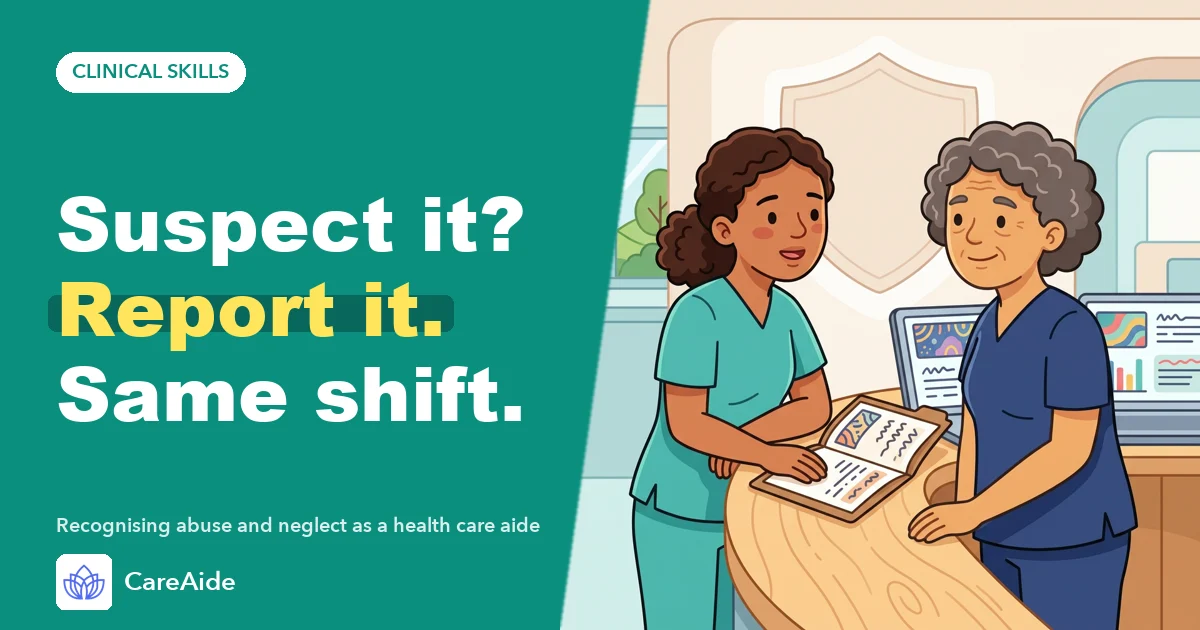
Recognising abuse and neglect as a health care aide in Alberta: what to observe, document and report
Recognising and reporting abuse or neglect is a fundamental safety responsibility for every health care aide working in Alberta. On the Alberta HCA Registration Examination, the Safety domain carries 16 to 20 per cent of the overall marks, placing significant emphasis on protecting vulnerable clients from harm. Health care aides are often the first team members to notice subtle physical or behavioural changes, making immediate and accurate reporting essential.
The categories of abuse and their observable indicators
Health care aides must remain vigilant to five primary forms of maltreatment: physical abuse, emotional abuse, financial abuse, sexual abuse, and neglect. Competency 6.3 states: "Recognize and report signs of abuse and/or neglect." To fulfill this duty, an aide must recognize concrete, factual indicators rather than relying on general impressions.
Physical abuse involves the intentional use of force resulting in bodily harm or discomfort. Observable signs include unexplained bruises, burns, welts, lacerations, fractures, or rope marks, particularly when injuries appear in varying stages of healing or show distinct patterns such as handprints.
Emotional abuse includes verbal aggression, humiliation, isolation, or intimidation. Observable indicators include sudden withdrawn behaviour, extreme fearfulness around specific individuals, cowering, uncharacteristic agitation, or severe distress when certain people enter the room.
Financial abuse occurs when a client's funds or property are misused or stolen. Observable indicators include missing personal belongings, unpaid bills despite adequate funds, sudden changes in legal documents, missing cash from a wallet, or expressed anxiety from the client regarding money management by a relative or caregiver.
Sexual abuse involves any non-consensual sexual contact or exposure. Observable signs include torn or bloody undergarments, bruising around the inner thighs, pelvic pain, difficulty walking or sitting, or sudden fear of physical touch during personal hygiene care.
Neglect is the failure to provide the necessary care, food, medical attention, or shelter required for a client's health and well-being. Observable indicators include unmanaged pressure injuries, severe weight loss, unwashed hair and body, dirty clothing, unaddressed foul odours, dehydration, or missing mobility aids and dentures.
Reporting versus investigating
A health care aide observes, reports, and documents. An aide does not investigate, gather evidence, or confront the suspected individual. The threshold for action is suspicion, not certainty. If an aide suspects that abuse or neglect has occurred or is occurring, the aide is professionally obligated to report the observation immediately. Alberta's Protection for Persons in Care Act also requires reporting of suspected abuse in publicly funded care settings, and your employer's policy will name the exact route.
Delaying a report to verify facts or wait for definitive proof puts the client at continued risk. Investigating is strictly outside the HCA scope of practice in Alberta. Health care aides do not assess, diagnose, or make clinical judgements. When an aide observes physical or behavioural signs, the sole professional obligation is to pass that information promptly to the appropriate authority.
Reporting lines, family members, and colleagues
Reporting is mandatory and cannot be skipped or deferred. An aide reports immediately to the designated regulated health care professional, such as a licensed practical nurse or registered nurse, and follows the employer's established line of reporting. Competency 3.4 directs aides to: "Report changes in the client to the appropriate regulated health care team member in a timely manner."
When the person of concern is a client's family member or visitor, the reporting protocol remains identical. The health care aide does not question the family member or refuse entry independently, but reports the factual observations directly to the regulated professional supervising care.
When the person of concern is a colleague or co-worker, the requirement to report is equally absolute. Professional loyalty never supersedes client safety. If an aide observes a colleague using excessive force, speaking disrespectfully, or ignoring care needs, the aide must report the incident up the administrative reporting line without delay. The aide does not engage in direct confrontation on site.
Consider a practical clinical scenario. At 09:00 in room 114, Health Care Aide Sarah is assisting Arthur with morning hygiene. Sarah observes three distinct, dark blue bruises across Arthur's upper left arm that were not present during yesterday's bath. Arthur winces when the area is touched and whispers that he fell because his evening caregiver was in a hurry. Sarah does not interrogate Arthur about who was working, nor does she question the evening staff. Sarah completes essential care safely, immediately leaves room 114, and verbally reports the exact physical findings and Arthur's statement to the charge nurse.
Objective documentation and standard of practice
Documenting suspected abuse or neglect requires exact, objective wording. Competency 2.10 directs aides to: "Report and/or record client information in accordance with employer documentation standards and guidelines." Competency 6.4 requires aides to: "Report and document incidents, adverse events and/or near misses according to practice setting guidelines and policies."
Documentation must contain facts only: what was seen, what was heard, the exact time, the location of injuries, and the exact words spoken by the client in quotation marks. An aide must avoid subjective conclusions, opinions, or assumptions. Writing "client appears abused" is an improper interpretation. Writing "observed a 3-centimetre red mark on the right cheek; client stated, 'I was slapped'" provides objective data that supports formal review.
Using structured approaches like DARP documentation for health care aides ensures that observation data stays completely separate from actions and reporting plans. When delivering a verbal report to the supervising nurse, applying SBAR for health care aides provides a concise structure for communicating urgent observations clearly.
Common questions
What should a health care aide in Alberta do if they suspect abuse but have no proof?
A health care aide in Alberta must report any suspicion of abuse or neglect immediately to the supervising regulated health care professional. Certainty is not required to initiate a report, and the health care aide must never delay reporting or attempt to investigate the situation independently.
How does an HCA document observed signs of neglect or abuse?
An HCA documents observed signs using objective, factual language without adding personal interpretations or clinical judgements. The HCA records exact client statements in quotation marks, physical observations, dates, and times in accordance with employer documentation standards.
What is the reporting procedure if an Alberta health care aide suspects a colleague of abuse?
If an Alberta health care aide suspects a colleague of abuse, the health care aide must report the observation immediately through the employer reporting line to a regulated health care professional or supervisor. Reporting is mandatory regardless of who the suspected individual is, and the health care aide must not confront the colleague directly.
Keep reading
-
 Manitoba health care aides: medication and restraint rules in personal care homes
Who may give medication and apply restraints in a Manitoba personal care home, what reserved acts mean, and how a health care aide hands decisions on.
Manitoba health care aides: medication and restraint rules in personal care homes
Who may give medication and apply restraints in a Manitoba personal care home, what reserved acts mean, and how a health care aide hands decisions on.
-
 BC health care assistants: assigned tasks, restricted activities and delegation
BC health care assistants have no legal scope of practice. Learn how assigned tasks, restricted activities and client-specific delegation sort the work.
BC health care assistants: assigned tasks, restricted activities and delegation
BC health care assistants have no legal scope of practice. Learn how assigned tasks, restricted activities and client-specific delegation sort the work.
-
 PSW medication in New Brunswick: why home support and nursing homes differ
What a New Brunswick PSW may do about medication in home support and in a nursing home, plus foot care, restraints and how reporting differs.
PSW medication in New Brunswick: why home support and nursing homes differ
What a New Brunswick PSW may do about medication in home support and in a nursing home, plus foot care, restraints and how reporting differs.