 CareAide Prep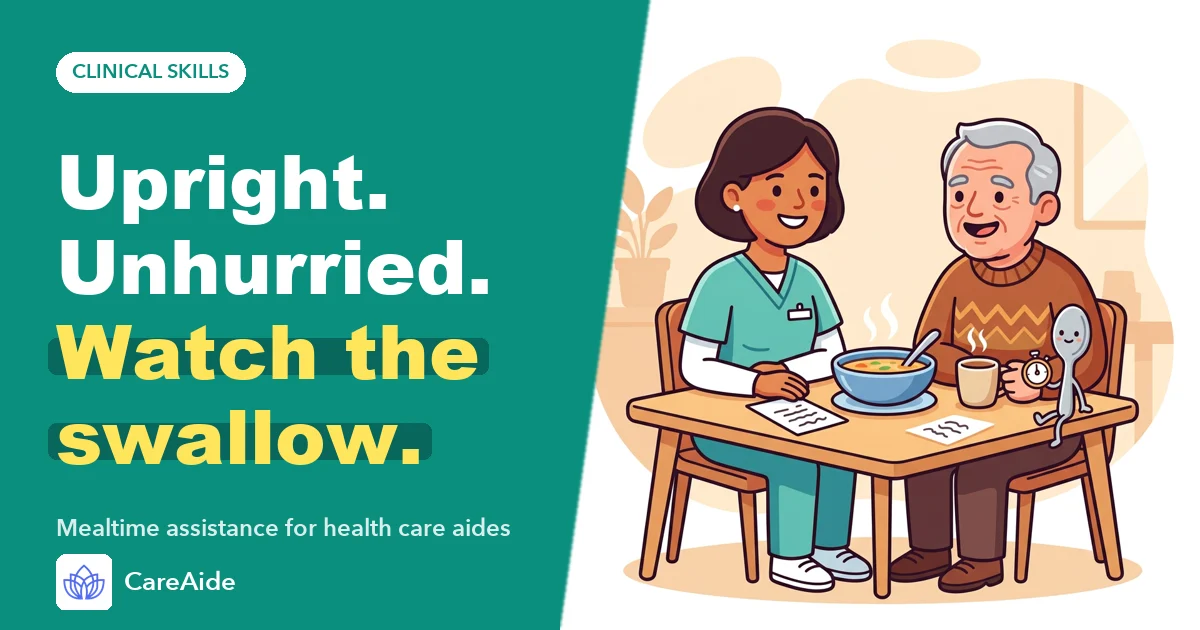
Mealtime assistance for health care aides in Alberta: safe eating, safe food, and what the exam asks
Mealtime assistance requires balancing physical safety with individualized, person-centred care. On the Alberta HCA Registration Examination, scenario questions test whether you can recognize swallowing hazards, maintain safe food handling, and stay strictly within your scope of practice.
Understanding Competency 6.8 and the care plan
In Alberta, safe mealtime care is anchored in Competency 6.8: "Understand and demonstrate the principles of safe food handling and safe mealtime assistance." When supporting a client during meals, a health care aide must always check the individual care plan before serving food or fluids. The care plan details crucial requirements including texture-modified diets, thickened fluid levels, and recorded food allergies.
Assisting with meals also reflects Competency 2.5: "Provide individualized, age appropriate, person-centred care, with a focus on physical, psychological, social, emotional, cognitive, cultural, and spiritual support." For example, at 12:00 PM in Room 104, an aide named Sarah prepares to assist a client named Arthur. Before offering any food, Sarah verifies Arthur's care plan to confirm that he requires minced solids and nectar-thickened liquids.
Positioning, pacing, and bite size
Proper physical positioning is essential to prevent aspiration and choked airways. A health care aide ensures the client sits fully upright at a 90-degree angle, or in high Fowler's position, during all meals and snacks. Clients should remain seated upright for at least 30 minutes after eating to support safe digestion.
Pacing must always be unhurried and led by the client. An aide offers small bites and small sips, ensuring the client has completely swallowed before offering the next portion. Rushing a meal increases the risk of choking and undermines person-centred care. Guidelines on positioning techniques can be reviewed alongside safe patient handling for health care aides.
Recognizing swallowing difficulties and handling emergencies
Health care aides observe clients closely for any signs of dysphagia or swallowing difficulty. Key indicators that must be reported straight away include:
- Coughing, choking, or throat clearing during or after swallowing
- A wet or gurgly voice after taking food or drink
- Pocketing food inside the cheeks
- Watery eyes, reddening face, or delayed swallowing attempts
If a client begins coughing or choking, the aide stops the meal immediately and responds in accordance with Competency 6.1: "Prevent, recognize, and respond to emergencies, safety hazards, and unsafe situations that may endanger the HCA and/or the client." If an emergency occurs or if swallowing difficulties appear, the aide immediately alerts a regulated health care professional.
Scope boundaries: observing versus assessing
A health care aide observes, reports, and documents; an aide never assesses, diagnoses, or makes clinical judgements. Assessing swallowing ability or changing a fluid thickness level is a clinical decision made by regulated health care professionals, such as a speech-language pathologist or registered nurse. An aide adheres strictly to Competency 3.4: "Report changes in the client to the appropriate regulated health care team member in a timely manner." Understanding these limits is fully explained on the HCA scope of practice in Alberta page.
Food safety basics and exam scenario patterns
The food-safety half of Competency 6.8 covers basic hygiene and storage principles. Aides must perform thorough hand hygiene before handling food, maintain correct hot and cold food storage temperatures, clean preparation surfaces, and prevent cross-contamination. On the Alberta HCA Registration Examination (AHRE), administered by Meazure Learning for the College of Licensed Practical Nurses and Health Care Aides of Alberta (CLHA), mealtime questions are usually presented as clinical scenarios. These test your ability to apply safety rules in practice. You can prepare for these scenarios using free Alberta HCA practice questions.
Common questions
How does the Alberta HCA exam test mealtime assistance?
The Alberta HCA Registration Examination presents scenario-based questions that evaluate your ability to apply safe mealtime techniques and recognize choking risks. Candidates must select options that demonstrate proper positioning, careful observation, and strict adherence to the client's established care plan.
What should a health care aide do if a client shows signs of swallowing difficulty?
When a health care aide observes signs of swallowing distress like coughing or a wet vocal quality, they must stop feeding immediately and report the change to a regulated health care professional. Aides observe and document changes but do not perform clinical swallowing assessments or alter prescribed dietary textures independently.
What are the primary food safety responsibilities for a health care aide in Alberta?
A health care aide in Alberta protects clients by practicing strict hand hygiene, maintaining safe food storage temperatures, and ensuring clean food preparation surfaces. Following these basic principles prevents foodborne illness while supporting overall safe mealtime delivery.
Keep reading
-
 Manitoba health care aides: medication and restraint rules in personal care homes
Who may give medication and apply restraints in a Manitoba personal care home, what reserved acts mean, and how a health care aide hands decisions on.
Manitoba health care aides: medication and restraint rules in personal care homes
Who may give medication and apply restraints in a Manitoba personal care home, what reserved acts mean, and how a health care aide hands decisions on.
-
 BC health care assistants: assigned tasks, restricted activities and delegation
BC health care assistants have no legal scope of practice. Learn how assigned tasks, restricted activities and client-specific delegation sort the work.
BC health care assistants: assigned tasks, restricted activities and delegation
BC health care assistants have no legal scope of practice. Learn how assigned tasks, restricted activities and client-specific delegation sort the work.
-
 PSW medication in New Brunswick: why home support and nursing homes differ
What a New Brunswick PSW may do about medication in home support and in a nursing home, plus foot care, restraints and how reporting differs.
PSW medication in New Brunswick: why home support and nursing homes differ
What a New Brunswick PSW may do about medication in home support and in a nursing home, plus foot care, restraints and how reporting differs.