 CareAide Prep
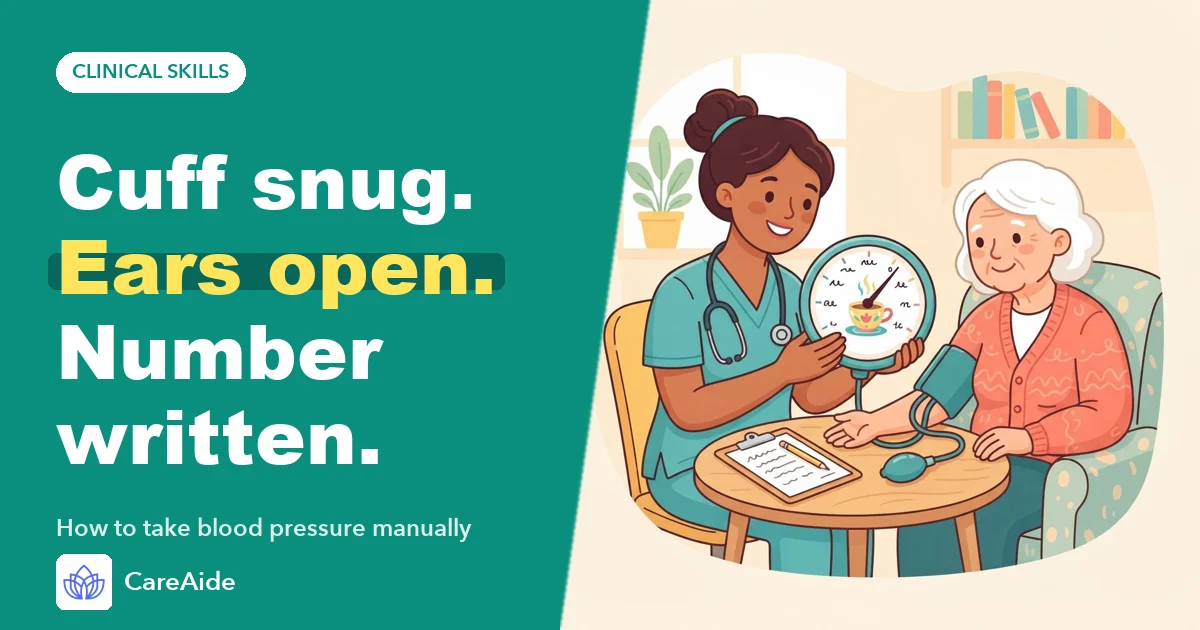
How to take blood pressure manually: preparation, steps, recording and what a care aide reports
To take blood pressure manually, a care aide who has been assigned the task rests the resident, supports the arm at heart level, fits the right cuff over the brachial artery, inflates it, lets the air out slowly while listening with a stethoscope, then records the readings and reports concerns. This guide sets out each step in order.
- When it applies
- Only when your care plan and employer assign blood pressure to you
- Equipment
- A cuff of the right size, a sphygmomanometer and a stethoscope
- Resident position
- Rested for at least 5 minutes, feet on the floor, arm supported at heart level
- Deflation
- A steady 2 to 3 mmHg per second
- Afterwards
- Tell the resident the reading, record it, and report concerns to the nurse or supervisor
How do you take blood pressure manually?
Taking blood pressure manually means using a cuff, a gauge and a stethoscope to listen for the sounds of blood flow in the artery of the upper arm. The first sound you hear is recorded as the systolic number, and the point where the sounds go silent is recorded as the diastolic number. A care aide does this only when the care plan and the employer assign it. The aide measures, records and reports. The nurse decides what a reading means.
A checklist from the open textbook Open RN Nursing Skills says that agency policy governs this skill. Where your employer's method differs from a textbook, follow your employer's method.
How do you prepare the resident and the equipment?
Good preparation prevents most bad readings. Use the same routine as for any care task: knock, clean your hands, introduce yourself, explain what you are about to do and ask for consent. Then work through the points below.
- Have the resident sit quietly for at least 5 minutes, relaxed, with both feet on the floor.
- Ask which arm the resident prefers. Avoid an arm that has a contraindication, for example a previous mastectomy or a fistula. If you are unsure, ask the nurse.
- Support the arm at heart level.
- Expose bare skin. Do not take a reading through clothing, and do not roll a sleeve so tight that it squeezes the arm.
- Clean the stethoscope and check that the bell or diaphragm is open.
The textbook also describes how to choose a cuff. It says the cuff width should be 40% of the arm circumference, and the length of the bladder should be 80 to 100% of the arm circumference, according to the checklist. If the cuff you have does not fit, ask for another size rather than using the wrong one.
What are the steps for a manual blood pressure?
The Open RN checklist and the Toronto Metropolitan University open book Vital Sign Measurement Across the Lifespan describe the same sequence.
- Centre the bladder of the cuff over the brachial artery, with the lower edge about 1 inch above the bend of the elbow. Fit it evenly and snugly.
- Find the pulse in the arm. Inflate the cuff quickly while you feel the pulse, and note the pressure where it disappears.
- Release the air, then wait 30 seconds.
- Place the stethoscope lightly on the brachial artery. The Toronto book says to use the bell with a light touch and a complete seal, or the diaphragm with firm pressure.
- Inflate the cuff to 30 mmHg above the pressure where the pulse disappeared.
- Open the valve slightly and let the air out slowly. The Open RN checklist gives 2 to 3 mmHg per second, and the Toronto book says about 2 mm Hg per second. A steady, slow rate is what matters.
- The first clear sound you hear is the systolic pressure. Note the number on the gauge.
- Keep deflating at the same rate. The point where the sounds disappear completely is the diastolic pressure. Note that number too.
- Deflate the cuff fully and remove it.
Steps two to five are often called the two-step technique. The Toronto book explains that you find the maximum inflation value first, and then fully deflate before you measure. A one-step technique inflates past the pulse and measures in a single pass, and your employer's policy decides which method you use. Whichever you use, the aim is the same: a slow, steady release of air and a clear note of where the first and last sounds occur.
Some people have a silent gap between the sounds. The Toronto book says to record the first systolic sound and the diastolic sound, and to note the gap in narrative notes. If the sounds continue all the way down to zero, the same book says to use the point where they become muffled as the diastolic reading. Tell the nurse when you see either of these.
What do you do after the reading?
Tell the resident the reading if your employer allows it, which the checklist includes as part of finishing the task. Clean the equipment and clean your hands. Then record the numbers exactly as you read them, with the arm used, the position of the resident and the time, according to your employer's documentation standards.
Do not round the numbers to look tidier, and do not guess a number you missed. The textbooks do not say how many repeat attempts are allowed, so ask your employer what its policy says, and ask for help if you cannot get a clear reading.
What should a care aide report?
The checklist says to document findings and report significant deviations according to agency policy. A care aide does not decide whether a number is good or bad. You report any reading that your care plan flags or that is different from what you usually see for that resident, as well as anything you observe that worries you.
In a facility, tell the nurse or the person supervising your care. In home care there may be no nurse on site, so follow your employer's process and contact your supervisor or case manager. Call 911 or the emergency number your employer gives you in an emergency. The guide to normal vital signs for adults covers the ranges and what to report, and the guide to SBAR shows how to put a report into words.
What mistakes cause wrong readings?
- Measuring before the resident has rested.
- Holding the arm below or above heart level.
- Using a cuff that is too small or too large.
- Placing the cuff over clothing.
- Letting the air out too fast.
- Pressing the stethoscope so hard that it squeezes the artery, or placing it loosely so that the seal is poor.
- Not waiting after the first palpated inflation before the second inflation.
- Recording a rounded or remembered number instead of the one you read.
How does this appear on a care aide exam?
Exam questions on blood pressure test the care aide's role more than the arithmetic. A typical question describes a resident with a reading that looks unusual and asks what the aide does. The right answer is to report the reading to the nurse and record it, without trying to treat it, diagnose it or change anything in the care plan. Other questions test preparation: resting the resident, arm at heart level, correct cuff size, and a slow, steady deflation.
CareAide offers exam practice on observation, measurement and reporting for care aides across Canada, and it is free to start. It is practice for your exam, not a substitute for the skills training your program gives you.
Common questions
How fast should the cuff be deflated when taking blood pressure manually?
A health care aide or PSW deflates the cuff at a steady 2 to 3 mmHg per second while listening with the stethoscope. The first clear sound is the systolic and the point where sounds disappear is the diastolic.
How long should a resident rest before a manual blood pressure?
A health care aide or PSW has the resident sit quietly for at least 5 minutes before measuring, relaxed, with both feet on the floor and the arm supported at heart level.
Which arm should a care aide not use for blood pressure?
A health care aide or PSW avoids an arm with a contraindication such as a previous mastectomy or a fistula. Ask the resident which arm they prefer, and ask the nurse if unsure.
Can a care aide interpret a blood pressure reading?
No. A health care aide or PSW measures, records and reports the reading according to employer policy. The nurse assesses what the reading means, and the aide never diagnoses or changes the care plan.
Keep reading
-
 Signs of dehydration in older adults: what a care aide notices, offers and reports
Signs of dehydration in older adults for care aides: dry mouth, less urine, dizziness and tiredness. What to offer per the care plan and what to report.
-
 How to give a bed bath: privacy, water temperature, order of washing and what to report
How to give a bed bath step by step: privacy, water no hotter than 105 F (40.5 C), cleanest to dirtiest order, drying, and skin changes to report.
-
 Fire safety in long term care: RACE, PASS and the care aide's role
Fire safety in long term care for care aides: what RACE and PASS mean, when not to fight a fire, why elevators are avoided, and following your home's plan.