 CareAide Prep
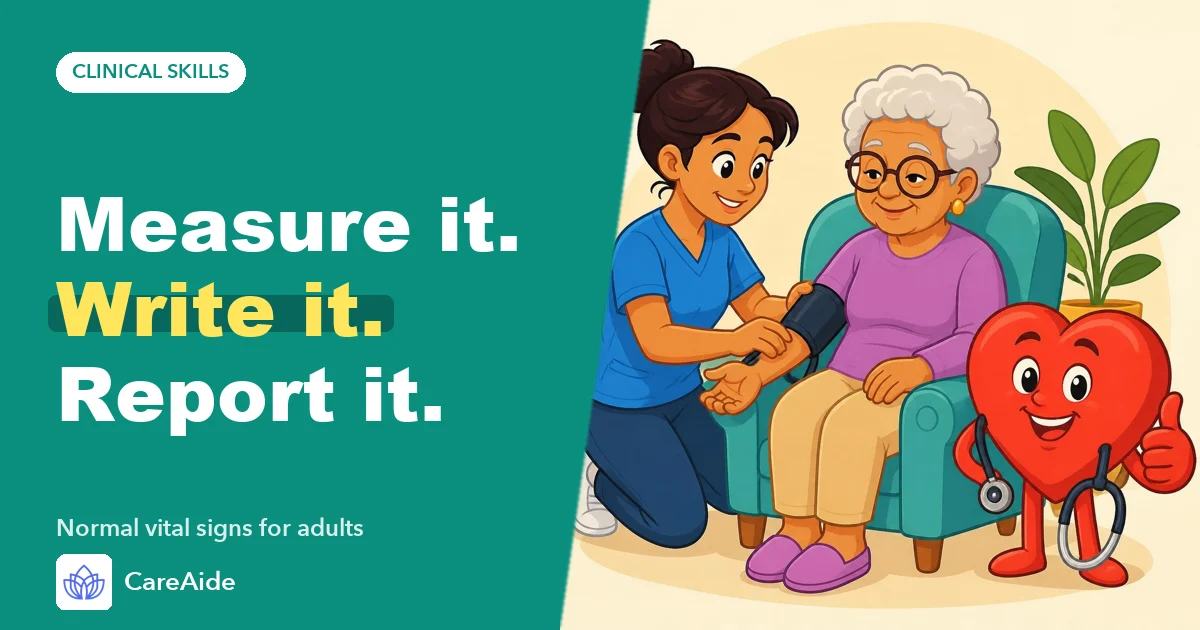
Normal vital signs for adults: the ranges, and what a care aide measures and reports
Normal vital signs for adults at rest are a pulse of 60 to 100 beats per minute and 10 to 20 breaths per minute, with temperature and blood pressure ranges that vary by source. A care aide measures only when assigned, records exactly, compares the result with the client's usual values and reports anything outside them to the nurse or supervisor.
- Adult pulse
- 60 to 100 beats per minute at rest, according to both open textbooks used here
- Adult breathing
- 10 to 20 breaths per minute at rest, according to both books
- Adult temperature
- About 36.1 to 37.2 °C in one book, 36.5 to 37.5 °C in the other, depending on the method
- Blood pressure
- 120/80 is only an average, and the books disagree on the exact normal range
- Your role
- Measure only when assigned, record exactly, and report to the nurse or your supervisor
What are the normal vital signs for adults?
Vital signs are measurements that show how the body is working: temperature, pulse, breathing and blood pressure. Many workplaces also check oxygen saturation. The table below shows the usual adult ranges at rest.
The ranges come from two open textbooks that anyone may read. One is the WisTech Open text Nursing Assistant, which is shared under a CC BY 4.0 licence. The other is Vital Sign Measurement Across the Lifespan, 2nd Canadian edition, published by Toronto Metropolitan University and also under a CC BY 4.0 licence. Where the two books differ, the table shows both.
| Vital sign | According to Nursing Assistant (WisTech Open) | According to Vital Sign Measurement, 2nd Canadian edition |
|---|---|---|
| Temperature | Average 37 °C. Normal 36.1 to 37.2 °C. Oral 35.8 to 37.3 °C | Adult normal 36.5 to 37.5 °C. Oral 35.8 to 37.3 °C |
| Pulse at rest | 60 to 100 beats per minute | 60 to 100 beats per minute |
| Breathing at rest | 10 to 20 breaths per minute | 10 to 20 breaths per minute |
| Blood pressure | Normal 91 to 129 over 61 to 89 mm Hg | Ages 19 to 40: 95 to 135 over 60 to 80. Ages 41 to 60: 110 to 145 over 70 to 90. Ages 61 and older: 95 to 145 over 70 to 90 |
| Oxygen saturation | Not covered | 97 to 100% in a healthy person. About 95% can be acceptable for someone over 70 |
Source: the two published books named above. Notice that the books do not match exactly. The Canadian book says that its ranges are generous and that you should always check the ranges used where you work. Your employer's policy and the client's care plan come first.
Why does the client's own baseline matter?
A normal range is a guide for a group of people. It does not describe one person. The Canadian textbook says that the 120/80 figure is only an average, and that the provider should consider the client's baseline and current health. It gives an example: 90/50 may be normal for a healthy 20-year-old.
The same book says that older adults tend to have lower body temperatures. It also says that blood pressure tends to rise with age, and that an oxygen saturation level of about 95% may be acceptable in someone over 70. People who have lung or heart conditions may have lower oxygen saturation levels than others.
So the care plan matters. It may list the client's usual readings or the numbers at which you must report. Read it before you measure, and ask the nurse or your supervisor if the plan does not say.
Is a care aide allowed to measure vital signs?
It depends on your province, your employer and what a regulated health care professional has assigned to you. Tasks vary. Measure vital signs only when your employer's policy allows it, you have been trained, and the task is assigned for that client.
Taking a measurement is not the same as deciding what it means. The aide measures, records and reports. The nurse decides what the reading means and what happens next. An aide does not diagnose, does not choose treatment and does not change a client's medication.
How do you take accurate measurements?
A wrong number can be worse than no number, because someone may act on it. The Canadian textbook gives these tips.
- Blood pressure, rest first. The client sits for five minutes before the measurement. The feet are flat on the floor, the back is supported and the legs are not crossed. The client does not talk or move during the reading.
- Blood pressure, arm and cuff. Use bare skin, not clothing under the cuff, and keep the arm at heart level. Choose the cuff for the arm size, not the age. A cuff that is too narrow can give a falsely high reading, and a cuff that is too loose can give a falsely low one.
- Blood pressure, other errors. The book lists an arm held above the level of the heart, which can give a falsely low reading, and an arm held below it, which can give a falsely high one. It also notes that blood pressure returns to baseline within five minutes of rest after activity.
- Pulse. Use the pads of your first three fingers, not your thumb. The book says to count for 30 seconds if the rhythm is regular and for one full minute if it is irregular.
- Breathing. Count after taking the pulse so the client is not aware of it. The book says to count for 30 seconds if regular and for a full minute if irregular.
- Oxygen saturation. Nail polish or artificial nails can affect a finger probe. Cold hands or poor circulation can give a falsely low reading. The pulse shown on the device should match the pulse you feel.
Write down the time of the reading and the circumstances. If the client was upset, in pain or had just been active, record that. The textbook notes that blood pressure is lower in the morning and rises through the day, which is one reason the time is recorded.
What should you report?
Report right away anything outside the range in the care plan, anything outside the client's usual values, and any sudden change. The WisTech text gives these examples for adults: report a pulse below 60 or above 100, a breathing rate below 10 or above 20, a temperature above 38 °C (100.4 °F), and a blood pressure outside the normal range.
Also report what you see. A client who is pale, confused, short of breath, in pain or sweating tells the nurse more than a number alone. The textbook lists loud breathing, nasal flaring and pulling in of the muscles between the ribs as signs of respiratory distress. Describe them. Do not label them.
- In a facility, tell the nurse or the person supervising your care, then document what you measured and saw according to your employer's policy.
- In a client's home, there may be no nurse on site. Tell your supervisor or the case manager. If the client seems to be in an emergency, for example struggling to breathe or not responding, call 911 and follow your employer's emergency procedure.
Do not guess, and do not round
If a reading looks odd, check your technique before you report it. Is the cuff the right size? Was the client resting? Are the probe and the finger clean and warm? Then report both the number and the circumstances. If you are unsure, repeat the measurement only if your policy allows it, and tell the nurse what you did.
Never change a number to make it look normal. Record what you measured. Honest records protect the client, and they protect you.
How does this appear on the exam?
Exam questions usually ask what you do, not what the number means. Expect a client whose reading is outside the usual range or a client whose reading is normal but who looks unwell. The safe answer is to report promptly to the nurse or the supervisor. The unsafe answers are to decide the client is fine, to give advice about treatment or to wait until the end of the shift. For more on where the aide's role stops, read the guide to HCA scope of practice in Alberta and the note on PSW scope of practice in Ontario.
You can practise these situations with the Alberta HCA exam practice questions. CareAide is free to start, and every answer has an explanation.
Common questions
What is the normal pulse for an adult?
For an adult, a health care aide or PSW can expect a normal pulse of 60 to 100 beats per minute at rest. The Canadian textbook calls its ranges generous and says to consider the client's own baseline. Report a pulse outside the care plan range or the client's usual to the nurse or your supervisor.
What is a normal blood pressure for an older adult?
For adults 61 and older, a health care aide or PSW can compare readings with the Canadian textbook, which lists 95 to 145 over 70 to 90 mm Hg and says 120/80 is only an average. The WisTech text gives a single adult range of 91 to 129 over 61 to 89. Ranges differ between sources, so use the one in the care plan and your employer's policy.
Can a care aide take vital signs?
For a health care aide or PSW, it depends on the province, the employer and what a regulated health care professional assigns. Measure only if your policy allows it, you are trained and the task is assigned for that client. The aide measures, records and reports, and the nurse decides what the reading means.
How long should you count a pulse or breathing rate?
A health care aide or PSW counting a pulse follows this rule: the Canadian textbook says to count for 30 seconds when the rhythm is regular and for a full minute when it is irregular. Use your employer's method if it differs.
What do you do if a client's vital signs are abnormal?
A health care aide or PSW should report right away to the nurse or the person supervising your care and record what you measured and saw. In a home with no nurse on site, tell your supervisor or case manager, and call 911 if it looks like an emergency.
Keep reading
-
 Occupied bed making procedure for care aides: step by step, with the client still in bed
The occupied bed making procedure for care aides, step by step: privacy, rails, turning, clean linen, safe linen handling, and what to observe and report.
-
 Perineal care steps for care aides: privacy, direction of cleaning, and what to report
Perineal care steps for care aides: consent, privacy, gloves, front to back for female clients, foreskin care for male clients, and what to report.
-
 Mouth care for bedridden patients: positioning, dentures, swabs and what to report
How care aides give mouth care for bedridden patients: positioning per the care plan, brushing, denture care, swabs, lip care and what to report to the nurse.