 CareAide Prep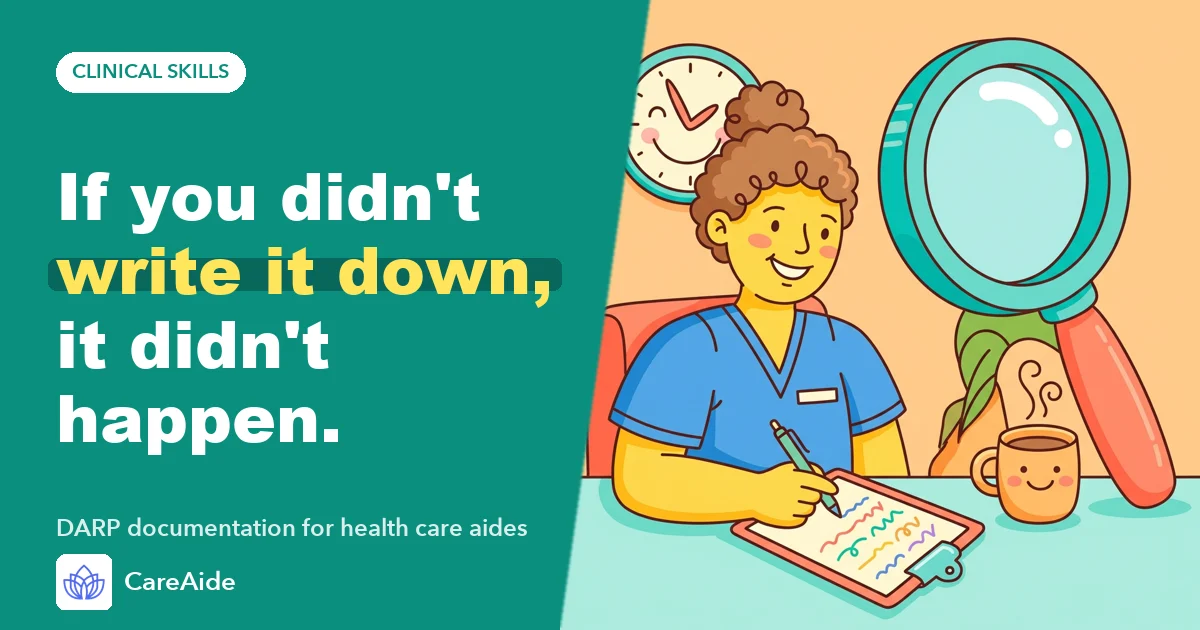
DARP documentation for health care aides: why interpretation costs the most marks
Almost every weak DARP note fails in the same place. The writer puts a conclusion in the Data line, and everything after it inherits the mistake.
What the four letters ask for
Data is what you observed and what the client said. Action is what you did. Response is what happened as a result. Plan is what should happen next or what you reported. The structure exists so that somebody reading later can separate what was seen from what was concluded, which is the whole point of a clinical record.
The error that costs most marks
Writing "client was agitated" in the Data line is an interpretation. What you observed was that the client raised their voice, pushed the tray away, and asked repeatedly to go home. Agitated is your reading of those facts, and it may be right, but it is not data.
This matters beyond the examination. A reader three days later can do something useful with the specific behaviours and can form their own judgement. They can do nothing with your adjective except accept it. The habit that fixes it is simple: if you could not have photographed it or quoted it, it is not Data.
Where scope shows up in a note
A health care aide observes, reports and documents. A note that records a diagnosis, or that describes deciding on treatment, is outside scope regardless of how well written it is. Medication belongs in a note only as assistance provided as assigned by a regulated health care professional, never as a decision the aide made.
The Plan line is where this most often goes wrong. Plan does not mean your clinical plan. It usually means what you reported and to whom, and what is scheduled to follow.
Being specific without being long
Good notes are short. Time, what was observed, what was done, what followed, who was told. Vague words like "well", "fine", "as usual" and "poor" carry almost no information; replace them with what you actually saw. "Ate approximately half of lunch" beats "poor intake" because the next reader can compare it to yesterday.
Quotation is powerful and underused. If a client says something that matters, write the words in quotation marks rather than summarising them. A summary is another interpretation.
Why this is examined at all
Reporting and documenting to employer standards sits in the competency profile, and the reasoning is the same as for everything else in the Safety and Provision of Care domains: the aide is the person who sees the client most. A record that separates observation from conclusion is what makes that presence useful to everybody else on the team.
SBAR does the same job for a spoken handover, and the two are worth practising together. Scope boundaries are set out on the scope of practice page.
Common questions
What goes in the Data line of a DARP note?
What the health care aide observed and what the client said, in specific terms. If you could not have photographed it or quoted it, it is not Data. Writing "client was agitated" is an interpretation; the raised voice, the pushed-away tray and the repeated request to go home are the data.
What is the most common DARP mistake?
Putting a conclusion in the Data line. Everything after it inherits the error, and a later reader of a health care aide’s note can do nothing with an adjective except accept it, whereas they can act on the specific behaviours.
What belongs in the Plan line?
Usually what you reported and to whom, and what is scheduled to follow. Plan does not mean the aide’s clinical plan; deciding on treatment is outside a health care aide’s scope.
Keep reading
-
 Reporting suspected abuse as a Saskatchewan CCA when there is no adult-protection act
Saskatchewan has no adult-protection act. Learn how a CCA reports suspected abuse in a special-care home, protects children and documents events.
Reporting suspected abuse as a Saskatchewan CCA when there is no adult-protection act
Saskatchewan has no adult-protection act. Learn how a CCA reports suspected abuse in a special-care home, protects children and documents events.
-
 Manitoba health care aides: medication and restraint rules in personal care homes
Who may give medication and apply restraints in a Manitoba personal care home, what reserved acts mean, and how a health care aide hands decisions on.
Manitoba health care aides: medication and restraint rules in personal care homes
Who may give medication and apply restraints in a Manitoba personal care home, what reserved acts mean, and how a health care aide hands decisions on.
-
 BC health care assistants: assigned tasks, restricted activities and delegation
BC health care assistants have no legal scope of practice. Learn how assigned tasks, restricted activities and client-specific delegation sort the work.
BC health care assistants: assigned tasks, restricted activities and delegation
BC health care assistants have no legal scope of practice. Learn how assigned tasks, restricted activities and client-specific delegation sort the work.