 CareAide Prep
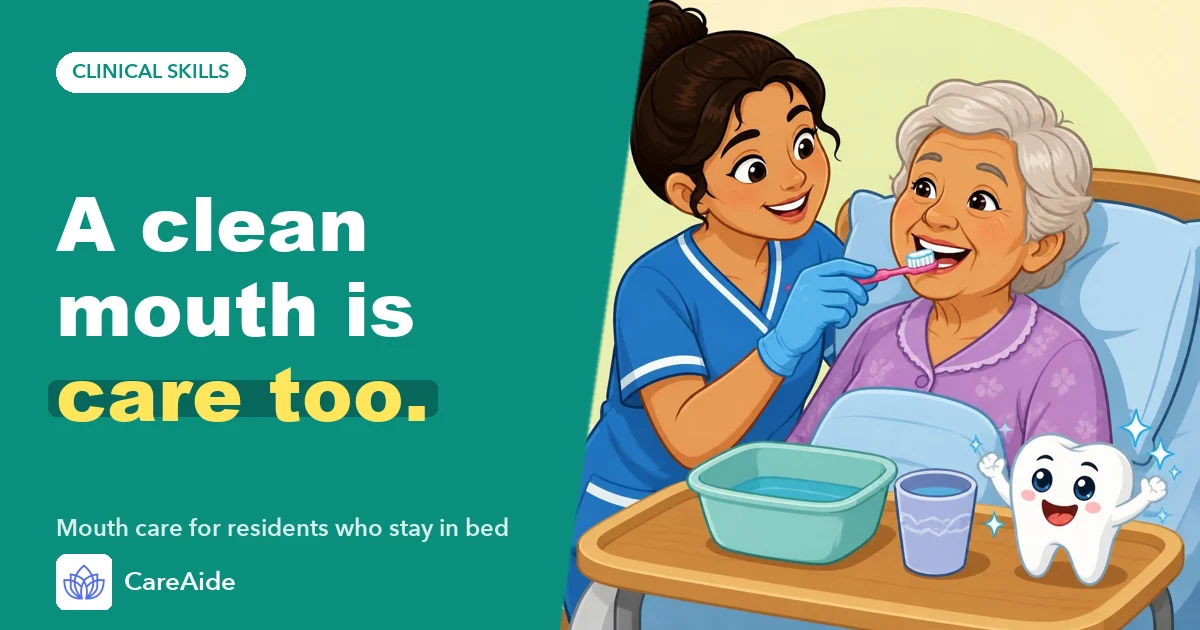
Mouth care for bedridden patients: positioning, dentures, swabs and what to report
Mouth care for bedridden patients means keeping the teeth, tongue, gums, dentures and lips clean and comfortable, in the position the care plan allows. A care aide brushes gently with a small amount of toothpaste, cares for dentures and reports any change in the mouth to the nurse or supervisor.
- Routine mouth care
- Brush teeth, clean the tongue gently and report oral changes, as the care plan directs
- In bed
- Raise the head of the bed if the care plan allows it
- Toothpaste
- A small amount on a wet toothbrush
- Dentures
- Handle over a lined sink, clean, then store in a rinsed cup with cool, clean water
- Near the end of life
- A moist swab for mouth care and lip moisturizer, as the care plan directs
How do you give mouth care to a bedridden patient?
Mouth care for a bedridden client follows the same steps as mouth care for anyone: set up, position the person, brush gently, clean the tongue, and report what you notice. The care plan tells you how, because each client is different. This guide uses the WisTech Open textbook Nursing Assistant and a Canadian research review, and it shows where an aide's work stops and the nurse's work begins.
Why does mouth care matter so much?
A Canadian systematic review, published in the Canadian Journal of Dental Hygiene in 2023, reports that nursing home acquired pneumonia is the leading cause of death among residents of long-term care homes. The authors list poor oral hygiene and denture use among the extra risk factors for aspiration pneumonia. They also report that most residents depend on staff to remove bacterial plaque from the mouth every day.
The review concludes that removing plaque and debris from the teeth, gums and dentures of long-term care residents is effective in reducing oral infections and related pneumonia. It suggests that caregivers and health care aides can provide mouth care twice per day for dependent residents. Treat that as research, not as your employer's rule. Your care plan sets the schedule for your client.
What do you need before you start?
The WisTech Open oral care checklist lists the supplies. Gather them first so you never leave a client alone in the middle of care.
- Gloves
- Toothbrush and toothpaste
- An emesis basin (a small curved basin) and a cup of water
- A towel to protect the client's clothing
- A barrier, such as a paper towel, for your supplies
- A linen bag or hamper
Wash your hands, introduce yourself, give privacy and explain what you will do, even if you think the client cannot hear you.
How should a client be positioned for mouth care?
The WisTech Open checklist says that if the resident is in bed, you elevate the head of the bed if the care plan permits it. That phrase is important. Some clients have a plan that limits how high the head can be raised, and some have a plan for lying on one side. Position the client as the care plan says, and do not choose a different position on your own.
If you are not sure how this client should be positioned, ask the nurse or the person supervising your care before you begin. Also ask if the client has any swallowing problem. If a client coughs or chokes during care, stop, make the client safe, and report it right away. In an emergency, follow your employer's emergency procedure and get help at once.
Our guide on mealtime assistance covers swallowing signs that aides notice at meals. The same signs matter during mouth care.
What are the steps for brushing a client's teeth in bed?
These steps come from the WisTech Open oral care checklist. Your employer may add to them.
- Put on gloves and place your supplies on a barrier.
- Raise the head of the bed if the care plan permits it.
- Cover the client's chest with a towel.
- Wet the toothbrush and apply a small amount of toothpaste.
- Brush the inner, outer and chewing surfaces of all upper and lower teeth.
- After each quarter of the mouth, let the client rinse and spit into the basin if the client can do so.
- Clean the tongue, taking care not to cause gagging.
- Help the client rinse, then wipe the mouth with the towel.
- Rinse and store the equipment, remove your gloves and wash your hands.
Notice the words "if needed" and "if the client can do so". A client who cannot rinse and spit safely needs a different method, and the care plan should say what it is. Do not pour water into the mouth of a client who may not swallow well. Ask first.
When are swabs used?
A swab is a small sponge or cotton tip on a stick. In the WisTech Open denture care checklist, a wet oral swab is used to gently clean the gums and tongue. In its end-of-life chapter, the book says that a client who breathes with the mouth open needs oral care with a moist swab, and it names an hourly schedule for that situation.
Use a swab only where the care plan says to use one. Keep it moist, not dripping, and wipe gently. Your employer may have a policy that differs from a textbook, and the employer's policy comes first.
How do you care for dentures?
The WisTech Open denture checklist gives a clear order of steps.
- Line the sink with a washcloth or paper towel. A dropped denture can break on a hard surface.
- Take the dentures from the cup or from the client's mouth and place them in a denture cup or basin.
- Handle them carefully to avoid damage or contamination.
- Brush all surfaces with a denture brush. Denture toothpaste is used if available, and water alone is acceptable if it is not.
- Rinse with clean, cool water.
- Use a wet swab to gently clean the gums and tongue.
- Put the dentures back in the mouth if the client wishes.
- In the evening, store the dentures in a rinsed cup covered with cool, clean water.
Label the cup with the client's name according to your employer's policy, so dentures never go to the wrong person.
How do you care for the lips and mouth near the end of life?
The WisTech Open end-of-life chapter says that because the jaw opens and the client breathes with the mouth open, oral care with a moist swab should be done hourly. It adds that you may consider applying lip balm or another moisturizer at the same time.
Those are textbook directions. In your workplace, the care plan and the nurse decide what products and what schedule to use. Your part is to be gentle, to keep the mouth and lips comfortable, and to report changes. Our guide on end of life care for health care aides explains the wider role of the aide at this time.
What should you observe and report?
The WisTech Open checklists end with the same step: document and report any oral issues or changes noted with the resident. You do not diagnose what you see. You describe it in plain words, and the nurse decides what it means.
Things to report, in your own clear words:
- Sores, white patches, redness or swelling in the mouth
- Bleeding from the gums or the mouth
- A loose tooth, or dentures that no longer fit or are cracked
- Coughing or choking during mouth care
- Trouble swallowing, or saliva that pools in the mouth
- A client who winces, pulls away or says the mouth hurts
- A very dry mouth or cracked lips
- A client who now refuses mouth care
Report to the nurse or the person supervising your care. In home care there may be no nurse on site, so tell your supervisor or the case manager, and call 911 in an emergency such as a client who cannot breathe. Then record what you saw and did, following your employer's rules for charting.
How do you handle a client who refuses or resists?
Responsive behaviours, such as turning the head away or clamping the mouth shut, are a way of telling you something. The client may be in pain, afraid or tired. Slow down, explain again, and try a calmer time. Do not force a toothbrush into a closed mouth. Report the refusal and the reason you think it happened, as the care plan directs.
What does the exam ask about mouth care?
Exam questions about mouth care usually test a few ideas: follow the care plan, protect the client's safety and dignity, wear gloves and wash your hands, and report changes instead of treating them. An answer that has the aide treat a mouth sore or decide on a medication is wrong, because those decisions belong to a regulated health care professional.
You can practise this kind of question with CareAide, which is free to start. Each question has a short explanation of why the right answer is right.
Common questions
How often should mouth care be given to a bedridden client?
Follow the care plan, because it sets the schedule for each client. A 2023 review in the Canadian Journal of Dental Hygiene suggests that caregivers and health care aides can provide mouth care twice per day for dependent long-term care residents. The WisTech Open textbook names an hourly moist swab for a client near the end of life who breathes with the mouth open.
How should a bedridden client be positioned for mouth care?
A health care aide or PSW positions the client as the care plan directs. The WisTech Open oral care checklist says to elevate the head of the bed if the care plan permits it. If you are unsure, ask the nurse or the person supervising your care before you begin.
How do you clean dentures for a client in bed?
For denture care, a health care aide or PSW lines the sink with a washcloth or paper towel, handle the dentures carefully, and brush all surfaces with a denture brush. Rinse with clean, cool water. In the evening, store them in a rinsed cup covered with cool, clean water, as the WisTech Open denture checklist describes.
What should a health care aide report after mouth care?
A health care aide or PSW reports any oral issues or changes you notice, such as sores, bleeding, a loose tooth, coughing or choking, trouble swallowing, pain or very dry lips. Describe what you saw in plain words and record it. The nurse decides what it means.
Can a health care aide use swabs for mouth care?
A health care aide or PSW uses swabs only as the care plan and your employer's policy say. The WisTech Open textbook describes a wet swab for cleaning the gums and tongue, and a moist swab for mouth care near the end of life. Ask your supervisor which products and methods your workplace allows.
Keep reading
-
 Care aide NOC code: what 33102 covers, its TEER level, and how it differs from 44101
Care aide NOC code: health care aides, PSWs and CCAs fall under NOC 2021 33102, TEER 3. See the listed titles, duties and how 44101 differs.
-
 Range of motion exercises for seniors: what a care aide does, and what stays with the therapist
Range of motion exercises for seniors explained: active, active-assisted and passive ROM, how aides support them per the care plan, and when to stop and report.
-
 Hand hygiene steps for health care workers: when to use hand rub, when to wash, and the key moments
Hand hygiene steps for health care workers: alcohol-based hand rub, soap and water, the four moments, gloves and nails, explained for care aides.