 CareAide Prep
Perineal care steps for care aides: privacy, direction of cleaning, and what to report
The perineal care steps for a care aide are to prepare with consent and privacy, wash from the cleanest area to the dirtiest with a fresh cloth for each stroke, pat dry, and report any skin change. The details differ for female and male clients, and this guide sets out each one in order.
- Who does it
- A care aide, as assigned in the client's care plan and the employer's policy
- Female client
- Clean from the front toward the back, away from the vagina
- Male client
- Clean from the urethra in a circular motion toward the scrotum, then the buttocks away from the urethra
- Order
- Clean the front first, the rectal area last, with fresh cloth for each stroke
- Afterwards
- Change gloves, wash your hands, and report any skin change
What are the perineal care steps for a care aide?
Perineal care means washing the genital and anal area. The steps follow one rule: always work from the cleanest area toward the dirtiest, and never bring anything from the rectal area back to the front. According to WisTech Open's Nursing Assistant, an open textbook, the glossary defines the perineal area as the genital and anal area.
Care aides do this task during a bath, after toileting, or after incontinence. Your care plan and your employer's policy decide when it is assigned to you. Tasks can differ between provinces and employers, so follow the plan you were given.
How do you prepare for perineal care?
Good preparation protects dignity and prevents infection. WisTech Open lists the same routine steps before every personal care task. The preparation below follows that list.
- Gather your supplies: a basin, warm water, soap, washcloths, a towel, a barrier such as a waterproof pad, gloves, and a bag for soiled linen.
- Knock, perform hand hygiene, introduce yourself and say clearly what you are about to do.
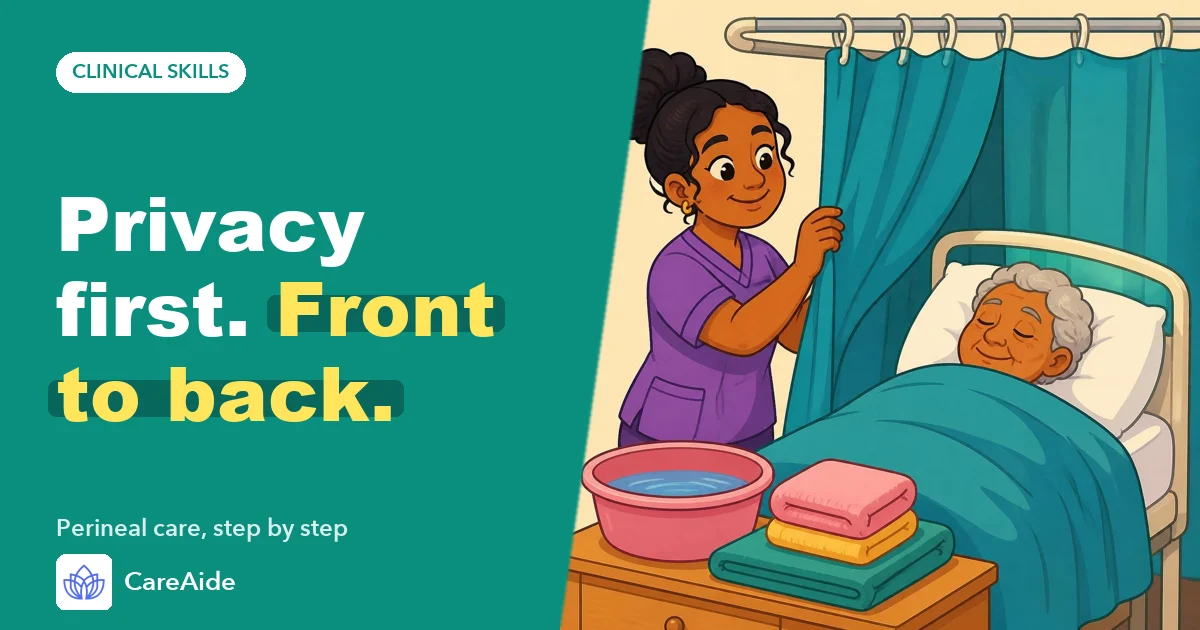
- Provide privacy by closing the door and the curtain.
- Ask for consent. A client who says no is not forced. Explain why the care matters, offer again later, and report the refusal.
- Put on gloves and fill the basin with warm water. Ask the client to check the temperature with a hand, or test it on the back of their hand.
- Expose only the area you are washing and keep the rest covered with a bath blanket.
Speak in a calm and ordinary voice. Many clients feel embarrassed, and a matter-of-fact approach helps. Encourage clients to wash for themselves if they can, and help only where they need it.
How do you give perineal care to a female client?
The textbook skills checklist, according to WisTech Open, says to use four washcloths. The first two wash and rinse the front. The last two wash and rinse the buttocks and rectal area. Each cloth is used only once and goes straight into the linen bag.
- Place a barrier under the client's buttocks. Expose the perineum only.
- Separate the labia gently. With a soapy washcloth, clean one side of the labia from top to bottom.
- Use a clean part of the same cloth for the other side, then for the vaginal area, always from top to bottom.
- Rinse with a second cloth in the same way, using a clean part for each stroke.
- Pat the area dry. Do not rub.
- Cover her with the bath blanket. Help her turn onto her side, holding the raised side rail if one is used.
- With a third cloth, wash one buttock, then the other, then the rectal area, wiping away from the vagina every time. Rinse with the fourth cloth the same way and pat dry.
The direction matters because of infection. WisTech Open explains that a urinary tract infection often begins when bacteria from the rectum enter the urethra. It says infections are more common in females because the urethra is shorter and sits closer to the rectum. The same source states that improper perineal care is a common cause of a urinary tract infection.
How do you give perineal care to a male client?
The male checklist in the same book also uses four washcloths and the same overall order. The front is washed and rinsed first, and the buttocks and rectal area are washed and rinsed last.
- Place a barrier under the buttocks and expose only the perineum.
- If the client is not circumcised, gently move the foreskin away from the urethra toward the base of the penis.
- With a soapy washcloth, start at the urethra and clean in a circular motion toward the scrotum.
- Using a clean part of the cloth, clean one groin fold and one side of the scrotum, then the other side.
- Rinse with a second cloth in the same pattern, then pat dry.
- If the client is not circumcised, gently return the foreskin toward the urethra. Do not skip this step.
- Cover him, help him turn onto his side, and wash and rinse the buttocks and rectal area with the third and fourth cloths, wiping away from the urethra.
Be gentle around the foreskin. If the client feels pain, or you see a change that worries you, stop and report it. Do not try to treat it yourself.
Why do gloves, cloths and water changes matter?
Every perineal area carries bacteria that belong in the bowel and not on the skin of the legs or the urinary opening. That is why you use a clean part of the cloth for each stroke and a new cloth for each stage. If the water becomes soiled, change it and use a clean cloth.
WisTech Open also says to wash from head to toe during a full bath and to finish with the perineal area. It says to change gloves and perform hand hygiene immediately after perineal care. The guide to infection control for health care aides explains hand hygiene and glove use in more detail.
At the end of the task, remove gloves inside out, put on clean ones to tidy the equipment, and then remove those too and wash your hands again. Make sure the client is comfortable, the bed is low and locked, and the call light is within reach.
What about catheter care?
Only provide catheter care if your care plan and employer assign it to you. According to WisTech Open, nursing assistants may provide catheter care "according to agency policy". A nurse places an indwelling catheter, and an aide never inserts, removes or adjusts one.
When catheter care is assigned, the textbook checklist says to hold the catheter where it leaves the body with one hand. Wash around that spot, then clean along the tube moving away from the body only. Use a clean part of the cloth for each stroke, and do not pull on the tube at any time. Never disconnect the tubing from the drainage bag.
Check that the tubing runs downhill from the client to the bag. It should have no kinks, and the bag must stay below the level of the bladder so urine does not flow back. Report leaking, a blocked or kinked tube, or urine that looks different from usual. The nurse decides what to do.
What should you observe and report?
You are not assessing anything when you give perineal care. You are looking, and you are telling the right person what you saw. WisTech Open lists these things to report to the nurse during a bath:
- Open or reddened areas, rashes or irritation.
- Foul odours that remain after washing.
- Any discharge from a mucous membrane.
- Signs of pain, such as a client pulling away when an area is touched.
- Changes in behaviour, such as withdrawal or agitation.
The same book says that if a client already has a wound or skin breakdown, the nurse should be told before the bath. Use plain words: where it is, what it looks like, when you saw it and what the client said. In home care there may be no nurse on site. Tell your supervisor or the case manager, and call 911 in an emergency.
Write down what you saw by your employer's documentation standards. The guides to SBAR and to DARP documentation show how to report and chart it. Do not name a cause, a stage or a condition.
How does this appear on a care aide exam?
Questions on personal care are usually short scenarios. They test whether you protect privacy, follow the care plan, wash in the right direction and report skin changes. Wrong options often have the aide wiping from back to front, applying a cream that was not assigned, or deciding what a rash is. For help with this domain, see the guide to the Provision of Care domain.
CareAide offers exam practice on personal care and safety scenarios for care aides across Canada, and it is free to start. It is practice for your exam, not a substitute for the skills training your program gives you.
Common questions
Which way do you clean when giving perineal care to a female client?
A health care aide or PSW cleans from the front toward the back, away from the vagina, and never from the rectal area toward the front. Use a clean part of the cloth for each stroke, then rinse and pat dry.
How do you clean an uncircumcised male client?
A health care aide or PSW gently moves the foreskin back, away from the urethra. Clean from the urethra in a circular motion toward the scrotum, rinse, pat dry, and gently return the foreskin to its normal position.
Can a care aide give catheter care?
A health care aide or PSW does this only if the care plan and the employer assign it. The aide holds the catheter where it leaves the body, cleans along the tube moving away from the body, never pulls on it and never disconnects the tubing.
What should a care aide report after perineal care?
A health care aide or PSW reports redness, open areas, rashes, irritation, odour that stays after washing, any discharge, signs of pain and changes in behaviour. Tell the nurse or the person supervising your care, and in home care tell your supervisor or case manager.
What if a client refuses perineal care?
A health care aide or PSW does not force the care. Explain why it matters, offer again a little later, and report the refusal to the nurse or your supervisor.
Keep reading
-
 Mouth care for bedridden patients: positioning, dentures, swabs and what to report
How care aides give mouth care for bedridden patients: positioning per the care plan, brushing, denture care, swabs, lip care and what to report to the nurse.
-
 Care aide NOC code: what 33102 covers, its TEER level, and how it differs from 44101
Care aide NOC code: health care aides, PSWs and CCAs fall under NOC 2021 33102, TEER 3. See the listed titles, duties and how 44101 differs.
-
 Range of motion exercises for seniors: what a care aide does, and what stays with the therapist
Range of motion exercises for seniors explained: active, active-assisted and passive ROM, how aides support them per the care plan, and when to stop and report.