 CareAide Prep
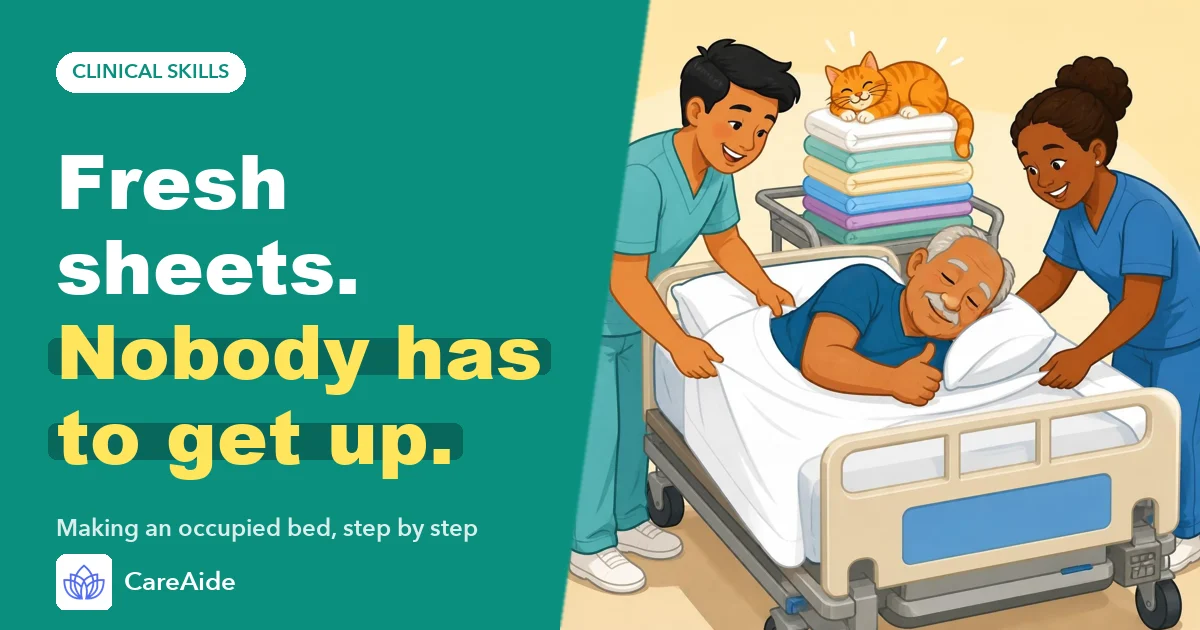
Occupied bed making procedure for care aides: step by step, with the client still in bed
The occupied bed making procedure is how a care aide changes the linen while the client stays in bed: explain, protect privacy, turn the client one way, make half the bed, turn them back, then finish the other half. Do it with safe body mechanics, never shake or floor the linen, follow the care plan on side rails, and report any change you notice.
What is an occupied bed, and how is it different from an unoccupied bed?
An occupied bed is a bed that is changed while the client stays in it. An unoccupied bed is made while the bed is empty, for example after a client has been moved to a chair or has been discharged. Care aides make an occupied bed when a client cannot get up, because of illness, weakness, pain or a care plan that calls for bed rest.
The two procedures use the same linen in the same order. The open textbook Foundations for Assisting in Home Care lists the order as bottom sheet, bed pad, top sheet, blanket and pillowcases. The difference is the client. With an occupied bed, you must keep the person warm, covered, comfortable and safe while you work.
- Who it is for
- Clients who cannot leave the bed during care.
- Main goals
- Privacy, safety, comfort, clean linen and smooth skin contact.
- Key rules
- One side at a time, no shaking linen, no linen on the floor, rails as the care plan says.
- After the task
- Observe, record and report changes to your supervisor.
What should you do before you start?
The skills checklist in Nursing Assistant begins with these steps:
- Gather the linen first, in the order you will use it.
- Knock, introduce yourself and check who the client is.
- Provide privacy by closing the door and the curtain.
- Explain what you are going to do, and ask the client to tell you if anything hurts or feels wrong.
- Wash your hands. Put on gloves if linen is soiled with body fluids.
Explaining first helps the client relax and help when asked. Check the care plan before you begin. It tells you how the client may be turned, what equipment to use and whether you need a second person.
How do you set up the bed safely?
Protect your own body as well as the client's. The textbook Nursing Assistant says to raise the bed to waist level, never lean over the bed and work on one side at a time. The Thompson Rivers University text for health care assistants says the same, and adds that this follows the principles of body mechanics and reduces the risk of musculoskeletal injury. The guide to safe patient handling for health care aides explains these principles in more detail.
Then loosen the old linen. Loosen the bottom sheet at the head and foot on your side, and loosen the top sheet at the foot. Leave the top sheet or a bath blanket over the client. This keeps the client warm and covered, which protects dignity. Leave the pillow under the client's head.
What about side rails?
In some settings a side rail can count as a restraint. Whether a rail is allowed, and when it must be up, depends on the client's care plan and your employer's policy. Follow the plan. Never decide on your own to raise or lower a rail for a client who does not have one in the plan.
The Thompson Rivers University text gives a clear safety rule: lower the rail only on the side where you are working, and make sure the rail on the other side is up. The same text says that if you step away from the bed, the rails must be up.
How do you change the bottom linen with the client in bed?
The steps below follow the Nursing Assistant checklist and the SUNY open text Foundations for Assisting in Home Care. Follow the order you were trained to use.
- Turn the client away from you. Roll the client onto one side, facing away. Use the lift sheet or slider sheet and any helper named in the care plan.
- Roll the soiled bottom linen toward the client. Roll the dirty sheet and pad inward, with the soiled side facing in, and tuck the roll gently under the client's back.
- Place the clean bottom sheet. Lay the clean sheet on your half of the bed, with the extra half fanfolded, which means folded back and forth like a fan, and tucked close to the client. Pull it smooth, with no wrinkles, and tuck it in at the head and foot.
- Add the bed pad. Place half of the clean pad on your side and fanfold the rest under the client.
- Turn the client to the clean side. Tell the client in advance that there will be a small bump when rolling over the folded linen. Make sure the rail is up and the client is safe before you walk around.
- Remove the soiled linen. Go to the other side. Loosen the old sheet, roll it with the dirty part inside and put it straight into the linen bag or hamper.
- Finish the clean side. Pull the fanfolded clean sheet and pad flat from under the client. Smooth them tight and tuck them in.
- Position the client. Roll the client onto the back, or into the position in the care plan, and centre them in the bed.
Smooth linen with no wrinkles is part of skin care. See the guide to pressure injury prevention for health care aides.
How do you finish the top linen?
With the client on their back and covered, place a clean top sheet over the client. Then remove the used top sheet from underneath it. This keeps the client covered the whole time. Add the blanket and any bedspread, and fold the top sheet down over the blanket to make a cuff.
Change the pillowcase next. The Nursing Assistant checklist ends with a toe pleat at the foot of the bed. A toe pleat is a small fold in the top linen, made by lifting the sheets with pinched fingers, which gives the feet room to move. Without it, tight linen can press on the feet.
When the bed is finished, position the client for comfort, and lower the bed to its lowest setting. Set the rails as the care plan says. The Nursing Assistant checklist also lists placing the call light within reach and opening the door and curtain again. Last, wash your hands.
How do you handle dirty linen safely?
Linen can carry germs, so handle it as little as possible and keep it away from your body.
- Carry clean linen away from your body. The SUNY text says this prevents bacteria from your clothes getting on clean linen.
- Do not shake linen. Both open textbooks say shaking releases microorganisms into the air.
- Roll soiled linen inward. Keep the dirty side inside the roll and away from your uniform.
- Never put linen on the floor. Put it straight into the linen bag.
- Wear gloves for soiled linen, and wash your hands after.
Look for the client's belongings in the bed before you roll anything. The Nursing Assistant checklist tells you to return glasses, hearing aids or other personal items to their proper place.
What should you observe and report?
Bed making gives you a close look at the client's skin and comfort. The SUNY text ends the procedure with observing, recording and reporting any change in the client's condition or behaviour. You do not decide what a change means. You describe what you saw and tell your supervisor.
Things worth reporting include:
- Redness, a darker patch, a blister, a scrape or an open area on the skin.
- Swelling, or skin that feels warmer or cooler than the skin around it.
- The client saying that something hurts, or flinching when moved.
- Wet or soiled linen that was not expected, or blood or other fluid on the sheets.
- A change in the client's mood, breathing or ability to help with the turn.
In a facility, report to the nurse or the person supervising your care. In home care, there may be no nurse on site, so report to your supervisor or the case manager, and call 911 in an emergency. Record what you saw according to your employer's documentation standards.
How can you practise for the exam?
Exam questions about bed making test safety, privacy and reporting more than the order of sheets. CareAide has free practice questions on safety and provision of care, so you can check your answers. It is exam practice only, and does not replace training in a lab.
Common questions
What is the difference between an occupied and an unoccupied bed?
For a health care aide or PSW, an occupied bed is made while the client stays in it, so you must keep the client covered, safe and comfortable while you change the linen. An unoccupied bed is made when the bed is empty, for example after discharge or when the client is in a chair.
Should side rails be up when making an occupied bed?
A health care aide or PSW follows the client's care plan and your employer's policy. Where the care plan uses rails, the open textbooks say to lower the rail only on the side you are working on and keep the other side up. A rail can be a restraint in some settings, so do not add or remove one on your own.
Why should you never shake dirty linen?
When a health care aide or PSW makes a bed, shaking linen releases microorganisms into the air, according to the open textbooks Nursing Assistant and Foundations for Assisting in Home Care. Roll soiled linen inward, hold it away from your uniform and put it straight into the linen bag, never on the floor.
What should a care aide report after making an occupied bed?
A health care aide or PSW reports any change in the client's skin, comfort or behaviour, such as redness, a blister, an open area, pain or unexpected fluid on the linen. Describe what you saw and tell the nurse or your supervisor. Do not decide what the change means.
How do you protect your back when making an occupied bed?
A health care aide or PSW raises the bed to waist level, never lean over the bed and work on one side at a time. Use the lift or slider sheet and any helper named in the care plan when turning the client.
Keep reading
-
 Perineal care steps for care aides: privacy, direction of cleaning, and what to report
Perineal care steps for care aides: consent, privacy, gloves, front to back for female clients, foreskin care for male clients, and what to report.
-
 Mouth care for bedridden patients: positioning, dentures, swabs and what to report
How care aides give mouth care for bedridden patients: positioning per the care plan, brushing, denture care, swabs, lip care and what to report to the nurse.
-
 Care aide NOC code: what 33102 covers, its TEER level, and how it differs from 44101
Care aide NOC code: health care aides, PSWs and CCAs fall under NOC 2021 33102, TEER 3. See the listed titles, duties and how 44101 differs.