 CareAide Prep
The Provision of Care domain on the Alberta HCA exam: how to win the largest block of marks
The Provision of Care domain carries the heaviest weight on the Alberta Health Care Aide Registration Examination. Most questions in this section present real-world scenarios that evaluate how you apply care plans while supporting client dignity. Understanding how the competency statements guide the correct choices will help you select the safest answer every time.
What the Provision of Care domain covers
The Provision of Care domain forms the foundation of the Alberta Health Care Aide Registration Examination, representing 25 to 35 per cent of the total marks. Questions in this section measure your ability to deliver safe, effective, and respectful care across diverse healthcare settings in Alberta. Rather than simply asking for memorized definitions, between 53 and 73 per cent of the overall examination questions require candidates to apply knowledge to realistic workplace situations.
The blueprint for this domain relies directly on key competency statements from the provincial curriculum. Specifically, competency 2.1 requires health care aides to "Demonstrate an understanding of the client's care plan and the role of the HCA in implementing the care plan." Competency 2.4 states that aides must "Promote the client’s ability to guide and participate in their own care to the greatest degree possible." Furthermore, competency 2.5 mandates that aides "Provide individualized, age appropriate, person-centred care, with a focus on physical, psychological, social, emotional, cognitive, cultural, and spiritual support." Finally, competency 2.2 expects aides to "Utilize knowledge of growth and development, the aging process, and related health conditions when implementing the care plan."
Why the care plan and person-centred care drive the right answers
Every scenario in the Provision of Care section hinges on two core principles: person-centred care and strict adherence to the established care plan. In Alberta, health care aides provide care under the supervision of a regulated health care professional. An HCA observes, reports, and documents changes in client status, but an aide never assesses, diagnoses, or makes clinical judgements. For instance, competency 2.7 outlines that an HCA may "Provide medication assistance as assigned by a regulated health care professional", emphasizing assistance rather than administration.
Understanding client behaviours also requires specific terminology on the exam. Alberta uses the term responsive behaviours to describe actions that express unaddressed needs, feelings, or environmental distress. When evaluating exam options, choices that dismiss client preferences or attempt to force compliance are incorrect. The exam rewards options that respect client independence while maintaining safety within the defined scope of practice. You can review the complete breakdown of domain weightings on the Alberta HCA exam blueprint page.
The pattern behind correct scenario options
When reviewing multiple-choice options in the Provision of Care domain, the correct option consistently follows a distinct three-part pattern. First, it preserves the client's dignity and promotes independence by encouraging self-direction whenever possible. Second, it strictly follows the client's individualized care plan without introducing unauthorized clinical interventions. Third, it remains fully within the HCA scope of practice by focusing on observation, supportive care, and timely reporting to the supervising regulated health care professional.
Incorrect options often tempt candidates by offering choices that seem efficient but compromise client autonomy, or choices that overstep HCA boundaries by adjusting care directives independently. Recognizing this pattern allows candidates to eliminate distractors quickly during the test.
A worked example scenario
Consider a practical scenario involving an aide named Marcus and a client named Mrs. Gable at eight o'clock in the morning in Room 114. Marcus enters the room to assist Mrs. Gable with her morning routine. Mrs. Gable, who experiences moderate cognitive impairment, exhibits responsive behaviours and firmly refuses to wear the blue cardigan selected for her, insisting instead on wearing her light floral dress.
A plausible but incorrect option might suggest that Marcus should insist Mrs. Gable wear the cardigan because the hallway is cool, or that Marcus should document that Mrs. Gable refused morning hygiene altogether. This option fails because it overrides the client's right to participate in her care, fails to demonstrate person-centred support under competency 2.4, and mistakes a simple preference for a complete refusal of care.
The correct response is for Marcus to respect Mrs. Gable's choice, assist her into the floral dress, ensure she remains comfortable and safe, and report any notable shifts in routine to the supervising nurse if needed. This choice honors her dignity, supports her independence, and aligns directly with the care plan directives.
Balancing study time between Provision of Care and Safety
Because Provision of Care accounts for 25 to 35 per cent of the exam marks and Safety accounts for 16 to 20 per cent, these two domains together represent roughly half of the entire evaluation. Preparing effectively requires structuring your schedule so that you master clinical support concepts without neglecting infection control, body mechanics, and safety protocols.
Candidates should combine theoretical review with practical scenario practice. Reviewing structured strategies on studying for the Alberta HCA exam helps establish clear study habits. Working through realistic Alberta HCA practice questions allows you to practice identifying person-centred responses under timed conditions, building confidence for exam day.
Common questions
What percentage of the exam covers the Provision of Care domain?
The Provision of Care domain accounts for 25 to 35 per cent of the total marks on the Alberta Health Care Aide Registration Examination. This makes it the largest single domain tested on the Alberta exam.
Can a health care aide alter a client's care plan during a shift?
A health care aide must follow the care plan as established by a regulated health care professional. While an HCA observes, reports, and documents changes in client condition, the aide does not assess, diagnose, or independently alter clinical care plans.
What cognitive level is tested most on the Alberta HCA exam?
Applying is the primary cognitive level on the Alberta HCA exam, representing 53 to 73 per cent of all test questions. Candidates must demonstrate how to apply care concepts in practical workplace scenarios rather than simply recalling definitions.
Keep reading
-
 The hardest part of the Alberta HCA exam, in 13,200 practice answers
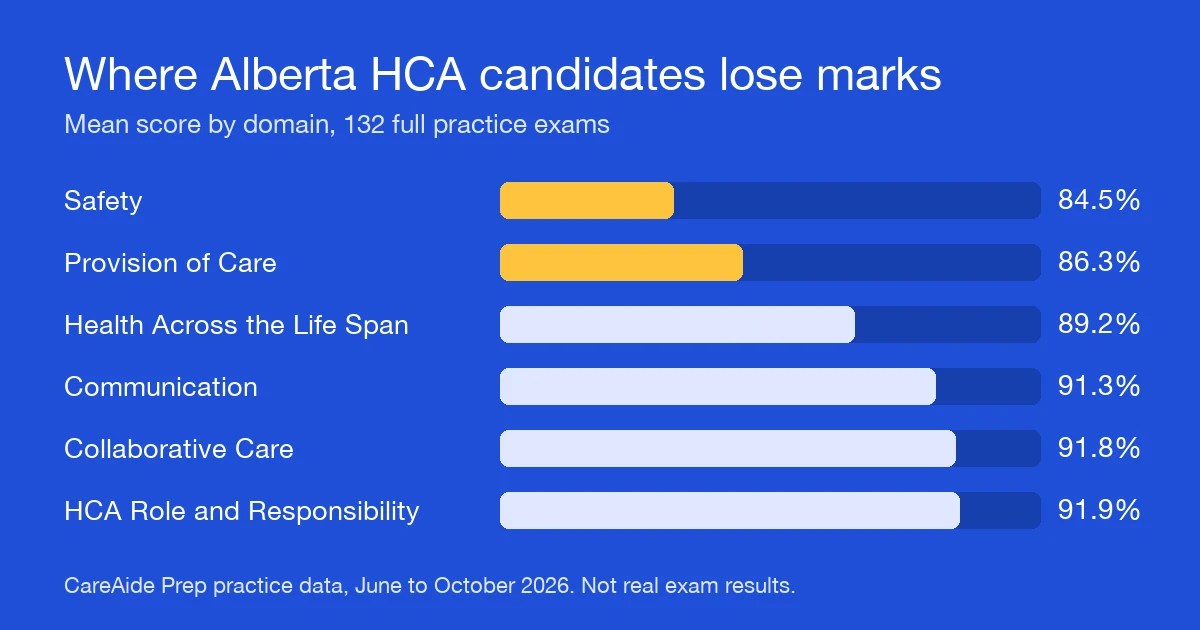
Across 132 full practice exams, Alberta HCA candidates scored lowest in Safety and Provision of Care, the two domains worth the most marks on the exam.
The hardest part of the Alberta HCA exam, in 13,200 practice answers
Across 132 full practice exams, Alberta HCA candidates scored lowest in Safety and Provision of Care, the two domains worth the most marks on the exam.
-
 Health Across the Life Span on the Alberta HCA exam: why younger clients catch candidates out
Prepare for the Health Across the Life Span domain on the Alberta HCA Registration Examination: age-specific growth, development and care principles.
Health Across the Life Span on the Alberta HCA exam: why younger clients catch candidates out
Prepare for the Health Across the Life Span domain on the Alberta HCA Registration Examination: age-specific growth, development and care principles.
-
 Am I ready for the Alberta HCA exam? Four signals that matter more than a practice score
Discover how to gauge your readiness for the Alberta HCA Registration Examination. Learn four reliable indicators of success before booking your test.
Am I ready for the Alberta HCA exam? Four signals that matter more than a practice score
Discover how to gauge your readiness for the Alberta HCA Registration Examination. Learn four reliable indicators of success before booking your test.