 CareAide Prep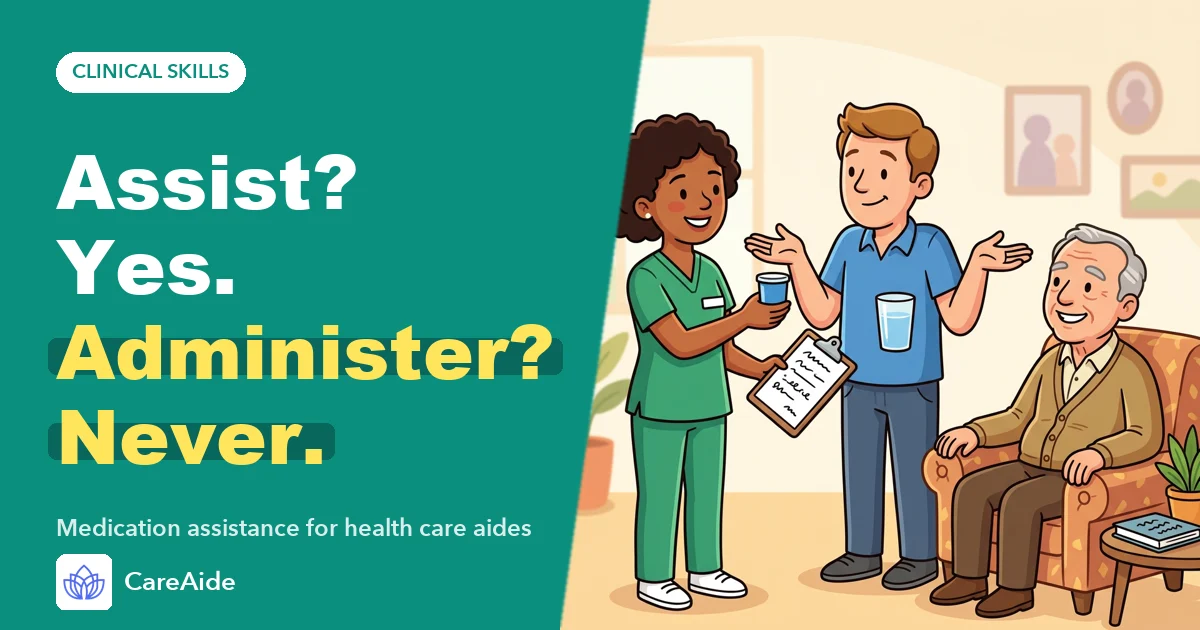
Medication assistance for health care aides in Alberta: assist, never administer
Medication questions are where the exact wording of the competency decides the mark. Candidates lose points not through carelessness but by choosing an option that asks a health care aide to make a clinical judgement. Knowing exactly where assistance ends and administration begins protects the client on the unit and the candidate on the Alberta HCA Registration Examination.
Assistance versus administration in Alberta care settings
The Alberta Health Care Aide Competency Profile sets clear limits on medication support. Competency 2.7 states verbatim: "Provide medication assistance as assigned by a regulated health care professional." The key word in this statement is assistance. An aide assists a client with a task that has already been planned, assessed, and authorised by a regulated team member, such as a licensed practical nurse or registered nurse. You can review full boundaries on the HCA scope of practice in Alberta page.
In daily practice, concrete assistance includes handing a pre-prepared dose to the client, opening a pill container or blister pack, offering a glass of water, remaining with the client while they take the medication, and immediately documenting the task. In contrast, medication administration involves clinical decision-making. A health care aide never decides when a medication is required, adjusts a dosage, crushes tablets based on personal judgement, gives an unassigned dose, or gives medication meant for another client. To better understand these distinctions between roles, consult the guide on health care aide vs LPN in Alberta.
Why decision options are wrong by construction on the examination
The Alberta HCA Registration Examination consists of 100 independent multiple choice questions with 4 options each. On this closed book exam, scope questions are designed to test whether a candidate recognizes professional limits. Any multiple choice option that suggests an aide should make a clinical judgement about medication is incorrect by construction.
When an exam question presents a client experiencing pain, discomfort, or distress, options that involve selecting a medication, deciding to administer a PRN dose, or altering medication timing are distractor choices. Health care aides observe, report, and document; they do not assess, diagnose, or formulate clinical plans. Recognizing that an aide cannot alter or initiate medication care allows candidates to eliminate incorrect options quickly.
A concrete example from daily practice
Consider a practical scenario involving an aide named Amara and a client named Mr. Henderson in Room 102 at 08:00. Amara enters the room to assist Mr. Henderson with his morning routine. The care plan indicates that Mr. Henderson requires assistance with his morning medications, which have been prepared and assigned by the supervising nurse.
Amara opens the designated blister pack, hands the prepared dose to Mr. Henderson, provides a glass of water, and remains at his bedside until he swallows the medication. She then records that assistance was provided according to standard procedures. Amara does not evaluate whether the pill choice is appropriate or adjust the timing based on her own opinion. Her actions remain entirely within the scope of assigned assistance.
Handling client refusal safely and correctly
A crucial scenario on both the exam and the unit occurs when a client refuses medication. If Mr. Henderson states that he does not want to take his morning pills, Amara must never force, bribe, or insist that he comply. Competency 3.4 requires aides to "Report changes in the client to the appropriate regulated health care team member in a timely manner." Furthermore, Competency 2.10 requires aides to "Report and/or record client information in accordance with employer documentation standards and guidelines."
When refusal occurs, the aide's responsibility is to ensure the client is safe, respect their autonomy, and report the refusal immediately to the supervising professional. Using structured communication techniques such as SBAR for health care aides ensures that the nurse receives clear, objective details about the refusal. The aide then records the refusal factually in the record. By adhering strictly to observation, reporting, and documentation, health care aides maintain safety and uphold professional standards across Alberta.
Common questions
What is the difference between medication assistance and administration for a health care aide in Alberta?
In Alberta, a health care aide provides medication assistance by helping a client take pre-prepared medication as assigned by a regulated health care professional. Assistance includes tasks such as opening a container, offering a glass of water, staying while the medication is taken, and documenting the event. A health care aide never administers medication, selects dosages, crushes tablets independently, or makes clinical judgements.
What should a health care aide do if a client refuses medication in Alberta?
When a client refuses medication, a health care aide must never insist, argue, or attempt to force compliance. The health care aide must ensure the client is safe, respect their decision, and promptly report the refusal to the regulated health care professional supervising care. The health care aide must also record the refusal accurately according to employer documentation standards.
Why are medication decision options always incorrect on the Alberta HCA examination?
Examination questions on the Alberta HCA Registration Examination test strict scope boundaries defined by the provincial competency profile. Options that suggest a health care aide should decide when to give a dose, alter a dose, or choose an alternative medication are incorrect by construction because clinical decision-making belongs solely to regulated health care professionals.
Keep reading
-
 Manitoba health care aides: medication and restraint rules in personal care homes
Who may give medication and apply restraints in a Manitoba personal care home, what reserved acts mean, and how a health care aide hands decisions on.
Manitoba health care aides: medication and restraint rules in personal care homes
Who may give medication and apply restraints in a Manitoba personal care home, what reserved acts mean, and how a health care aide hands decisions on.
-
 BC health care assistants: assigned tasks, restricted activities and delegation
BC health care assistants have no legal scope of practice. Learn how assigned tasks, restricted activities and client-specific delegation sort the work.
BC health care assistants: assigned tasks, restricted activities and delegation
BC health care assistants have no legal scope of practice. Learn how assigned tasks, restricted activities and client-specific delegation sort the work.
-
 PSW medication in New Brunswick: why home support and nursing homes differ
What a New Brunswick PSW may do about medication in home support and in a nursing home, plus foot care, restraints and how reporting differs.
PSW medication in New Brunswick: why home support and nursing homes differ
What a New Brunswick PSW may do about medication in home support and in a nursing home, plus foot care, restraints and how reporting differs.