 CareAide Prep
Am I ready for the Alberta HCA exam? Four signals that matter more than a practice score
Learners ask their tutors this question constantly: am I ready for the exam? The honest answer is that no single practice score guarantees a pass because the Alberta HCA Registration Examination is evaluated strictly as pass or fail with no published passing mark, and standards vary by exam form.
Why raw practice scores can be misleading
The Alberta HCA Registration Examination (AHRE), administered by Meazure Learning for the College of Licensed Practical Nurses and Health Care Aides of Alberta (CLHA), does not issue numerical grades to candidates. When you complete the exam, your result is reported only as a pass or a fail. Because the passing standard is adjusted across different exam forms to maintain fairness, scoring high on a familiar practice quiz does not automatically translate to a passing result on test day. Practice tests are diagnostic tools rather than guarantees.
The four signals that actually measure readiness
Rather than relying on a single percentage mark, candidates should look for four specific indicators that demonstrate genuine readiness for the examination environment.
1. Consistent performance across all six domains
The examination evaluates knowledge across six distinct domains. Strong preparation requires balanced understanding rather than reliance on one familiar topic. Candidates should show steady comprehension whether answering questions on HCA Role and Responsibility, Communication, Health Across the Life Span, or Collaborative Care. Over-reliance on workplace experience in a single setting often masks knowledge gaps in other areas.
2. Maintaining accuracy under 72 seconds per question
The exam consists of 100 independent multiple choice questions with four options each, delivered in a closed-book format over two hours. This pacing allows an average of 72 seconds per question. Being ready means reading the scenario, identifying the core issue, and selecting the correct option within this time frame without feeling rushed or falling behind.
3. Strong performance on unseen scenarios
Between 53 and 73 per cent of exam marks target the Applying cognitive level. Re-taking the same practice quiz repeatedly often measures memory of specific questions rather than clinical reasoning. Readiness is demonstrated when you can apply principles to brand-new scenarios that you have never encountered before.
4. Solid performance on the two largest domains
Provision of Care represents 25 to 35 per cent of the total marks, while Safety represents 16 to 20 per cent. Because these two domains make up roughly half of the examination, candidate stability in these areas is essential for success.
Scope boundaries in examination scenarios
Exam questions regularly test whether a candidate understands the precise boundaries of the health care aide role. Consider a concrete scenario: at 08:30 in Room 104, an aide named Elena is working with Mr. Vance. Mr. Vance exhibits what Alberta health care frameworks term responsive behaviours while receiving morning care. Elena must recognise that health care aides observe, report, and document clinical details, but do not assess, diagnose, or make clinical judgements.
Scope rules apply directly to medication items as well. Competency 2.7 requires an aide to "Provide medication assistance as assigned by a regulated health care professional"—meaning assistance only, never administration. Options on the exam that involve independently choosing, administering, or altering medication are incorrect for an HCA candidate.
A short self-check to run this week
Before booking your exam attempt through Meazure Learning, review these practical self-check questions:
- Can you complete a set of 20 unseen practice questions in under 24 minutes while maintaining consistent accuracy?
- Do you correctly distinguish between medication assistance and administration in every practice scenario?
- Are you comfortable answering questions involving client age targets across the lifespan, including the 65 per cent of focus directed toward clients aged 61 and older?
- Can you identify appropriate actions for infection prevention and control under Competency 6.5 and safe client handling under Competency 6.7 without hesitation?
What to do if the honest answer is not yet
If your self-check reveals gaps, pause before scheduling your sitting. Candidates who are provisional registrants with the CLHA have one year and three attempts to pass the exam, with each attempt costing $200 + GST. Using an attempt before you are ready creates unnecessary pressure.
Focus your remaining preparation time on weak domains highlighted in practice feedback. Review fundamental documentation formats such as DARP and handover structures like SBAR. For comprehensive guidance on structuring your remaining study time, read our guide on How to study for the Alberta HCA exam. To understand what happens at the testing centre on test day, review Alberta HCA exam day, and to learn more about attempt limits and rules, visit Alberta HCA exam results and retakes.
Common questions
What score do I need to pass the Alberta HCA Registration Examination?
The Alberta HCA Registration Examination yields a result of pass or fail only, without a published numerical passing mark. The passing standard varies by exam form to ensure fairness across different test versions. Health care aides receive a report indicating relative strengths and weaknesses across test domains rather than a percentage grade.
How many questions are on the Alberta HCA Registration Examination and how much time is allowed?
The Alberta HCA Registration Examination consists of 100 independent multiple choice questions with four options each. Candidates have 2 hours to complete the closed-book exam, which averages 72 seconds per question. An HCA taking the test must complete all items within this timeframe at a Meazure Learning test centre.
What should an HCA do if they are not ready for the exam?
If an Alberta HCA candidate determines they are not ready, they should focus study efforts on the largest test domains, specifically Provision of Care and Safety. The candidate should practise answering unseen scenario questions within the 72-second time limit while reviewing the scope of practice. Scheduling the test after demonstrating consistent accuracy across all six domains helps avoid using one of the three permitted attempts prematurely.
Keep reading
-
 The hardest part of the Alberta HCA exam, in 13,200 practice answers
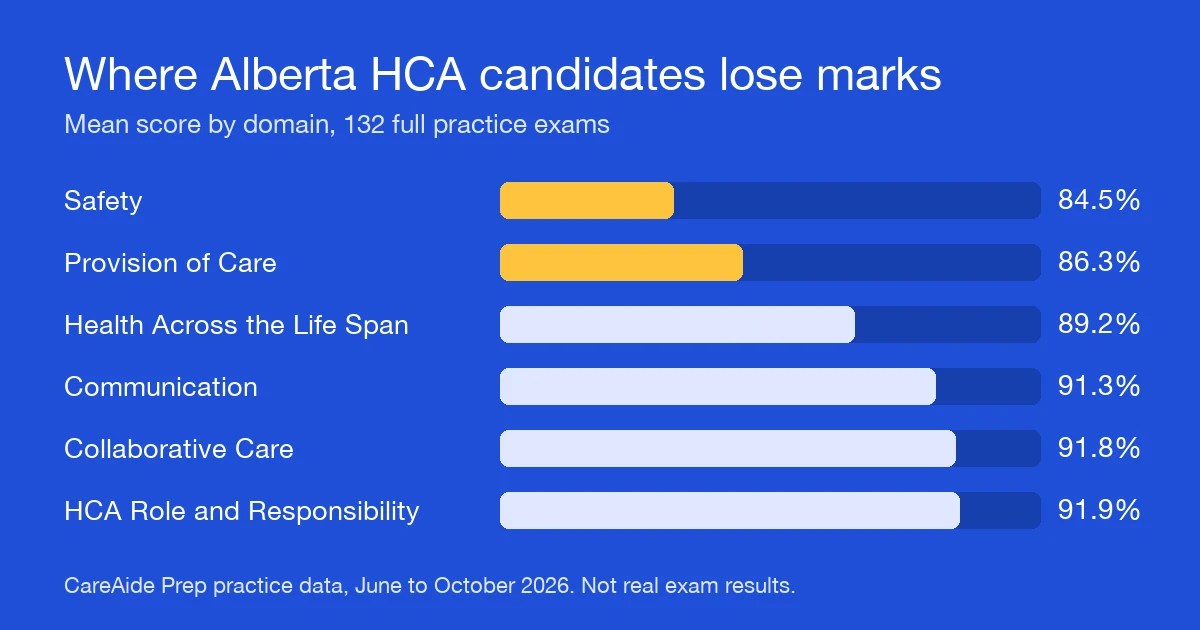
Across 132 full practice exams, Alberta HCA candidates scored lowest in Safety and Provision of Care, the two domains worth the most marks on the exam.
The hardest part of the Alberta HCA exam, in 13,200 practice answers
Across 132 full practice exams, Alberta HCA candidates scored lowest in Safety and Provision of Care, the two domains worth the most marks on the exam.
-
 Health Across the Life Span on the Alberta HCA exam: why younger clients catch candidates out
Prepare for the Health Across the Life Span domain on the Alberta HCA Registration Examination: age-specific growth, development and care principles.
Health Across the Life Span on the Alberta HCA exam: why younger clients catch candidates out
Prepare for the Health Across the Life Span domain on the Alberta HCA Registration Examination: age-specific growth, development and care principles.
-
 The Provision of Care domain on the Alberta HCA exam: how to win the largest block of marks
Learn how to apply person-centred principles on the Alberta HCA exam. Master the Provision of Care domain with competency breakdowns and scenario strategy.
The Provision of Care domain on the Alberta HCA exam: how to win the largest block of marks
Learn how to apply person-centred principles on the Alberta HCA exam. Master the Provision of Care domain with competency breakdowns and scenario strategy.