 CareAide Prep
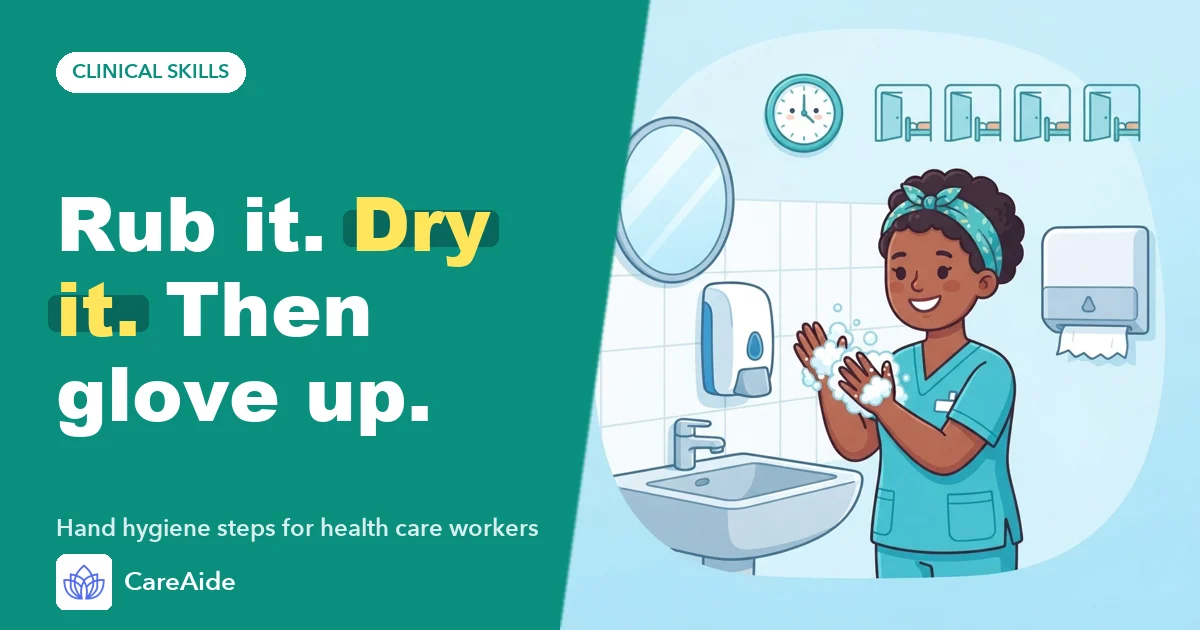
Hand hygiene steps for health care workers: when to use hand rub, when to wash, and the key moments
The hand hygiene steps for health care workers are to use alcohol-based hand rub on hands that are not visibly soiled, to wash with soap and water when they are soiled, and to clean your hands at four key moments around every resident. This guide sets out both methods in order and explains how to choose between them.
- Preferred method
- Alcohol-based hand rub, when hands are not visibly soiled
- Use soap and water
- When hands are visibly soiled, or when hand rub is not available
- Wash time
- At least 20 seconds of washing
- Moments
- Before touching a resident or their surroundings, before a clean procedure, after body fluid exposure risk, after contact with the resident or their surroundings
- Gloves
- Hands must be dry before gloves go on; gloves do not replace hand hygiene
What are the hand hygiene steps for health care workers?
There are two methods, and a care aide needs both. The first is alcohol-based hand rub, which is the quick method for hands that are not visibly dirty. The second is washing with soap and water, which is the method for hands that look or feel soiled. According to the Public Health Agency of Canada, adherence to hand hygiene is the single most important practice for preventing healthcare-associated infections.
The agency also names alcohol-based hand rub at the point of care as the preferred method, with certain exceptions. Healthcare Excellence Canada describes hand rub as faster, more effective and gentler on hands than soap and water. Your employer's hand hygiene policy gives the final rules, including how your workplace handles the exceptions.
What are the steps for using alcohol-based hand rub?
A textbook checklist from the open textbook Nursing Assistant gives the order. Use it as a picture of the routine, and follow the directions on your employer's product.
- Remove jewellery according to your employer's policy and push your sleeves above your wrists.
- Pour the amount of product that the directions specify into one palm.
- Rub over every surface of your hands and fingers: palm to palm, the back of each hand with the fingers interlaced, palm to palm with fingers interlaced, each thumb, the fingertips against the opposite palm, and the wrists.
- Keep rubbing until the alcohol is completely dry. Do not wipe or rinse it off.
On timing, sources differ a little. According to Canada.ca public guidance, rub for 20 seconds or until dry, and choose a product with 60% or higher alcohol. The textbook checklist uses at least 30 seconds. The safe habit is to keep going until your hands are dry, and to follow your employer's stated time.
What are the steps for washing with soap and water?
The same textbook sets out the soap and water routine in this order.
- Gather soap and paper towels. Remove jewellery per policy and push your sleeves above your wrists.
- Turn on warm water and wet your hands thoroughly. Keep your hands and forearms lower than your elbows, and avoid splashing your uniform.
- Apply a palm-sized amount of soap.
- Work up plenty of lather and friction. Cover your palms, the backs of your hands with the fingers interlaced, between the fingers, each thumb, your fingertips against the opposite palm, and your wrists.
- Clean under your nails with a disposable nail cleaner if one is available.
- Wash for a minimum of 20 seconds in total.
- Rinse so that the water runs off your fingertips, pointing down. Do not shake your hands, and do not lean on or touch the inside of the sink.
- Dry from the fingers to the wrists with a paper towel.
- Use a new paper towel to turn off the tap, then throw it away.
The paper towel on the tap matters. A tap handle that you touched with dirty hands can put germs straight back onto clean ones.
When should you use soap and water instead of hand rub?
Use soap and water when your hands are visibly soiled, or when hand rub is not available. This is the rule from Healthcare Excellence Canada, and it is the one most often tested. If you can see or feel dirt, grease, food or body fluid on your hands, rub alone is not enough. Canada.ca public guidance adds that dirt, grease and food reduce how well a sanitizer works.
Two more rules from the same source are worth remembering. First, do not wash with soap and water immediately before or after using hand rub, because that can cause contact dermatitis. Pick one method for each moment. Second, if a resident is under isolation precautions, follow the hand hygiene directions given for those precautions instead of assuming hand rub is allowed.
When do health care workers clean their hands?
Healthcare Excellence Canada lists four key moments for hand hygiene in care settings.
- Before contact with a resident or the resident's surroundings. Clean your hands before you help with a transfer, a meal or personal care, and before you touch the bed, chair or table.
- Before an aseptic procedure. This is a clean task where germs must be kept away. Your employer and your care plan decide which tasks count, and a care aide does only the tasks that are assigned.
- After a risk of body fluid exposure. This includes any time your hands may have touched urine, stool, blood, saliva or wound drainage, even if you wore gloves.
- After contact with the resident or the resident's surroundings. Clean your hands when you finish, before you move to the next person or the next room.
The moments are about the resident's space as well as the resident. Touching a bed rail, a call light or a walker counts as contact with the surroundings.
How do gloves, nails and jewellery fit in?
Gloves are not a substitute for clean hands. Healthcare Excellence Canada says to let your hands dry completely after washing or rubbing before you put gloves on. The wet or damp skin under a glove is more likely to become irritated. Clean your hands again when you take the gloves off. The guide to infection control for health care aides explains when gloves are used, and the guide to the order for putting on and taking off PPE shows where hand hygiene fits in that sequence.
The same source says not to wear artificial nails or nail extenders in healthcare settings, especially during direct contact with residents. It says natural nails should be kept short, at 0.5 cm. The textbook checklists tell you to remove jewellery according to your employer's policy before you clean your hands, because rings and bracelets hold soil and make cleaning harder.
What mistakes should you avoid?
- Rubbing for a few seconds and stopping before the product is dry.
- Using hand rub on hands that are visibly soiled.
- Washing and then rubbing straight afterward, or the other way round.
- Putting on gloves with damp hands.
- Turning off the tap with bare, wet hands.
- Touching the inside of the sink or leaning on it.
- Skipping hand hygiene after removing gloves because the hands felt clean.
How does this appear on a care aide exam?
Exam questions on hand hygiene are short and practical. They usually give you a situation, such as soiled hands after toileting care, or an aide about to start a task with a resident, and ask what the aide does first. The best answer is nearly always the one that cleans hands with the right method at the right moment and then follows the care plan. Wrong answers tend to skip hand hygiene, use rub on visibly soiled hands, or treat gloves as enough on their own.
CareAide offers exam practice on infection prevention and safety scenarios for care aides across Canada, and it is free to start. It is practice for your exam, not a substitute for the skills training your program gives you.
Common questions
Is hand rub or soap and water better for a health care aide?
For a health care aide or PSW, alcohol-based hand rub is the preferred method when hands are not visibly soiled. Soap and water is for visibly soiled hands, or when hand rub is not available.
How long should a health care aide wash their hands?
A health care aide or PSW washes for a minimum of 20 seconds in total, with plenty of lather and friction on the palms, backs of hands, fingers, thumbs, fingertips and wrists, then rinses and dries well.
What are the four moments for hand hygiene?
A health care aide or PSW cleans their hands before contact with a resident or their surroundings, before an aseptic procedure, after a risk of body fluid exposure, and after contact with a resident or their surroundings.
Can a care aide wear artificial nails at work?
No. A health care aide or PSW should not wear artificial nails or extenders in healthcare settings, especially during direct resident contact, and should keep natural nails short at 0.5 cm.
Keep reading
-
 How to transfer a patient from bed to wheelchair: the pivot transfer a care aide does, step by step
How to transfer a patient from bed to wheelchair as a care aide: check the care plan, lock the brakes, use a gait belt, pivot safely and report changes.
-
 Signs of a stroke: FAST, calling 9-1-1, and what a care aide does next
Signs of a stroke from Heart & Stroke and the Government of Canada: FAST, other signs, why the time matters, and what a care aide does and never does.
-
 PSW cover letter: how to write one, what to include, and a short sample
How to write a PSW cover letter: research the posting, follow a short outline, match your skills, avoid common mistakes, with a sample letter to adapt.