 CareAide Prep
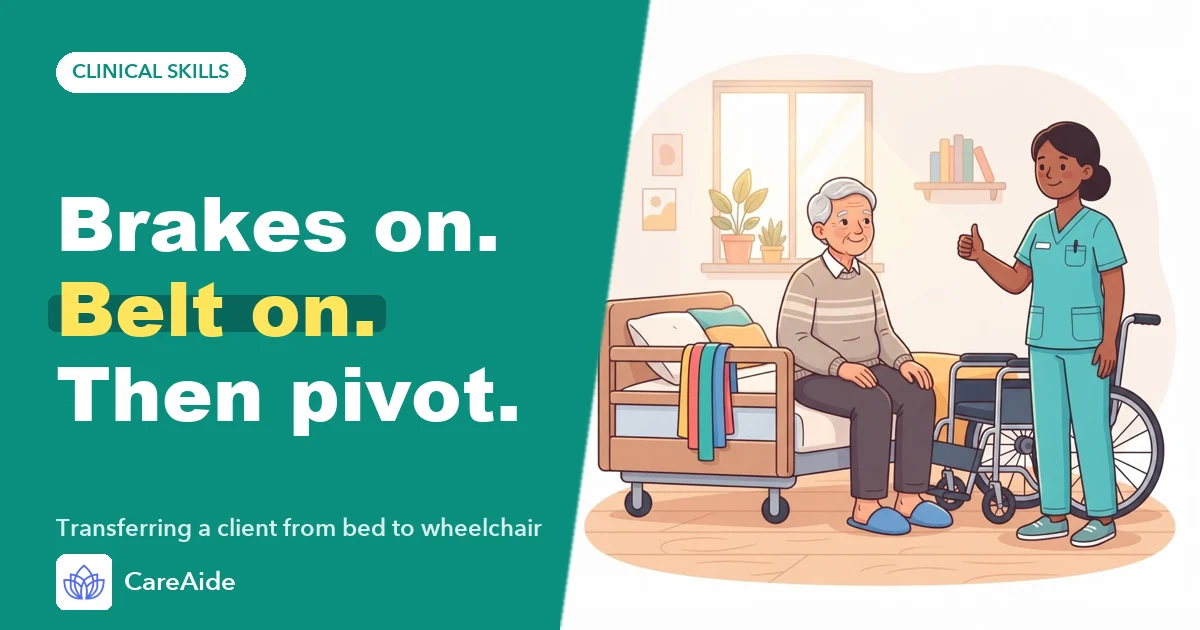
How to transfer a patient from bed to wheelchair: the pivot transfer a care aide does, step by step
To transfer a patient from bed to wheelchair, a care aide first checks the care plan for the client's transfer status, then locks the brakes, sits the person up to dangle, applies a gait belt, and helps them stand and pivot into the chair. A client who cannot bear weight needs a mechanical lift and two people, never a lone aide's strength.
- First step
- Read the care plan for the client's transfer status before you touch anything
- Brakes
- Locked on the bed and on the wheelchair
- Before standing
- Sit the client up, let them dangle, and ask about dizziness
- Hands
- Grip the gait belt with both hands, palms and fingertips up
- Lifting
- A client who bears no weight needs a full-body lift and two assistants
Why do transfers need so much care?
According to the WisTech Open textbook Nursing Assistant, most injuries to clients and to staff happen while clients are being transferred. The book says safety should receive the highest priority. A fall during a transfer can hurt a resident, and a poor lifting position can hurt you.
A care aide does not decide how a person is moved. The textbook says nursing assistants should always review the client's care plan for their current transfer status before moving them. Transfer status describes how a resident moves from one place to another, such as from the bed to a wheelchair. Your employer teaches the exact method, and it can differ between provinces and workplaces. The guide to safe patient handling covers the wider rules for moving clients.
What does the care plan say about transfers?
The textbook explains that physical therapists assess clients and recommend how they should be transferred. The order depends on how much body weight the client can bear and how much weight an assistant must support. You follow the order. You do not upgrade or downgrade it because the client seems stronger or weaker that day. If you think the order no longer fits, tell the nurse or your supervisor.
The textbook lists these transfer status orders:
- Independent: the client needs no help.
- Contact-guard-assist: one assistant keeps a hand on the client to steady their balance.
- One assist with a gait belt: one assistant helps.
- Two assist with a gait belt: two assistants help.
- Sit-to-stand lift: a lift supports the client as they stand.
- Full-body mechanical lift: used when the resident cannot bear any of their weight.
The textbook says a full-body lift always needs two assistants, and that the person moving the lift must be 18 years of age or older. A two-assist transfer without a lift uses the same pivot steps described below, with one assistant on each side of the client.
How do you get ready for the transfer?
The WisTech skills checklist for a bed to chair transfer with a gait belt begins with gathering a gait belt, a wheelchair and nonskid footwear. It then lists the routine steps before any care: knock, perform hand hygiene, introduce yourself, provide privacy and explain what you are about to do.
- Check that the brakes on the bed are locked.
- Remove the foot pedals from the wheelchair if needed.
- Help the resident to a seated position on the side of the bed, with their feet on the floor.
- Let them dangle their feet for a few minutes.
- Help them put on nonskid footwear.
- Place the gait belt on the resident.
The pause matters. The textbook explains that orthostatic hypotension is a sudden drop in blood pressure that can cause dizziness and falls when a person moves quickly from lying to sitting or from sitting to standing. Dangling gives the body time to adjust. Ask the client whether they feel dizzy before you go on, and watch how they look and sound. If they say yes, stop and tell the nurse. You do not decide what the dizziness means.
How do you help a client sit up safely?
Many clients need help to reach the edge of the bed. The textbook gives this method. Lock the bed brakes and raise the bed to a working height. Support the resident's shoulders with one hand and their knees with the other. Bend your knees and keep your back straight. Move the resident as one unit instead of the upper body first and the legs after. Do not let the resident put their arms around your shoulders, because the book warns this can cause serious back injuries. When they are sitting, lower the bed so their feet touch the floor.
How do you apply the gait belt?
The gait belt goes on once the person is sitting up and says they are not dizzy. The textbook says it should be snug, but you should be able to slip your fingers underneath. Tuck any extra length back into the belt so it cannot catch in the client's legs. The belt can loosen as the person stands, so a snug fit matters. The guide to how to use a gait belt goes through placement in more detail.
A gait belt is not right for every client. The textbook says belts should not be used for clients with abdominal wounds or some heart conditions, and that a different method should then be in the care plan. If you have any concern about using a belt for a client, contact the nurse before you start.
What are the steps of the bed to wheelchair pivot?
The checklist in the textbook sets out the pivot in this order. Read it as a model, then follow the version your employer teaches.
- Place the wheelchair at the head or foot of the bed so the client moves toward the chair with their stronger side. The chair touches the side of the bed.
- Lock the wheelchair brakes.
- Ask the client if they feel dizzy or light-headed.
- Face the client and place each of your feet in front of theirs, so their feet cannot slip.
- Ask the client to push up on the bed when you count to three.
- Grasp the gait belt with both hands, with your palms and fingertips pointing up.
- Count to three and help the client stand.
- Help the client pivot.
- Tell the client to grasp the arms of the wheelchair once they feel the backs of their knees touch the seat.
- Help the client lower into the wheelchair.
- Remove the gait belt gently to avoid skin injury, then release the wheelchair brakes.
Talk through each step as you go. A client who knows what comes next is steadier and less likely to grab you. If the transfer is a two-person assist, the second aide stands on the other side and the same steps apply.
What if the client cannot stand?
Do not try a pivot with a client who cannot bear weight, and do not lift them alone. Check the care plan. If it calls for a sit-to-stand or full-body lift, use the lift with the number of people the plan and your employer require. If the client suddenly cannot do what the plan says they can, stop, make them safe and comfortable, and tell the nurse. In home care, where there may be no nurse on site, tell your supervisor, and call 911 if there is an emergency.
What do you do after the transfer?
The checklist ends with a short routine. Check how the client feels and ask if they need anything. Make sure the bed is low and locked. Place the call light within reach. Open the privacy curtain and wash your hands. Then document and report any skin problems, pain with movement or other changes you noticed. Use plain words: what you saw, where, when, and what the client said. Do not name a cause. The guides to SBAR and DARP documentation show how to put it on record, and the guide to preventing falls covers what to do if a client goes down.
How does this show up on a care aide exam?
Exam questions on transfers are short scenarios. They test whether you read the care plan first, lock the brakes, ask about dizziness, use the gait belt correctly and report changes. Wrong options often have the aide lifting alone, skipping the brakes, choosing a method the plan does not list, or judging why a client is dizzy. Practice with these scenarios builds the habit of checking the plan before you act.
CareAide offers exam practice for care aides across Canada, and it is free to start. It is practice for your exam, not a substitute for the skills training your program gives you.
Common questions
What is the first thing a care aide does before a bed to wheelchair transfer?
A health care aide or PSW reads the client's care plan for their transfer status, because the plan says whether the client is independent, needs one or two assistants, or needs a lift. Then the aide locks the bed brakes and gathers the wheelchair, gait belt and nonskid footwear.
Why does a client dangle before standing up?
A health care aide or PSW lets the client sit on the edge of the bed for a few minutes because a sudden change of position can cause a drop in blood pressure, dizziness and falls. The aide asks whether the client feels dizzy and tells the nurse if they do.
Which side should the wheelchair be on for a pivot transfer?
A health care aide or PSW places the wheelchair at the head or foot of the bed, touching the bed, so the client moves toward it with the stronger side of their body. The wheelchair brakes are locked before the client stands.
Can a care aide transfer a client alone?
A health care aide or PSW transfers a client alone only when the care plan lists a one-person assist. If the client cannot bear weight, the plan calls for a full-body mechanical lift, which always needs two assistants.
What should a care aide report after a transfer?
A health care aide or PSW reports skin problems, pain with movement, dizziness and any other change noticed during the transfer. Describe what you saw and heard in plain words and leave out any guess about the cause.
Keep reading
-
 Signs of a stroke: FAST, calling 9-1-1, and what a care aide does next
Signs of a stroke from Heart & Stroke and the Government of Canada: FAST, other signs, why the time matters, and what a care aide does and never does.
-
 PSW cover letter: how to write one, what to include, and a short sample
How to write a PSW cover letter: research the posting, follow a short outline, match your skills, avoid common mistakes, with a sample letter to adapt.
-
 How to take blood pressure manually: preparation, steps, recording and what a care aide reports
How to take blood pressure manually when assigned: resting, arm at heart level, cuff size, slow deflation, recording and reporting for care aides.