 CareAide Prep
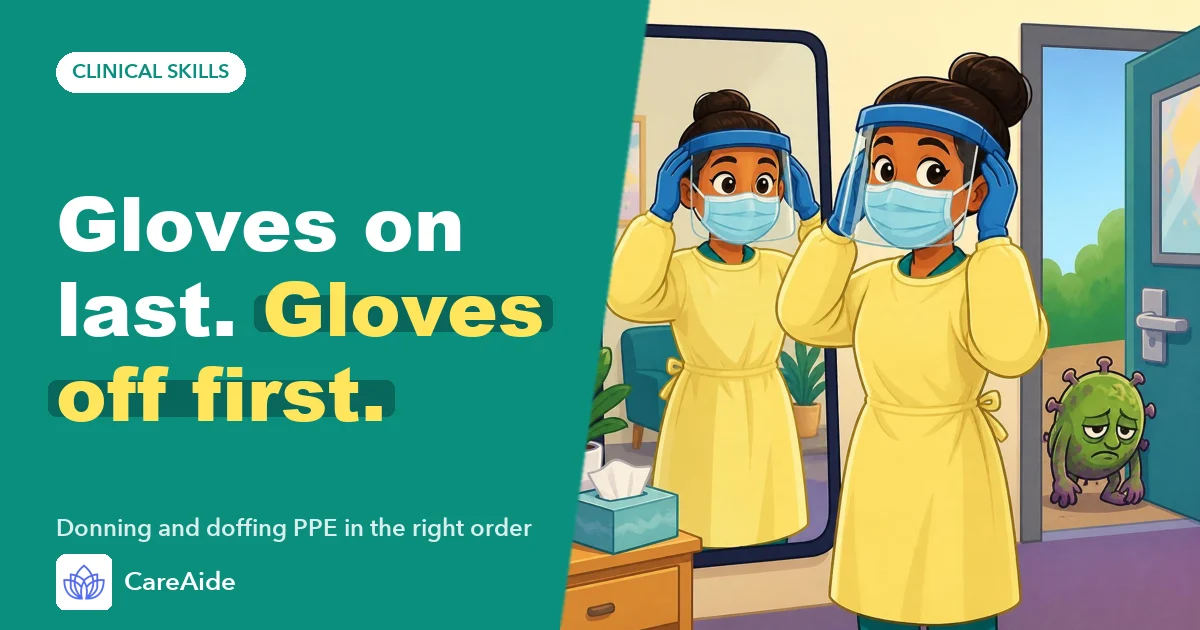
Donning and doffing PPE order: the steps care aides follow, and why the order matters
The donning and doffing PPE order starts with hand hygiene, then the gown, mask or respirator, eye protection and gloves to put on, and gloves first to take off. The sequences from Public Health Ontario and Alberta Health Services agree on putting on and differ a little on taking off. When sources differ, follow the sequence your employer posts.
- Putting on (donning)
- Hand hygiene, gown, mask or N95 respirator, eye protection, gloves
- Taking off (doffing)
- Gloves first, then the gown, eye protection and mask, with hand hygiene between steps
- Why gloves come off first
- They are the dirtiest item, so you remove them before you touch anything else
- If sources differ
- Follow the sequence posted by your employer
What is the correct order for donning and doffing PPE?
The usual order for donning and doffing PPE is: clean your hands, then put on the gown, mask or respirator, eye protection and gloves. To take PPE off, remove the gloves first, because they are the most contaminated, and clean your hands during and after the removal steps.
PPE means personal protective equipment. Donning means putting it on. Doffing means taking it off. Public Health Ontario and Alberta Health Services both publish posters for these steps, and their sequences match for putting on. They differ a little for taking off, and this guide shows both.
How do you put on PPE, step by step?
Public Health Ontario and Alberta Health Services publish the same five steps for putting on a full set of PPE. Do them outside the client's room or space, before you start care.
- Hand hygiene. Use alcohol-based hand rub. Use soap and water if your hands are visibly dirty.
- Gown. The gown should cover you from the neck to the knees and to the wrists. Tie it at the back of the neck and at the waist.
- Mask or N95 respirator. Secure the ties or elastic so the mask stays in place, and mould the metal band over the bridge of your nose. For an N95 respirator, do a seal check as the poster shows. The respirator is only for use when your employer or the care plan calls for it.
- Eye protection. Place goggles or a face shield over your eyes, or over your face, and adjust it to fit.
- Gloves. Pull the cuffs of the gloves over the cuffs of the gown, so no skin is left showing at the wrist.
Hand hygiene comes first so the gown and mask stay clean. Gloves go on last because you touch the rest of your PPE with bare hands.
How do you take off PPE, step by step?
Taking PPE off is where most self-contamination happens, because the outside of the PPE is now dirty. The rule is simple: touch only the clean parts, which are the inside of the gown, the ear pieces or headband, and the ties or elastic. Here is the sequence on the Public Health Ontario poster, last updated in July 2024.
- Remove the gloves. Take care not to touch your bare skin to the outside of the glove.
- Remove the gown. Undo the ties and pull the gown away from your body. Roll it inside out and put it in the waste container.
- Hand hygiene.
- Remove the eye protection. Do not touch the front. Pull it up and away from your face.
- Remove the mask or N95 respirator. Use the ear loops or straps, pull it forward away from your face, and put it in the waste container.
- Hand hygiene again.
Alberta Health Services publishes its own doffing poster, revised in April 2021. It has a different order, so read the next section before you memorise either one.
Do all sources use the same order for doffing?
No. Both posters start with the gloves, and both finish with eye protection, then the mask, then hand hygiene. The difference is in the middle. Here is the Alberta Health Services sequence:
- Gloves. Grasp the outside edge near the wrist, peel the glove away so it turns inside out, and hold it in your other gloved hand. Slide a clean finger under the wrist of the remaining glove and peel it off over the first one, making a bag for both gloves.
- Hand hygiene.
- Gown. Unfasten the ties, grasp the outside of the gown at the back of the shoulders, pull it down over your arms and turn it inside out as it comes off.
- Hand hygiene. The poster also places leaving the room here: exit, close the door and clean your hands again.
- Eye protection or face shield. Handle it only by the headband or ear pieces. Put reusable items in the area for cleaning and disposable items in the garbage.
- Mask or N95 respirator. Touch only the ties or elastic. Remove the bottom tie first, then the top tie.
- Hand hygiene.
Compare the two lists. Public Health Ontario puts one hand hygiene step between the gown and the eye protection. Alberta Health Services adds a hand hygiene step right after the gloves, and its poster puts leaving the room before the eye protection and mask come off. A Public Health Agency of Canada guidance page on influenza says to remove all PPE just before leaving the patient's room. So even the national and provincial documents are not identical on exactly when you step out.
Settings differ, and some workplaces take the gloves and gown off together. That is a local choice, not a mistake.
The practical rule: follow the sequence your employer posts. If you are not sure, ask your supervisor or the infection prevention and control team before your shift. Do not invent your own order.
Why does the order matter so much?
Each step has a reason, and the reasons are the easiest way to remember the order.
- Gloves come off first because they have touched the client and the surfaces around the client. They are the most contaminated item you wear.
- The gown comes off second, turned inside out, so the dirty outside is rolled inward and away from your clothes.
- The mask and eye protection come off last, because they protect your face. Your face is where germs can enter, so you touch it only after your hands are clean.
- Hand hygiene happens between steps because your hands may have touched the outside of the PPE while you removed it.
- Touch only clean surfaces means the inside of the gown, the ties, the straps and the ear pieces. Never touch the front of a mask or the front of eye protection.
-
 Normal vital signs for adults: the ranges, and what a care aide measures and reports
Normal vital signs for adults from open textbooks: temperature, pulse, breathing, blood pressure and oxygen. What care aides measure, record and report.
-
 Occupied bed making procedure for care aides: step by step, with the client still in bed
The occupied bed making procedure for care aides, step by step: privacy, rails, turning, clean linen, safe linen handling, and what to observe and report.
-
 Perineal care steps for care aides: privacy, direction of cleaning, and what to report
Perineal care steps for care aides: consent, privacy, gloves, front to back for female clients, foreskin care for male clients, and what to report.
If a glove tears or you touch your face during removal, clean your hands and tell your supervisor.
What is a point-of-care risk assessment?
A point-of-care risk assessment is a quick check you do before every interaction with a client. It asks what you are about to do, what the client's condition and environment are, and what could touch you. According to Alberta Health Services, it is how you decide what PPE is needed. The Public Health Agency of Canada's guidance also describes it as something health care workers perform before every patient interaction.
In plain words: look at the task, the person and the room, and ask what could touch you. Check the care plan and any signs on the door, because they tell you what to wear. If the signs and your own check do not match, ask your nurse or supervisor.
A care aide follows the care plan and the employer's policy. You do not decide an infection diagnosis or change a precaution on your own. You wear what the plan and the signs require, and you report anything new.
What are routine practices and additional precautions?
Routine practices are the basic infection prevention steps used with every client, every time. They include the point-of-care risk assessment, hand hygiene and the right use of PPE. Additional precautions are extra measures used on top of routine practices when a client has, or may have, a specific infection. Contact, droplet and airborne precautions are the usual types.
The Public Health Agency of Canada guidance describes additional precautions as being applied "in addition to" routine practices, and not instead of them. Public Health Ontario has a shorter poster for contact precautions, with just the gown and gloves. Your employer decides which precaution applies and posts the sign.
For a wider view of infection prevention in the care aide role, read our guide on infection control for health care aides.
How to prepare for your first shift and the exam
Practise the sequence out loud and learn the reason for each step. Alberta Health Services, for example, lists a donning and doffing video and a PPE module on its infection prevention and control page, and says competence comes through practice. You can also read what to expect on your first shift as a health care aide.
When you want more practice, try the free practice questions on CareAide. You can start free, and every answer comes with an explanation.
Common questions
What is the order for putting on PPE?
Clean your hands, put on the gown, then the mask or N95 respirator, then eye protection, and put on the gloves last. Pull the glove cuffs over the cuffs of the gown. This is the sequence on both the Public Health Ontario and the Alberta Health Services posters.
What is the order for taking off PPE?
Gloves come off first, then the gown, then eye protection and the mask, with hand hygiene between the steps and at the end. Public Health Ontario and Alberta Health Services differ slightly in where hand hygiene and leaving the room fall. Follow the sequence your employer posts.
Why do the gloves come off first?
When a health care aide or PSW removes PPE, gloves come off first. Gloves are the most contaminated item because they have touched the client and the surfaces around the client. Taking them off first means you do not touch the gown, face or mask with dirty gloves.
What if my employer's order is different from the one I learned?
A health care aide or PSW follows the employer's posted sequence. Sources differ on small points, such as when to clean your hands and when to leave the room. If you are unsure, ask your supervisor or the infection prevention and control team.
What is a point-of-care risk assessment?
For a health care aide or PSW, a point-of-care risk assessment is a quick check before every client interaction to decide what PPE you need. You look at the task, the person and the setting. You also follow the care plan and any signs on the door, and you ask your nurse or supervisor if you are unsure.
Is a care aide allowed to decide which precautions a client needs?
No. A health care aide or PSW does not choose precautions alone. The employer and the regulated health care team decide which precautions apply and post the sign. You follow the care plan and the sign, wear the PPE they require, and report anything new.