 CareAide Prep
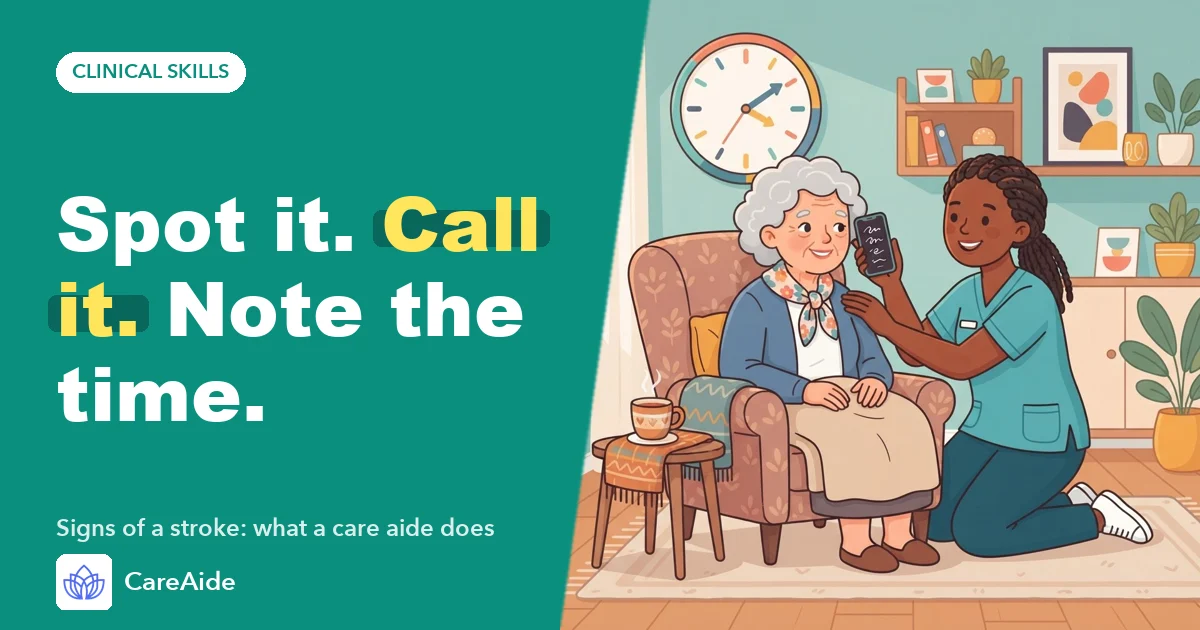
Signs of a stroke: FAST, calling 9-1-1, and what a care aide does next
The signs of a stroke are remembered as FAST: Face drooping, Arms that cannot both be raised, Speech that is slurred or jumbled, and Time to call 9-1-1 right away. A care aide who sees any of these signs calls for emergency help as the employer policy directs, stays with the client, notes the time the signs began and reports, and never tries to diagnose.
- FAST
- Face drooping, Arms (can you raise both?), Speech slurred or jumbled, Time to call 9-1-1
- First action
- Call 9-1-1 or your emergency number right away, as your employer policy directs
- Note the time
- Write down the exact time the signs began, because hospital staff use it to choose treatment
- Never
- Wait to see if it passes, drive the person yourself, or name the cause
- Your role
- Recognize, call for help, stay, note the time and report. The nurse and paramedics assess
What are the signs of a stroke?
The Government of Canada teaches the signs of stroke with the word FAST. Each letter is a quick question you can ask in a few seconds without any equipment.
- Face: is it drooping?
- Arms: can the person raise both?
- Speech: is it slurred or jumbled?
- Time: time to call 9-1-1 right away.
The same page says symptoms can start suddenly, or they can come and go over several days. A care aide often sees a client more than anyone else on the team, so noticing a sudden change from the client's usual face, arm movement or speech is part of the job.
Are there other signs besides FAST?
Yes. Heart & Stroke calls FAST the most common signs, and it also lists less common ones. These are blurred or double vision, a sudden severe headache that usually comes with other signs, numbness that is usually on one side of the body, and problems with balance. A client who suddenly cannot stand steadily or says their vision has gone strange needs the same urgent response as a client with a drooping face.
Not everyone has every sign. If you see any one of them, act. You do not need to wait for a second sign to appear.
What does a care aide do when a client shows signs of a stroke?
Stroke is a medical emergency. Heart & Stroke says that if you notice any of the signs you should call 9-1-1, and that you should not drive to the hospital. An ambulance takes the person to the closest hospital that provides urgent stroke care, and paramedics call ahead so hospital staff are ready.
The exact steps depend on your workplace, so follow your employer's policy and the client's care plan. In a facility the policy usually says whom to call first and who makes the 9-1-1 call. Open RN, a nursing textbook, says that when signs of stroke are actively occurring, emergency assistance is obtained according to agency policy. In home care there may be no nurse on site, so you call 9-1-1 yourself and then tell your supervisor.
- Recognize one of the signs and say clearly what you see, for example "her face is drooping on the left."
- Call for emergency help right away as your policy directs. Do not leave the call for later.
- Stay with the client and keep them calm and safe. Reassure them in a steady voice.
- Note the time the signs began, or the last time you saw the client acting normally, and write it down.
- Report to the nurse or your supervisor, and give the information to the paramedics when they arrive.
- Document what you saw and did, by your employer's documentation standards.
A care aide does not diagnose. You do not say that a client has had a stroke, and you do not decide that signs are too mild to matter. You describe what you see and get help. The nurse and the paramedics do the assessing.
Why does the time matter so much?
Heart & Stroke says that knowing the exact time the signs began is important, because it helps hospital staff choose the right treatment. The Government of Canada says that the first 4 and a half hours after a stroke are very important for getting medical help, and that ideally a person should be at the hospital within the first hour after symptoms start. It also says that a person should still go to hospital if more than 4 and a half hours have passed.
That is why the clock starts at the first sign you noticed, not at the moment you decided to call. Write the time on your hand or on paper straight away if you can. If you did not see the start, note the last time the client was seen acting normally, and say so plainly to the paramedics.
What if the signs go away?
Sometimes signs fade within minutes. Heart & Stroke says that signs of a TIA may last only a few minutes, usually under an hour, and it still says to call 9-1-1 right away even if signs seem to pass. The Government of Canada describes a mini-stroke as a brief blockage of a blood vessel by a small clot, with symptoms that last less than 24 hours, and says that the person still needs to go to hospital.
So a client who says "I am fine now" is not a reason to cancel the call or to skip the report. Tell the nurse or your supervisor about every episode, even one that ended before you could finish writing down the time.
What should you avoid doing?
- Do not wait to see whether the signs pass.
- Do not drive the client to hospital yourself. Heart & Stroke says not to.
- Do not name the cause or tell the client or family that it was a stroke.
- Do not leave the client alone while you look for a phone or a nurse, if another person can do that for you.
Follow your care plan for anything else that is not listed in your policy, such as positioning or whether the client may have food and drink. When your policy does not say, ask the nurse or the emergency dispatcher on the phone.
What should you report and write down?
Use plain words and times. A good report names what you saw, where, when it began and what the client said. For example: "At 10:40 I saw Mr. A's right side of the face drooping and his words slurred. He could not lift his right arm. I called 9-1-1 at 10:42." The guides to SBAR for health care aides and to DARP documentation show how to structure a report and a chart entry.
- Which signs you saw: face, arms, speech, or any of the less common signs.
- The time they began, or the last time the client was seen acting normally.
- Whether the signs were still present, changing or gone when help arrived.
- What you did and who you told.
How does this appear on a care aide exam?
Exam questions often describe a client who suddenly has a drooping face, slurred speech or weakness on one side. The correct option calls for emergency help according to policy and reports the facts. Wrong options have the aide waiting to see whether it passes, giving a drink to test swallowing, deciding it is a minor problem, or telling the family the diagnosis. For more on how these safety questions are weighted, see the guide to the Provision of Care domain.
CareAide offers exam practice on emergencies and reporting for care aides across Canada, and it is free to start. It is practice for your exam, not a substitute for the training your program gives you.
Common questions
What does FAST stand for in stroke signs?
The Government of Canada says FAST means Face (is it drooping?), Arms (can you raise both?), Speech (is it slurred or jumbled?) and Time to call 9-1-1 right away. A health care aide or PSW who sees any sign calls for help.
What should a care aide do first if a client shows signs of a stroke?
A health care aide or PSW calls 9-1-1 or the emergency number right away as the employer policy directs, stays with the client, notes the time the signs began, and reports to the nurse or supervisor.
Why does the time the stroke signs began matter?
Heart & Stroke says knowing the exact time helps hospital staff choose the right treatment. A health care aide or PSW writes down when the signs began, or when the client was last seen acting normally.
Should a care aide call 9-1-1 if the stroke signs go away?
Yes. Heart & Stroke says to call 9-1-1 right away even if signs seem to pass, because a TIA can last only minutes. A health care aide or PSW also reports the episode to the nurse or supervisor.
Can a care aide say that a client has had a stroke?
No. A health care aide or PSW does not diagnose. The aide describes what was seen and when, calls for help, and leaves assessment to the nurse and the paramedics.
Keep reading
-
 PSW cover letter: how to write one, what to include, and a short sample
How to write a PSW cover letter: research the posting, follow a short outline, match your skills, avoid common mistakes, with a sample letter to adapt.
-
 How to take blood pressure manually: preparation, steps, recording and what a care aide reports
How to take blood pressure manually when assigned: resting, arm at heart level, cuff size, slow deflation, recording and reporting for care aides.
-
 Signs of dehydration in older adults: what a care aide notices, offers and reports
Signs of dehydration in older adults for care aides: dry mouth, less urine, dizziness and tiredness. What to offer per the care plan and what to report.