 CareAide Prep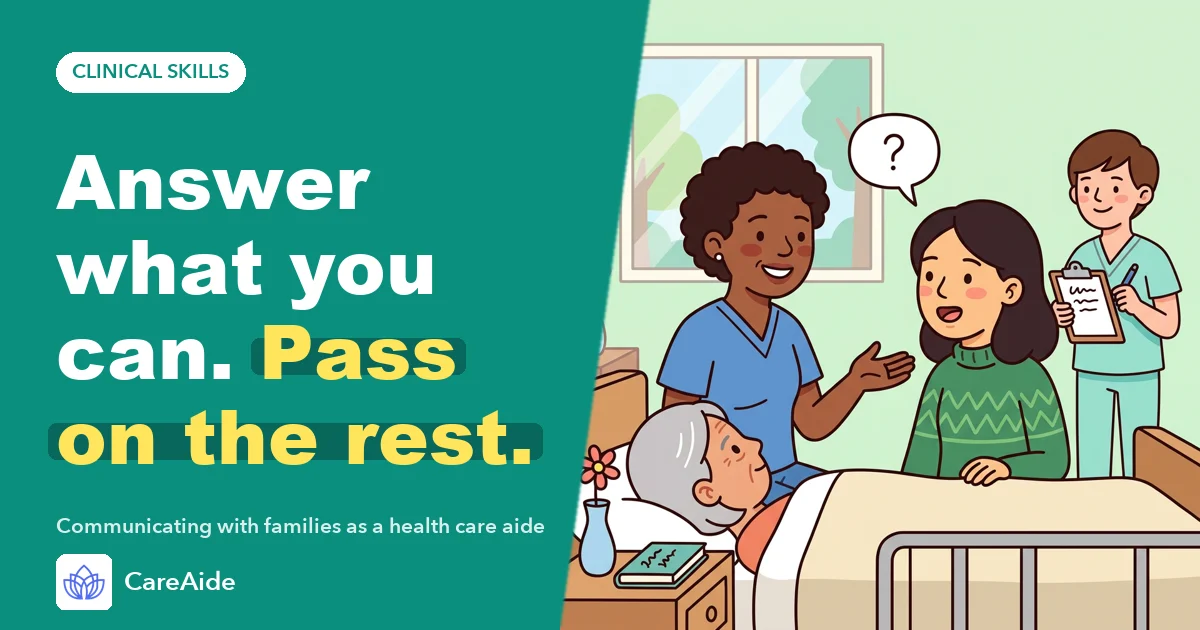
Communicating with families as a health care aide: what you can answer, and what goes to the nurse
Family members frequently ask health care aides detailed questions about a client's prognosis, medication changes, or medical diagnosis. Responding to these questions requires a balance between empathy, clear scope boundaries, and professional reporting.
Scope boundaries in family interactions
Health care aides build close relationships with clients and their families through daily contact. Family members often view the aide as their primary source of information and may ask questions regarding medical diagnoses, disease progression, or proposed medication adjustments. Answering these questions directly exceeds the role of the aide.
Under the oversight of the College of Licensed Practical Nurses and Health Care Aides of Alberta (CLHA), an HCA provides care under the supervision of a regulated health care professional and follows the established care plan. Competency 3.1 requires an aide to "Communicate the role and responsibilities of the HCA to the client, the family, and other health care team members." An aide observes, reports, and documents client status, but does not assess, diagnose, or make clinical judgements. In alignment with Competency 2.7, an aide may "Provide medication assistance as assigned by a regulated health care professional", which involves assistance rather than administration or clinical decisions.
The four-step response model
When faced with inquiries outside their scope, aides must respond honestly without exceeding professional limits. A reliable strategy consists of four steps: acknowledge the family member's concern, state what you can share based on daily observations, offer to connect the family with the supervising regulated health care professional, and promptly follow through on passing the request along.
This structured approach satisfies professional standards while maintaining trust. Further details on professional limits are available on the HCA scope of practice in Alberta page.
Worked scenario 1: responding to status inquiries
Consider a scenario at 14:00 in Room 104 involving an aide named Elena and a client named Arthur. Arthur's daughter approaches Elena and asks, "Is Dad getting worse? He seems so much more tired today."
Elena uses the four-step response model to answer:
- Acknowledge: "I understand why you are concerned seeing your father so tired today."
- State observed facts: "During lunch at 12:30, Arthur ate his meal slowly and mentioned feeling sleepy, so I helped him settle into bed for a rest."
- Offer referral: "Questions about overall changes in his medical condition need to be discussed with the nurse. I can let the nurse know you are here and would like an update."
- Follow through: Elena documents her observations and informs the licensed practical nurse immediately.
Worked scenario 2: handling requests outside the care plan
In another situation, a family member asks an aide named David to apply an over-the-counter ointment to a client's leg, a task not documented in the care plan. The family member insists that the treatment was used at home successfully.
David maintains scope boundaries while adhering to Competency 4.1, which states: "Demonstrate appropriate communication with the client, family, and other members of the health care team." Competency 4.1.4 requires aides to "Use tone, verbal, and non-verbal communication that demonstrates respect, promotes the client’s dignity, and is culturally appropriate."
David explains calmly: "I understand that this ointment helped at home. However, my role requires me to follow the specific care plan set by the care team. I cannot apply any new creams or treatments without authorization. I will inform the charge nurse right now so they can review the treatment with you."
Managing upset family members and confidentiality
Family members experiencing stress may display frustration or critical behaviour. Aides are expected to recognize emotional distress by applying Competency 4.1.2: "Recognize, interpret, and respond appropriately to non-verbal cues." Maintaining a calm tone, active listening posture, and professional distance helps de-escalate emotional conversations.
Confidentiality is another strict boundary. Information regarding care, status, or daily routines can only be shared with designated family members or substitute decision-makers as authorized by facility policy. Discussions should take place in private spaces rather than hallways to protect privacy. For clients experiencing severe physical decline, communication guidelines align closely with End of life care for health care aides.
How family communication is tested on the AHRE
The Alberta HCA Registration Examination (AHRE), administered by Meazure Learning, evaluates these interactions within the Communication domain, which represents 12 to 16 per cent of the total marks. The exam consists of 100 independent multiple choice questions to be completed in 2 hours, allowing an average of 72 seconds per question.
Exam questions in this domain present realistic clinical situations to test whether candidates can identify correct scope boundaries, communicate professionally, and report appropriately. Identifying client cues is also critical in specific practice contexts, such as those described on the Dementia care on the Alberta HCA exam guide. Recognizing the exact limits of the HCA role ensures safe client care and aligns with provincial regulation standards under the CLHA.
Common questions
What should a health care aide do when a family member asks about a client's diagnosis?
An HCA in Alberta must acknowledge the family member's concern, explain their scope of practice calmly, and offer to transfer the query to the supervising nurse. A health care aide observes, reports, and documents care, but does not provide clinical diagnoses or prognoses.
How does family communication feature on the Alberta HCA Registration Examination?
Family communication questions appear primarily within the Communication domain, which accounts for 12 to 16 per cent of the marks on the AHRE. Questions evaluate how an HCA maintains professional boundaries, protects client confidentiality, and demonstrates respectful dialogue under supervision.
Can a health care aide alter care routines if requested directly by a client's family?
A health care aide must follow the established care plan and cannot alter care routines or provide unauthorized interventions based solely on family requests. In Alberta, an HCA reports the family request to the regulated health care professional supervising care so the care plan can be reviewed.
Keep reading
-
 Manitoba health care aides: medication and restraint rules in personal care homes
Who may give medication and apply restraints in a Manitoba personal care home, what reserved acts mean, and how a health care aide hands decisions on.
Manitoba health care aides: medication and restraint rules in personal care homes
Who may give medication and apply restraints in a Manitoba personal care home, what reserved acts mean, and how a health care aide hands decisions on.
-
 BC health care assistants: assigned tasks, restricted activities and delegation
BC health care assistants have no legal scope of practice. Learn how assigned tasks, restricted activities and client-specific delegation sort the work.
BC health care assistants: assigned tasks, restricted activities and delegation
BC health care assistants have no legal scope of practice. Learn how assigned tasks, restricted activities and client-specific delegation sort the work.
-
 PSW medication in New Brunswick: why home support and nursing homes differ
What a New Brunswick PSW may do about medication in home support and in a nursing home, plus foot care, restraints and how reporting differs.
PSW medication in New Brunswick: why home support and nursing homes differ
What a New Brunswick PSW may do about medication in home support and in a nursing home, plus foot care, restraints and how reporting differs.