 CareAide Prep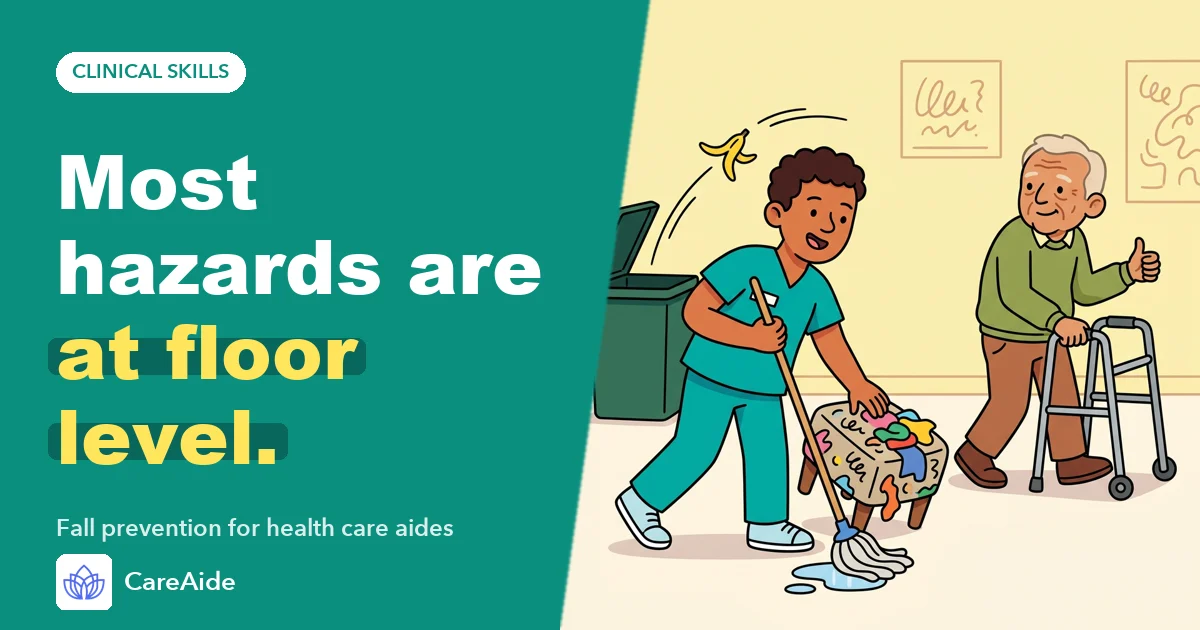
Fall prevention for health care aides in Alberta: what you can fix, and what you must report
Preventing client falls in Alberta continuing care settings relies on immediate environmental fixes and keen observation. Knowing when to fix a hazard yourself and when to report a change protects both the client and your professional practice.
Fixing environmental hazards in seconds
In Alberta continuing care facilities, many fall hazards can be corrected immediately upon entering a room. Competency 6.2 directs health care aides to "Recognize and respond to potential risks in order to prevent harm and avoid injury to the client, self and others." An aide who scans the environment continuously catches small details before they lead to serious harm.
Consider a morning care routine with Sarah, a health care aide, assisting Mr. Chen in Room B. Before assisting Mr. Chen out of bed, Sarah wipes up a water spill near the sink, clears clutter from the walkway, turns on the overhead lights, and checks that his non-slip footwear is secure. She lowers the bed height, locks the bed and wheelchair brakes, and positions the call bell directly within his reach. These actions take seconds, but they eliminate primary environmental triggers for client falls.
Client-side risks that belong in a report
Environmental hazards are yours to fix, but physical or cognitive changes in a client belong in a report. When a client exhibits sudden dizziness, unsteady gait, physical weakness, or new confusion and responsive behaviours, an aide must not attempt to alter care independently. Competency 3.4 requires HCAs to "Report changes in the client to the appropriate regulated health care team member in a timely manner."
If Mr. Chen mentions feeling lightheaded or seems uncharacteristically unsteady, Sarah does not force the transfer or guess at the cause. She keeps him seated safely, ensures his call bell is nearby, and reports the change immediately to the nurse. Using structured communication tools like SBAR for health care aides helps convey observed changes clearly to the clinical team so the care plan can be updated.
Responding safely during an active fall
If a fall occurs while assisting a client, catching or holding up the client is extremely dangerous for both of you. Attempting to bear full weight during a fall risks severe injury to your spine and can cause violent impact for the client. Competency 6.7 mandates that health care aides "Demonstrate safe use of body mechanics and patient handling techniques."
When a client begins to fall, step close to support them, protect their head from hitting hard objects, and ease them gently down along your leg to the floor. Never attempt to lift a falling client alone. Applying proper body mechanics and controlled lowering techniques minimizes impact forces. Practice guidelines on safe patient handling for health care aides emphasize that controlled descent is the safest response when balance is lost.
Post-fall protocol and scope limits
Once the client is on the floor, immediate actions must follow facility protocol and scope of practice. Competency 6.1 requires health care aides to "Prevent, recognize, and respond to emergencies, safety hazards, and unsafe situations that may endanger the HCA and/or the client." Stay with the client, call for help, and summon the regulated health care professional immediately. Do not move or attempt to lift the client back into bed or a chair before a full clinical assessment is complete.
Deciding whether the client is injured is not an aide's call. Health care aides observe, report, and document; they do not assess, diagnose, or make clinical judgements. Determining whether a hip is fractured or a concussion has occurred requires clinical assessment by a regulated nurse or physician. After the regulated professional evaluates the client, document the objective details in the record according to competency 6.4 standards. Reviewing the HCA scope of practice in Alberta reinforces how observing and reporting safeguard client care on the Alberta HCA Registration Examination administered by Meazure Learning for the College of Licensed Practical Nurses and Health Care Aides of Alberta.
Common questions
What environmental hazards can an Alberta health care aide fix immediately?
An Alberta health care aide can instantly fix environmental hazards such as liquid spills, floor clutter, dim lighting, missing anti-slip footwear, misplaced call bells, unadjusted bed heights, and unlocked equipment brakes. Correcting these items right away prevents client falls and satisfies provincial safety standards.
What should a health care aide do if a client falls during a transfer?
If a client falls during a transfer, a health care aide must protect the client's head and ease them gently to the floor using proper body mechanics rather than attempting to catch or lift them. The HCA must stay with the client, call for the nurse, and avoid moving the client until a clinical assessment is completed.
Can a health care aide determine if a client is injured after a fall?
No, deciding whether a client is injured is strictly outside the scope of practice for a health care aide in Alberta. An HCA observes, reports, and documents facts, while regulated health care professionals perform clinical assessments and diagnose injuries.
Keep reading
-
 Reporting suspected abuse as a Saskatchewan CCA when there is no adult-protection act
Saskatchewan has no adult-protection act. Learn how a CCA reports suspected abuse in a special-care home, protects children and documents events.
Reporting suspected abuse as a Saskatchewan CCA when there is no adult-protection act
Saskatchewan has no adult-protection act. Learn how a CCA reports suspected abuse in a special-care home, protects children and documents events.
-
 Manitoba health care aides: medication and restraint rules in personal care homes
Who may give medication and apply restraints in a Manitoba personal care home, what reserved acts mean, and how a health care aide hands decisions on.
Manitoba health care aides: medication and restraint rules in personal care homes
Who may give medication and apply restraints in a Manitoba personal care home, what reserved acts mean, and how a health care aide hands decisions on.
-
 BC health care assistants: assigned tasks, restricted activities and delegation
BC health care assistants have no legal scope of practice. Learn how assigned tasks, restricted activities and client-specific delegation sort the work.
BC health care assistants: assigned tasks, restricted activities and delegation
BC health care assistants have no legal scope of practice. Learn how assigned tasks, restricted activities and client-specific delegation sort the work.