 CareAide Prep
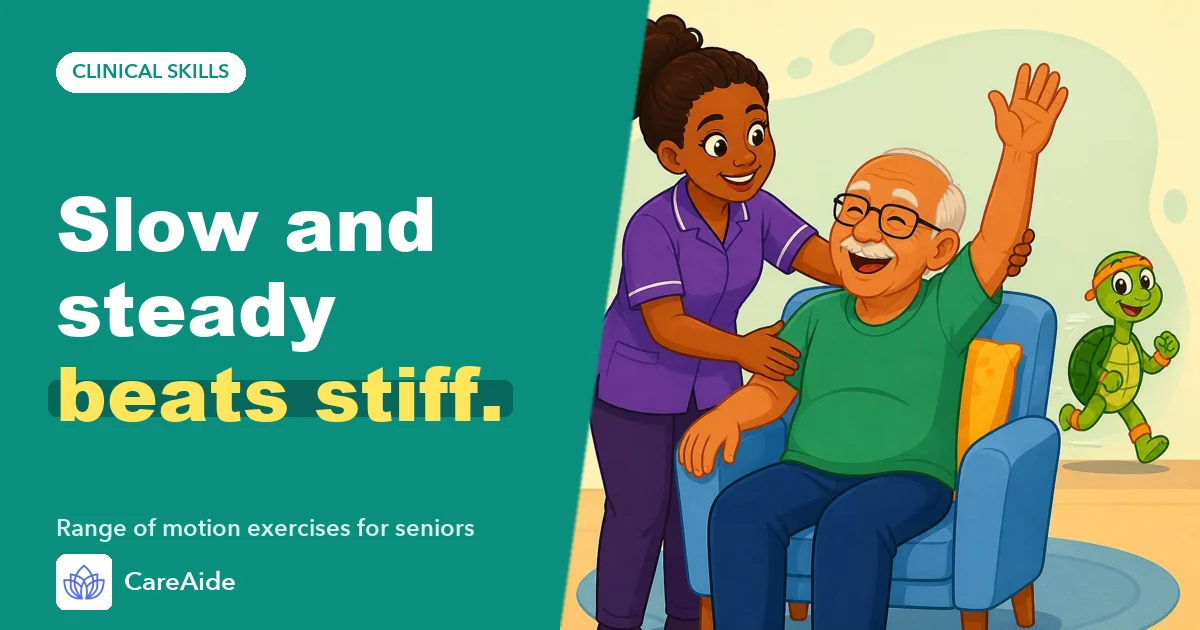
Range of motion exercises for seniors: what a care aide does, and what stays with the therapist
Range of motion exercises for seniors move each joint through its normal movement, either by the person alone, with some help, or fully by another person. A care aide supports these exercises only as the care plan directs, moves slowly, stops at pain or resistance, and reports what they notice. The plan itself comes from a nurse, physiotherapist or occupational therapist, not from the aide.
- Active ROM
- The person moves the joint alone, with no outside force helping
- Active-assisted ROM
- The person moves the joint with partial help from another person
- Passive ROM
- Another person moves the joint while the person's joint stays relaxed
- Who decides
- The care plan, set by a nurse or therapist, says which exercises, how often and which joints
- Stop when
- The client reports pain, shows signs of pain, or you feel resistance
What are range of motion exercises?
Range of motion, often shortened to ROM, is how far a joint can move in its normal directions. ROM exercises take a joint through that movement on purpose. For an older client who moves less than before, they are one way to keep joints moving.
Open nursing textbooks describe three kinds. Active ROM is movement of a joint by the person, with no outside force aiding the movement. Active-assisted ROM is movement by the person with partial assistance from an outside force. Passive ROM is applied when the joint of the person receiving the exercise is completely relaxed, and another person does the moving, according to the open textbook Nursing Assistant, which is published under a CC BY licence.
Which kind a client receives is not your choice. It depends on what the client can do safely, and that is written in the care plan.
Why do older clients need them?
The same textbook lists ROM exercises among the ways to prevent musculoskeletal problems that come with immobility. It names contracture, a joint that becomes stuck in one position, as one of those problems. It also says joint changes can occur quickly, so a nursing assistant should begin ROM only as soon as the nurse directs that it is safe to do so.
That last point matters. An aide does not start a ROM routine because a client looks stiff. The nurse decides when it is safe, and a licensed therapist sets the plan. The textbook says the nursing assistant must follow the plan of care that the therapist established.
Who writes the plan, and what is the aide's part?
The Nursing Assistant textbook describes physical therapists as professionals who plan and supervise exercises tailored to a client's condition. It describes occupational therapists as helping clients reach their highest possible level of independence in daily activities such as bathing, dressing and eating. In Canada the matching titles are physiotherapist and occupational therapist.
The aide's part is to carry out the exercises exactly as assigned, to watch the client while doing so, and to report what happens. The aide does not choose new exercises, add repetitions, test how far a joint can go, or decide that a client is ready for more. Those are decisions for the nurse or therapist. Tasks vary by province and employer, so confirm with your employer that ROM is assigned to you and that you have been shown how.
What do the movement words mean?
Care plans and instructions use a small set of words. Open nursing textbooks and study references define them this way:
- Flexion: movement that decreases the angle between two bones. Bending the elbow is flexion.
- Extension: movement that increases the angle between two bones. Straightening the elbow is extension.
- Abduction: movement of a limb away from the body's midline.
- Adduction: movement of a limb toward the midline.
- Rotation: turning a body part around its axis.
You do not need to memorize a routine. You need to read the care plan, know what each word asks you to do, and ask when a word is unclear.
How does a care aide support ROM exercises safely?
The Nursing Assistant textbook gives skills checklists for the shoulder, and for the hip and knee. Together with a nursing skills reference, they point to the same habits. Use them as a pattern for the care you are assigned, and follow your employer's own procedure where it differs.
- Prepare the client. Wash your hands, identify the client, explain what you will do and provide privacy.
- Position the client. In the textbook skill, the client lies on the back with the bed flat, and the bed is raised if needed so you do not strain.
- Support the joint above and below. For the arm, one hand goes under the elbow and the other under the wrist. For the leg, one hand goes under the knee and the other under the ankle.
- Move slowly and gently. Move only as far as the joint moves easily. Stop at any resistance. A joint should never be forced to achieve full range if there is resistance.
- Watch and ask. Look at the client's face for signs of pain, and ask whether they feel any.
- Repeat as the plan says. The textbook gives no fixed number of repetitions. It says to repeat movements as ordered in the restorative care plan.
- Finish well. Check the client is comfortable, lower and lock the bed, place the call bell within reach and wash your hands.
- Record and report. Document and report the exercises done, and any skin problems, pain with movement or other changes.
How do I encourage the client to do what they can?
When the plan calls for active or active-assisted ROM, the aim is for the client to do as much of the movement as they safely can. Give clear, short instructions. Wait while they try. Offer support only where the plan says you may, and thank them for their effort.
Doing the movement for a client who could do it themselves takes away a chance to stay independent. Doing more than the plan allows can hurt them. Stay inside the plan, and tell the nurse if the client is able to do more or less than the plan expects.
What about the neck and other restricted movements?
Some movements are restricted for some clients, for example after surgery or a fracture. One nursing skills reference notes that exercises should not be done after a recent fracture or surgery without clearance, and that neck movements are to be done only if allowed. So never assume a movement is permitted because it is on a general list.
If the care plan does not mention the neck, or you are unsure about any joint, do not guess. Ask the nurse or the person supervising your care before you start. In home care there may be no nurse on site, so ask your supervisor or the case manager.
When should I stop and report?
Stop the exercise at once if the client says it hurts, shows objective signs of pain, or if you feel resistance. Do not try the movement again to see if it was a mistake. Make the client comfortable and report.
- Pain with movement, or a client who refuses because it hurts
- New swelling or redness at a joint, or other skin changes
- A joint that moves less than it did before, or movement that looks different
- Anything the client says about how the movement feels
Describe what you saw and heard in plain words. Do not name a cause or decide what it means, because an aide does not assess or diagnose. If the client falls ill suddenly or you think it is an emergency, follow your employer's emergency procedure and call 911 in a home setting.
Is this a home exercise program for my own family member?
No. This page explains how care aides support exercises that a professional has already prescribed for a client. It is not a self-help program. Exercises that suit one person may harm another, depending on surgery, fractures, pain or other conditions.
If you want an exercise plan for an older family member, ask their doctor for a referral to a physiotherapist, who can assess them and show you what is safe. For older adults in general, HealthLinkBC advises checking with a health care provider about which types and amounts of activity are best before becoming more active.
How does this connect to falls and safe handling?
Joints that move well help a client stand, walk and transfer more safely. Read preventing falls as a health care aide in Alberta for the observing and reporting side, and safe patient handling for health care aides for protecting your own body while you support a limb. The limits that apply to every aide are in the HCA scope of practice in Alberta.
To practise how these rules appear in exam questions, try the free practice questions at CareAide. They are free to start, and each answer comes with an explanation.
Common questions
What are active, active-assisted and passive range of motion?
For a health care aide or PSW, the difference is this: in active ROM the person moves the joint alone. In active-assisted ROM the person moves it with partial help from another person. In passive ROM the joint stays relaxed and another person does all the moving.
Can a care aide decide which range of motion exercises a senior needs?
No. For a health care aide or PSW, the nurse decides when ROM is safe to start, and a therapist sets the plan. The aide carries out the exercises as assigned in the care plan and reports what they notice.
How far should I move a client's joint?
A health care aide or PSW moves slowly and gently, and stop at any resistance or pain. Open nursing textbooks say a joint should never be forced to reach full range. Repeat only as many times as the care plan says.
Are neck exercises safe for all older clients?
Not always. For a health care aide or PSW, neck movements are often restricted, so do them only if the care plan allows. If the plan is silent or unclear, ask the nurse or your supervisor before starting.
Can I use these exercises at home with my own parent?
For a family member who is not a health care aide, this page is not a home exercise program. Ask your parent's doctor about a physiotherapist, who can assess what is safe for them and show you how to help.
Keep reading
-
 Hand hygiene steps for health care workers: when to use hand rub, when to wash, and the key moments
Hand hygiene steps for health care workers: alcohol-based hand rub, soap and water, the four moments, gloves and nails, explained for care aides.
-
 How to transfer a patient from bed to wheelchair: the pivot transfer a care aide does, step by step
How to transfer a patient from bed to wheelchair as a care aide: check the care plan, lock the brakes, use a gait belt, pivot safely and report changes.
-
 Signs of a stroke: FAST, calling 9-1-1, and what a care aide does next
Signs of a stroke from Heart & Stroke and the Government of Canada: FAST, other signs, why the time matters, and what a care aide does and never does.