 CareAide Prep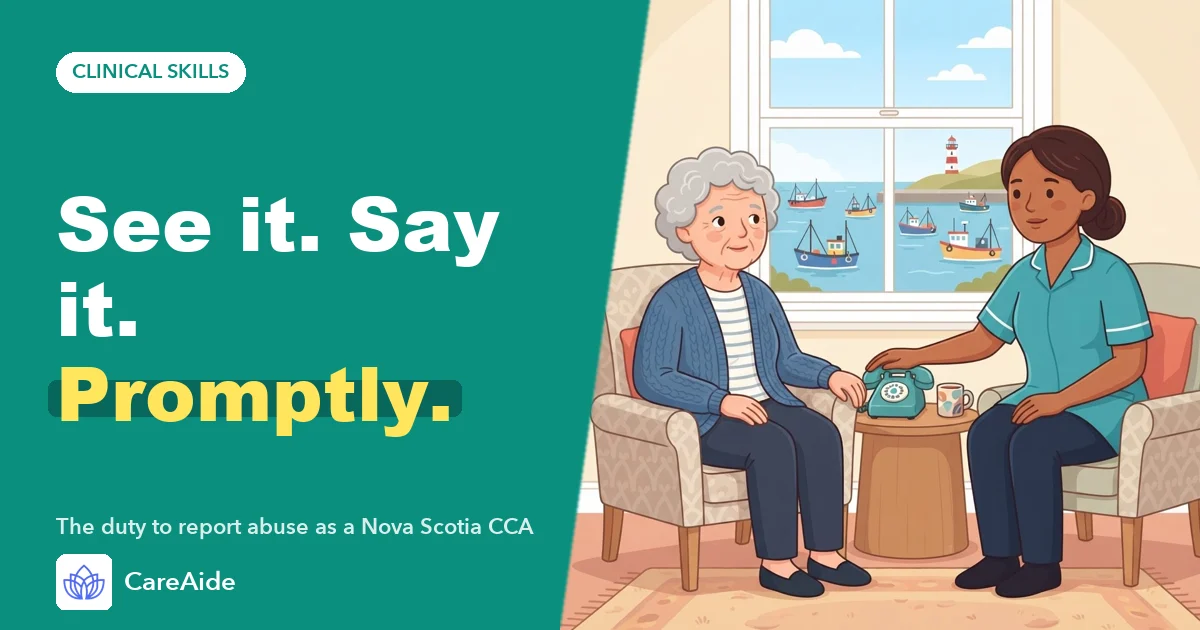
Nova Scotia CCA duty to report abuse: what the two Acts require
A Nova Scotia CCA must report abuse. The Protection for Persons in Care Act requires a prompt report to the Minister when a service provider reasonably believes a patient or resident is, or is likely to be, abused. The Adult Protection Act puts a wider duty on every person.
- Main law in care facilities
- Protection for Persons in Care Act, section 5
- Who must report under it
- A service provider who reasonably believes a patient or resident is, or is likely to be, abused
- How fast
- Promptly
- Who receives the report
- The Minister, through the report line 1-800-225-7225
- Wider duty
- Adult Protection Act, section 5: every person with information that an adult is in need of protection must report it to the Minister
The short answer
A Nova Scotia CCA has a legal duty to report abuse. Under section 5 of the Protection for Persons in Care Act, a service provider who reasonably believes a patient or resident is, or is likely to be, abused must promptly report it to the Minister. The report line is 1-800-225-7225.
A second law reaches further. Under section 5 of the Adult Protection Act, every person with information that an adult is in need of protection must report it to the Minister. The first duty is about patients and residents. The second duty rests on everyone.
Reading section 5 of the Protection for Persons in Care Act
The sentence in section 5 is short. Take it one phrase at a time.
- A service provider. The duty is placed on the people who provide the service, not only on managers.
- Reasonably believes. The test is a reasonable belief. It is not certainty, and it is not proof.
- Is, or is likely to be, abused. The duty covers abuse that is happening now and abuse that is likely to happen.
- A patient or resident. In Nova Scotia the person is a patient in hospital and a resident in a nursing home or residential care facility.
- Must promptly report. The word is must, so this is not a choice. The word promptly means you do not wait for the end of the week.
- To the Minister. The report goes outside the building, and the line for it is 1-800-225-7225.
Students often think they need evidence before they say anything. The Act asks only whether you reasonably believe abuse is happening or is likely.
The Adult Protection Act: a duty on every person
The Adult Protection Act uses different words. Section 5 says that every person with information that an adult is in need of protection must report it to the Minister. The duty is not limited to service providers, and it is not limited to people at work.
This matters for a CCA in home support. The person you care for there is a client, not a patient or resident. If you have information that an adult client is in need of protection, the Adult Protection Act duty is yours, as it is everyone's.
Why this duty sits naturally in CCA work
CCAs are not a regulated profession, and the employer is accountable for their practice. Reporting abuse fits the role for three reasons.
First, a CCA is the person who sees. The standards describe observational point-of-care checks of the environment, level of consciousness, changes in status, skin integrity, safe handling, and diet and intake. A CCA escalates changes to a supervisor. Those same checks are how a worrying change comes to light.
Second, the core competencies expect it. A CCA practises ethically, works within the law, and knows when to report and escalate. A CCA also advocates for each person's rights, interests and well-being, including by reporting risks and changes.
Third, a CCA does not assess or diagnose. You are not asked to decide what caused a mark or who is at fault. You are asked to notice, to describe what you saw and heard, and to report it.
What to do when something is not right
These steps follow the rules a CCA already works under. Your employer's policy sets the details.
- Keep the person safe. Reducing hazards to physical, emotional and psychological safety is a core competency. Stay with the person if they are frightened or at risk.
- Tell your supervisor promptly. A CCA reports to the supervisor or the regulated healthcare professional. Do it the same shift, in plain words.
- Make sure the report is made. The duty in section 5 is to report to the Minister. Your employer will explain how that duty is met where you work, and the line is 1-800-225-7225.
- Document what you observed. Report and document as employer policy and the care plan require. Write the time, what you saw, what you heard and who you told.
Write facts, not conclusions. "At 19:40 Mr. MacLeod was crying and holding his left wrist" is an observation. "Mr. MacLeod was abused" is a conclusion, and it is not yours to write.
What not to do
- Do not wait for proof. A reasonable belief is the test in the Act.
- Do not investigate. Questioning co-workers or family members is not part of a CCA's role.
- Do not promise to keep it secret. You have a duty to report, so that is a promise you cannot keep.
- Do not talk about it in the hallway or with people who have no need to know. Keeping confidentiality is part of ethical practice.
A worked example in a nursing home
Nadia is a CCA on an evening shift in a nursing home. She walks into a room and hears a co-worker shouting at a resident, Mr. MacLeod. She sees the co-worker pull him roughly by the wrist. Mr. MacLeod is crying.
Nadia does not argue with her co-worker and does not start asking questions. She stays with Mr. MacLeod and speaks calmly to him. She then goes straight to the nurse in charge and says what she saw and heard, with the time. She documents it in the same factual words.
Nadia reasonably believes a resident has been abused. She is a service provider, so section 5 of the Protection for Persons in Care Act applies to her. She asks her supervisor how the report to the Minister will be made, and she knows the line is 1-800-225-7225.
A worked example in home support
Owen is a CCA who visits Mrs. Boudreau at home. Over two weeks he notices that the fridge is empty on each visit. Mrs. Boudreau tells him that a relative takes her money and that she is afraid to say no.
Owen does not confront the relative, and he does not tell Mrs. Boudreau that he will keep it to himself. He tells her kindly that he has to pass on what she has said so she can get help. He reports to his supervisor that day and documents her words and what he saw.
Mrs. Boudreau is a client, not a patient or resident. Owen has information that an adult may be in need of protection. The Adult Protection Act duty, which rests on every person, is the one to think about first here.
Words you can borrow
- To the person: "Thank you for telling me. I can't keep this to myself, because I want you to be safe. I'm going to tell the nurse now."
- To your supervisor: "At 19:40 in room 12 I heard shouting and saw Mr. MacLeod pulled by the left wrist. He was crying. I stayed with him."
Each one names the next step and keeps you with the person.
How this shows up in practice questions
In CareAide's Nova Scotia practice questions, abuse scenarios test one habit. The wrong options sound sensible. They have the CCA wait to be sure, speak to the family first or promise secrecy. The strongest answer keeps the person safe, reports promptly and documents the facts.
You can try that reasoning on the free Nova Scotia CCA practice questions. The limits of the role are set out in CCA scope of practice in Nova Scotia, and the route into the work is in how to become a CCA in Nova Scotia.
Common questions
Does a CCA in Nova Scotia have to report abuse?
Yes. A Nova Scotia CCA who is a service provider and reasonably believes a patient or resident is, or is likely to be, abused must promptly report it to the Minister under section 5 of the Protection for Persons in Care Act.
What number does a Nova Scotia CCA call to report abuse of a patient or resident?
A Nova Scotia CCA can use the Protection for Persons in Care report line, which is 1-800-225-7225, and the employer explains how the duty is met in that workplace.
Does a Nova Scotia CCA need proof before reporting abuse?
No. A Nova Scotia CCA needs a reasonable belief that a patient or resident is, or is likely to be, abused, and the CCA reports what was seen and heard without investigating.
What does the Adult Protection Act require of a CCA in Nova Scotia?
The Adult Protection Act requires every person in Nova Scotia, including a CCA, who has information that an adult is in need of protection to report it to the Minister under section 5.
Can a Nova Scotia CCA promise a client to keep abuse secret?
No. A Nova Scotia CCA has a duty to report, so the CCA tells the person kindly that the information must be passed on and then tells the supervisor promptly.
Keep reading
-
 PSW scope of practice in Ontario: what you may do, and where the line sits
What an Ontario PSW may and may not do: the plan of care, controlled acts and delegation, medication rules by setting, and when to report.
PSW scope of practice in Ontario: what you may do, and where the line sits
What an Ontario PSW may and may not do: the plan of care, controlled acts and delegation, medication rules by setting, and when to report.
-
 Reporting suspected abuse as a Saskatchewan CCA when there is no adult-protection act
Saskatchewan has no adult-protection act. Learn how a CCA reports suspected abuse in a special-care home, protects children and documents events.
Reporting suspected abuse as a Saskatchewan CCA when there is no adult-protection act
Saskatchewan has no adult-protection act. Learn how a CCA reports suspected abuse in a special-care home, protects children and documents events.
-
 Manitoba health care aides: medication and restraint rules in personal care homes
Who may give medication and apply restraints in a Manitoba personal care home, what reserved acts mean, and how a health care aide hands decisions on.
Manitoba health care aides: medication and restraint rules in personal care homes
Who may give medication and apply restraints in a Manitoba personal care home, what reserved acts mean, and how a health care aide hands decisions on.